Have you ever seen both “honor” and “honour” and wondered which one is correct? 🤔 Don’t worry — you’re not alone! These two words often confuse English learners because they look almost identical but appear in different countries’ spellings.
The truth is, both are correct — the difference lies in where you are using them. In this guide, you’ll learn:
- What honor and honour mean
- The difference between honor and honour
- When to use each one
- Common mistakes and how to avoid them
- Fun examples and an easy memory trick
By the end, you’ll confidently know when to write “honor” or “honour” — like a grammar pro!
🧠 What Does Each Word Mean?
Let’s start with what both words actually mean.
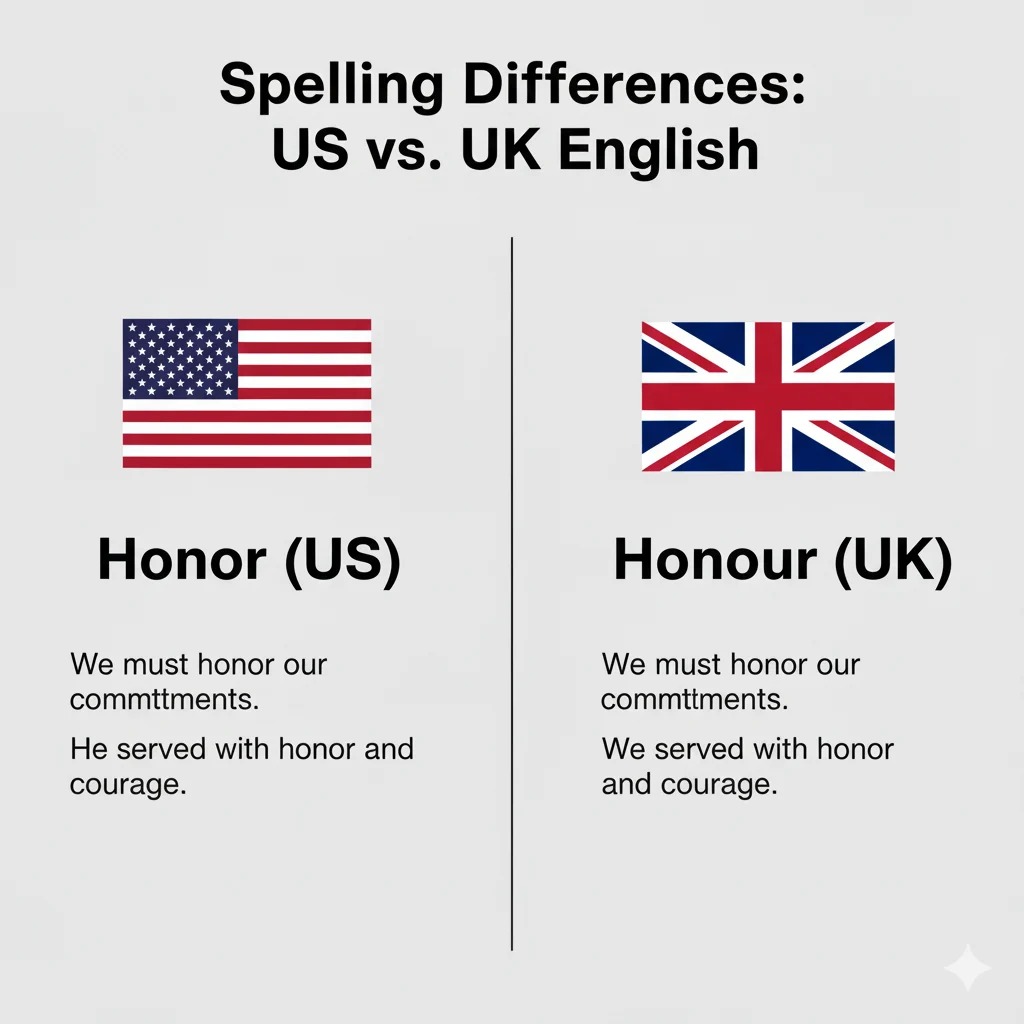
Honor (American English)
Part of Speech: Noun or Verb
Meaning:
Honor means respect, high regard, or recognition for doing something good or right. It can also mean keeping your promises or acting with integrity.
Examples:
- It’s an honor to meet you.
- The soldier received a medal of honor.
- We must honor our parents.
Honour (British English)
Part of Speech: Noun or Verb
Meaning:
“Honour” means the same thing as “honor” — respect, dignity, or moral integrity — but it is the British English spelling.
Examples:
- She felt it was an honour to represent her school.
- The Queen awarded him the title of honour.
- We must honour our traditions.
👉 Simple Explanation:
Both words mean respect or high moral standards. The only difference is spelling, not meaning.
🔍 The Key Difference Between “Honor” and “Honour”
Here’s the simplest way to remember it:
| Feature | Honor | Honour |
|---|---|---|
| Used In | 🇺🇸 United States | 🇬🇧 United Kingdom, 🇨🇦 Canada, 🇮🇳 India, 🇦🇺 Australia |
| Spelling Style | American English | British English |
| Meaning | Respect, recognition, or moral value | Same meaning |
| Example Sentence | “He received the Medal of Honor.” | “She was given an Honour by the Queen.” |
✅ Quick Tip to Remember:
If you write color, favor, and neighbor without “u,” then use honor.
If you write colour, favour, and neighbour with “u,” then use honour.

🚫 Common Mistakes and How to Avoid Them
Let’s look at some common mix-ups and how to fix them:
❌ Incorrect: I received an honour from the President of the United States.
✅ Correct: I received an honor from the President of the United States.
❌ Incorrect: It’s an honor to serve Her Majesty.
✅ Correct: It’s an honour to serve Her Majesty.
Why it happens:
People often mix them up because both versions appear online. The key is to match your spelling style to your audience.
- Writing for an American audience? Use honor.
- Writing for a British or Commonwealth audience? Use honour.
🇺🇸 When to Use “Honor”
Use honor when writing in American English or for audiences in the United States.
Example Sentences:
- The students stood to show honor during the national anthem.
- It’s my honor to present this award.
- He always acts with honor and honesty.
- We should honor our history and heroes.
- The Medal of Honor is the highest military award in the U.S.
Memory Trick:
Think of honor and color — both are spelled without “u” in America.
🇬🇧 When to Use “Honour”
Use honour when writing in British English or for readers in the U.K., Canada, Australia, or India.
Example Sentences:
- It was an honour to meet the Prime Minister.
- He accepted the award with great honour.
- We must honour our family traditions.
- The Honours List includes famous artists and scientists.
- She was given a title in recognition of her honourable work.
Memory Hack:
The “U” in honour stands for the “United Kingdom.” 🇬🇧
So, if it’s British English → keep the “U”!
🧩 Quick Recap: Honor vs Honour
Here’s a quick summary you can memorize easily:
- Both mean: respect, integrity, or recognition
- Honor → American English (no “u”)
- Honour → British English (with “u”)
- Meaning: same
- Usage: depends on your audience
Easy Trick:
America says “color” → no U → “honor”
Britain says “colour” → has U → “honour”
📘 Advanced Tips: History and Formal Use
The word “honor/honour” comes from the Latin honor (meaning respect or esteem).
- British English kept the traditional Latin-based spelling (honour).
- American English simplified many “-our” endings to “-or” during the 1800s to make writing easier.
In formal writing or essays, choose the spelling that matches your regional standard:
- American schools → honor
- British or Commonwealth schools → honour
In texting or online chats, people rarely care about the “u,” but in academic or professional writing, consistency is key!
🏷️ Labeling vs Labelling: What’s the Difference and Which One Is Correct?
📝 Mini Quiz: Test Yourself!
Fill in the blanks with the correct word — honor or honour.
- It was an ______ to be part of the ceremony.
- The Medal of ______ is given for bravery.
- We must ______ our family’s traditions.
- She received an ______ for her contribution to science.
- He always acts with ______ and honesty.
(Answers: 1. honour, 2. honor, 3. honour, 4. honour, 5. honor — depending on region!)
🧠 FAQs
1. What’s the difference between honor and honour?
They mean the same thing — respect or recognition. The only difference is that “honor” is American spelling and “honour” is British spelling.
2. Which spelling is correct: honor or honour?
Both are correct! Use honor in the U.S. and honour in countries like the U.K., Canada, or Australia.
3. Is honor a noun or a verb?
It can be both. As a noun: It’s an honor to meet you. As a verb: We honor our teachers.
4. Why does British English add a “u”?
British spelling follows older French and Latin patterns, keeping “-our” endings (like colour, favour, honour).
5. Should I use “honour” in exams or essays?
Use the spelling that matches your school or exam’s English style — American English (honor) or British English (honour).
🏁 Conclusion
Now you know the simple difference between honor and honour!
They mean the same thing — the only change is in spelling. Use honor for American English and honour for British English.
So next time you write an essay, post, or message, you’ll choose the right word with confidence. Keep practicing, and you’ll keep improving your English — for real honour… or should we say honor! 😄

Isla Merrin is a language and writing expert at Definevs.com, creating simple, engaging guides to help readers master words, grammar, and modern English usage.