Ever heard someone say, “Well, that idea was a hit or miss,” and wondered what it really means? 🤔
The phrase “hit or miss” can be confusing because it sounds like two opposites — but together, they describe something that can go either very well or very badly.
In this simple guide, you’ll learn:
- What “hit or miss” really means in English
- The difference between “hit” and “miss”
- How to use the phrase correctly in sentences
- Common mistakes to avoid
- Fun examples and a short quiz at the end
By the end, you’ll easily remember when and how to use “hit or miss” — like a pro! 🎯
🧠 What Does Each Word Mean?
Let’s start with the two words separately — hit and miss.
✅ Hit — Meaning and Examples
“Hit” means success, impact, or to strike something correctly.
It can be used as both a noun and a verb.
Examples:
- She hit the ball out of the park. 🎾
- That movie was a big hit! 🎬
- He finally hit his goal score in the game. 🎯
In simple words, hit = success or correct target.
❌ Miss — Meaning and Examples
“Miss” means to fail, to not reach, or to not notice something.
It can also be a noun or a verb, depending on how it’s used.
Examples:
- He missed the bus this morning. 🚌
- Don’t miss the chance to win the prize! 🏆
- That joke totally missed — no one laughed. 😅
In short, miss = failure or something that didn’t go as planned.
⚖️ The Key Difference Between “Hit” and “Miss”
Here’s the main difference:
| Word | Meaning | Type | Example Sentence |
|---|---|---|---|
| Hit | Success, something that worked | Noun/Verb | “Her idea was a big hit.” |
| Miss | Failure, something that didn’t work | Noun/Verb | “His joke was a total miss.” |
Quick Tip:
👉 Think of “hit” as “good result” and “miss” as “not good.”
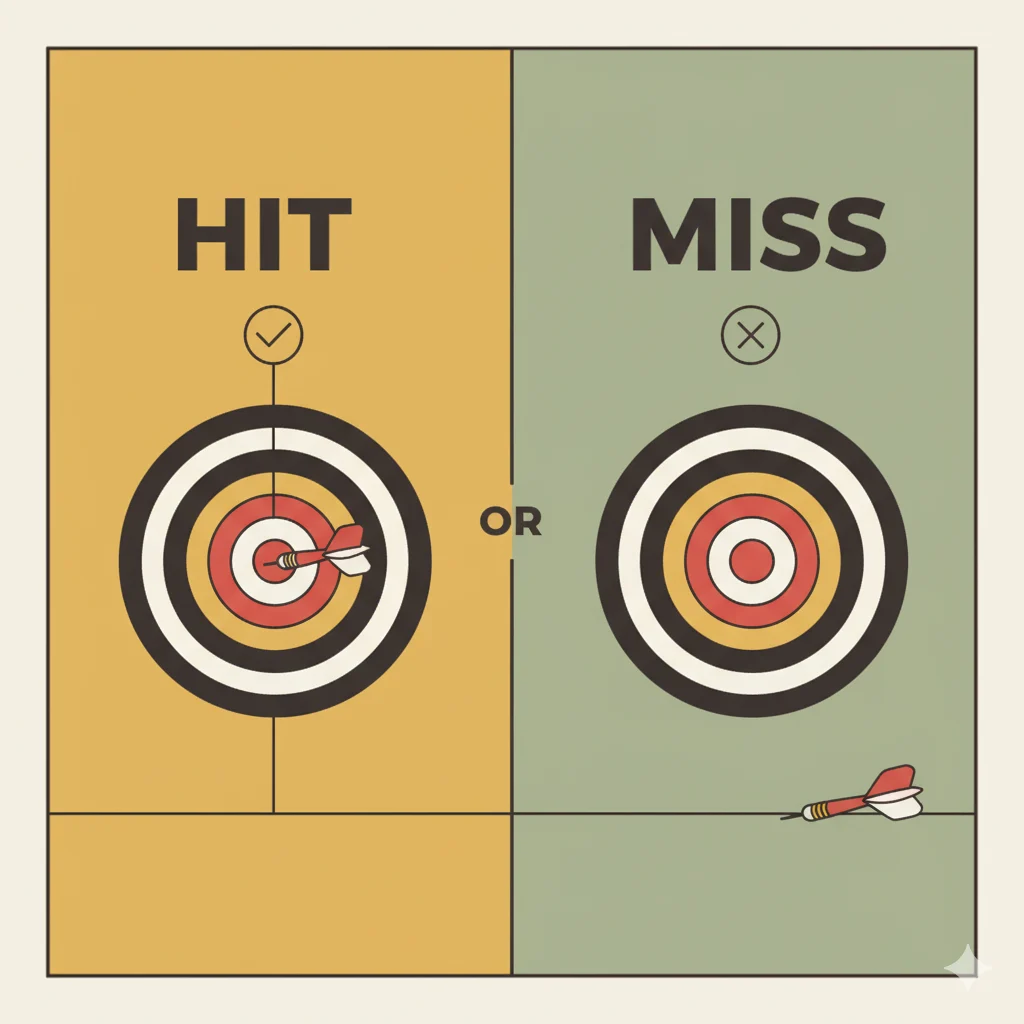
Together, “hit or miss” means something can go either way — it might be great (a hit) or disappointing (a miss).
💡 Common Mistakes and How to Avoid Them
Here are a few mix-ups people make with “hit or miss” and how to fix them:
❌ Wrong: The concert was hit or miss for me.
✅ Correct: The concert was a hit or miss experience for me.
Why: “Hit or miss” works as an adjective or noun phrase, not on its own.
❌ Wrong: He hit or missed the ball.
✅ Correct: He either hit or missed the ball.
Why: When used literally (in sports or actions), you must use “either” before “hit or missed.”
Tip:
If you’re talking about quality or results, say “a hit or miss situation.”
If it’s literal action, use “either hit or missed.”
🕹️ When to Use “Hit”
Use “hit” when something is successful, effective, or right on target.
Examples:
- Her new song was a massive hit.
- You really hit the nail on the head with that idea.
- Our campaign hit its target audience perfectly.
- That new café is a hit among students.
- He finally hit the jackpot in the lottery.
👉 Memory Hack:
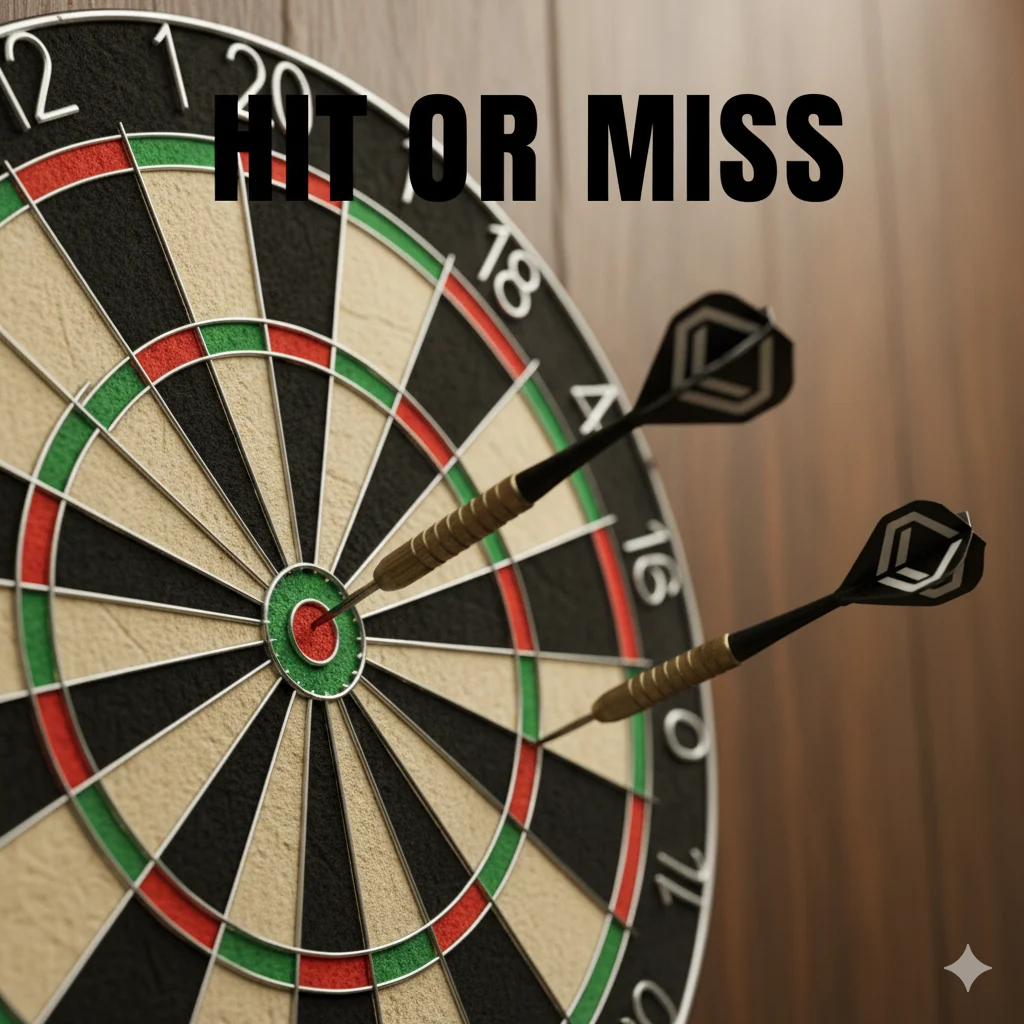
Think of a hit like a bullseye 🎯 — you did it right!
🎯 When to Use “Miss”
Use “miss” when something fails, doesn’t work, or doesn’t meet expectations.
Examples:
- The movie tried to be funny but was a miss.
- He missed the target during the competition.
- The plan sounded great but turned out to be a miss.
- Don’t miss your chance to apply!
- The timing of his joke was off — total miss.
👉 Memory Hack:
Picture a dart flying past the target — that’s a miss! 🎯➡️❌
🔁 Quick Recap: “Hit” vs “Miss”
Here’s an easy way to remember:
- Hit = Success / Good result / Win
- Miss = Failure / Poor result / Loss
- Hit or Miss = Uncertain outcome — could go either way
In one sentence:
“My cooking is hit or miss — sometimes amazing, sometimes awful!” 🍳😅
📘 Advanced Tips and Deeper Meaning
- The phrase “hit or miss” first appeared in the 1800s, describing hunting or shooting accuracy.
- Today, it’s used figuratively in daily English to describe anything unpredictable — like reviews, products, or experiences.
- In modern slang, “hit or miss” also became popular from an internet meme and TikTok trend, where it meant “sometimes good, sometimes bad.”
In formal writing:
You can use “hit or miss” carefully — for example:
“The company’s strategy was hit or miss depending on market conditions.”
In everyday English:
“My internet connection is hit or miss — sometimes it works perfectly, other times not at all.”
🧩 Mini Quiz: Test Yourself!
Fill in the blanks with hit, miss, or hit or miss:
- The teacher’s new method was a big ______.
- My drawing skills are ______ — sometimes good, sometimes not.
- Don’t ______ your chance to join the club.
- That show was a total ______; no one liked it.
- Their vacation plans were ______ because of the weather.
(Answers: 1. hit, 2. hit or miss, 3. miss, 4. miss, 5. hit or miss)
❓ FAQs
1. What does “hit or miss” mean?
It means something that can go either very well or very badly — unpredictable in result or quality.
2. Is “hit or miss” positive or negative?
It’s neutral. It means the outcome isn’t guaranteed — could be great (a hit) or disappointing (a miss).
3. Can I use “hit or miss” in formal writing?
Yes, but use it sparingly. It’s more common in casual speech or writing.
4. What’s another word for “hit or miss”?
You can say “unpredictable,” “uncertain,” or “inconsistent.”
5. How can I remember the difference between “hit” and “miss”?
Think of a target: if you hit it — success 🎯; if you miss it — failure ❌.
🏁 Conclusion
Now you know the real difference between “hit” and “miss” and how the phrase “hit or miss” means something that can go either way — good or bad.
It’s one of those fun English expressions that sounds simple but adds a lot of meaning to your speech or writing.
Keep practicing by making your own examples — and soon, your English will be more hit than miss! 💪

Isla Merrin is a language and writing expert at Definevs.com, creating simple, engaging guides to help readers master words, grammar, and modern English usage.