Ever wondered whether it’s spelled “hippy” or “hippie”? You’re not alone!
These two words look almost the same, sound the same, and even show up in similar contexts — but one is the correct word for describing a free-spirited person from the 1960s, while the other has a different meaning altogether.
In this simple guide, you’ll learn:
- The meaning of hippy and hippie
- The difference between them
- When to use each word correctly
- Examples, memory tricks, and a quick quiz to help you remember
By the end, you’ll never mix them up again — promise!
🧠 What Does Each Word Mean?
Let’s break down both words one by one so you can clearly understand their meanings and usage.
🌸 “Hippie” — The Free-Spirited Person
Part of Speech: Noun
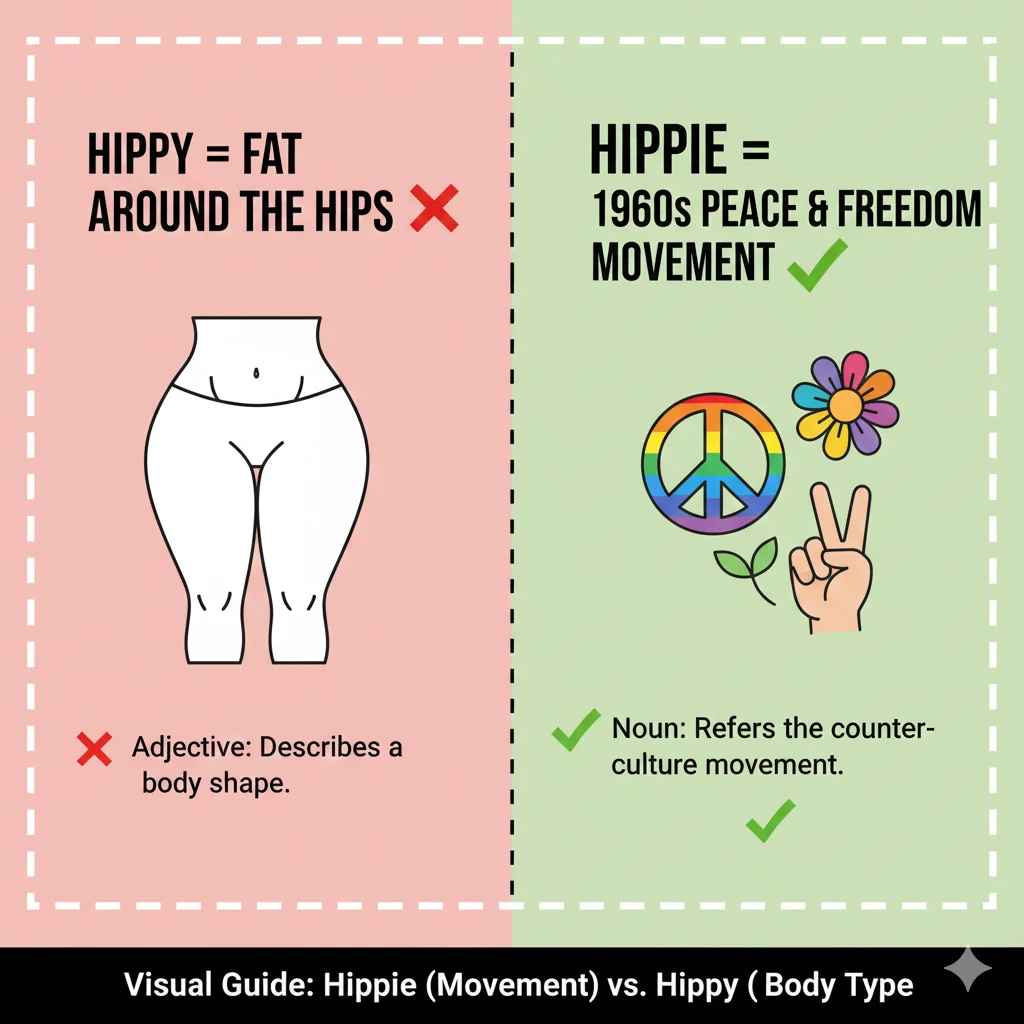
Meaning: “Hippie” refers to someone who follows the counterculture movement that began in the 1960s. Hippies believe in peace, love, freedom, and simplicity, often rejecting traditional social rules.
Examples:
- My parents were hippies in the 1970s who loved music and nature.
- The hippie wore a flower crown and colorful clothes.
- Many hippies promoted peace and kindness instead of war.
💡 Memory Trick: Think of hippie as the one who loves peace and tie-dye — both have “ie” at the end!
🧍♀️ “Hippy” — Related to Hips
Part of Speech: Adjective
Meaning: “Hippy” describes someone who has wide or rounded hips. It has nothing to do with lifestyle or culture — it’s about body shape.
Examples:
- She felt a bit hippy in her new jeans.
- The artist drew a hippy woman dancing.
- Some fashion styles are designed for hippy figures.
💡 Memory Trick: “Hippy” has “hip” in it — that’s your clue it’s about hips or body shape.
🔍 The Key Difference Between Hippy and Hippie
Here’s a quick side-by-side comparison to make it crystal clear:
| Feature | Hippy | Hippie |
|---|---|---|
| Part of Speech | Adjective | Noun |
| Meaning | Someone with large or rounded hips | A person who follows the 1960s counterculture movement |
| Used For | Describing body shape | Describing lifestyle or personality |
| Example Sentence | She’s a bit hippy in that dress. | My aunt was a hippie who loved peace rallies. |
| Quick Tip | “Hip” → body | “Hippie” → peace & love |
✅ Quick Tip to Remember:
If you’re talking about hips, use hippy.
If you’re talking about peace and love, use hippie.
❌ Common Mistakes and How to Avoid Them
Many people confuse these two words because they sound exactly the same (they’re homophones). Let’s fix that confusion with examples:
Incorrect: She dressed like a hippy at the music festival.
Correct: She dressed like a hippie at the music festival.
(She’s acting like a free-spirited 1960s person, not describing her hips!)
Incorrect: The hippie jeans fit her hips perfectly.
Correct: The hippy jeans fit her hips perfectly.
(The jeans suit her body shape — not her lifestyle.)
💡 Why This Happens:
Both words look similar and come from the same root “hip,” which means “cool” or “fashionable.” But over time, their meanings drifted apart.
🌻 When to Use “Hippie”
Use “hippie” when talking about:
- People who believe in peace, love, and freedom
- 1960s or 1970s culture
- Music festivals, bohemian lifestyles, or colorful clothing
Examples:
- The hippie community gathered for a peace march.
- He’s got a hippie soul and loves nature.
- Her room has a hippie vibe with candles and posters.
- The hippie movement inspired eco-friendly living.
- Those hippie sandals are back in fashion!
💭 Memory Hack: Hippie and peace both have “ie” sounds — that’s your clue!
👖 When to Use “Hippy”
Use “hippy” when describing:
- A person’s body shape, especially if they have wide hips
- Clothing or styles that fit curvier figures
Examples:
- The dress suits hippy figures beautifully.
- She felt too hippy for that slim skirt.
- Some dancers have naturally hippy builds.
- The tailor adjusted the pants for her hippy shape.
- That style is perfect for hippy women.
💡 Visual Tip: Imagine the word “hippy” hugging your hips — easy to remember!
🪶 Quick Recap: Hippy vs Hippie
Here’s a simple summary you can keep in mind:
- Hippie → Lifestyle, peace, freedom, 1960s
- Hippy → Body shape, wide hips
- Sound the same, but mean very different things
- Tip: If it’s about culture → hippie
If it’s about body → hippy
🧠 Mini Story:
Anna called her aunt a hippy by mistake. Her aunt laughed and said,
“Sweetie, I’m not hippy, I’m hippie — peace and love, not hips!”
🌼 Advanced Tips and Word Origins
- The word “hippie” comes from the slang “hip”, meaning “cool” or “in the know.”
It became popular in the 1960s in the U.S. during the peace and love movement. - “Hippy” is simply formed from “hip” + “-y”, describing someone with hips.
In formal writing, use “hippie” only when referring to people or culture.
In informal or descriptive writing, “hippy” fits when describing shape or style.
📱 Modern Use Tip:
On social media, “hippie” is still used to describe boho fashion or eco-friendly people — but “hippy” rarely appears unless describing body shape.
📝 Mini Quiz: Test Your Understanding
Choose the correct word — hippy or hippie:
- My mom was a _______ who loved rock concerts.
- That dress flatters women with _______ hips.
- The _______ movement encouraged kindness and peace.
- She’s proud of her _______ figure.
- He calls himself a modern _______ who grows his own food.
✅ Answers:
- hippie
- hippy
- hippie
- hippy
- hippie
Does Eliquis Cause Depression or Anxiety? The Hidden Truth 😱
❓ FAQs About Hippy vs Hippie
1. What’s the main difference between hippy and hippie?
Hippy describes body shape (wide hips), while hippie refers to a person who follows the peace-and-love culture of the 1960s.
2. Is hippie the correct spelling?
Yes. Hippie is the correct spelling when referring to lifestyle or people. Hippy is a separate word about body shape.
3. Can you call someone a hippy person?
Only if you mean they have curvy hips! If you mean they’re peace-loving and free-spirited, say hippie.
4. Are hippy and hippie pronounced the same?
Yes — they sound exactly the same, but their meanings differ.
5. How can I remember the difference easily?
Think “hippie = peace,” “hippy = hips.” The extra ie stands for individual expression — a hippie’s motto!
🎯 Conclusion
Now you know the difference between hippy and hippie — and it’s easy to remember!
Use hippie for people who love peace, nature, and freedom, and hippy for describing body shapes or figures.
Keep practicing these words in your writing and speech, and soon it’ll come naturally.
Learning small distinctions like this can make your English stronger and more confident every day. 🌟

Mira Loxley is a passionate language and writing expert at Definevs.com, turning tricky words and grammar into clear, engaging guides for every reader.