Ever wondered whether you should write “gluing” or “glueing”? 🤔
You’re not alone! Many English learners — and even native speakers — get confused by these two spellings. Both seem right, both look similar, but only one is widely accepted in modern English.
In this simple guide, you’ll learn:
- The correct spelling between gluing and glueing
- The meaning of each
- Examples to help you remember easily
- Common mistakes and how to avoid them
By the end, you’ll know exactly which one to use — whether you’re writing a school essay, crafting instructions, or sending a quick text.
🧠 What Does Each Word Mean?
Let’s start by understanding what both words mean and how they’re used.
🔹 Gluing
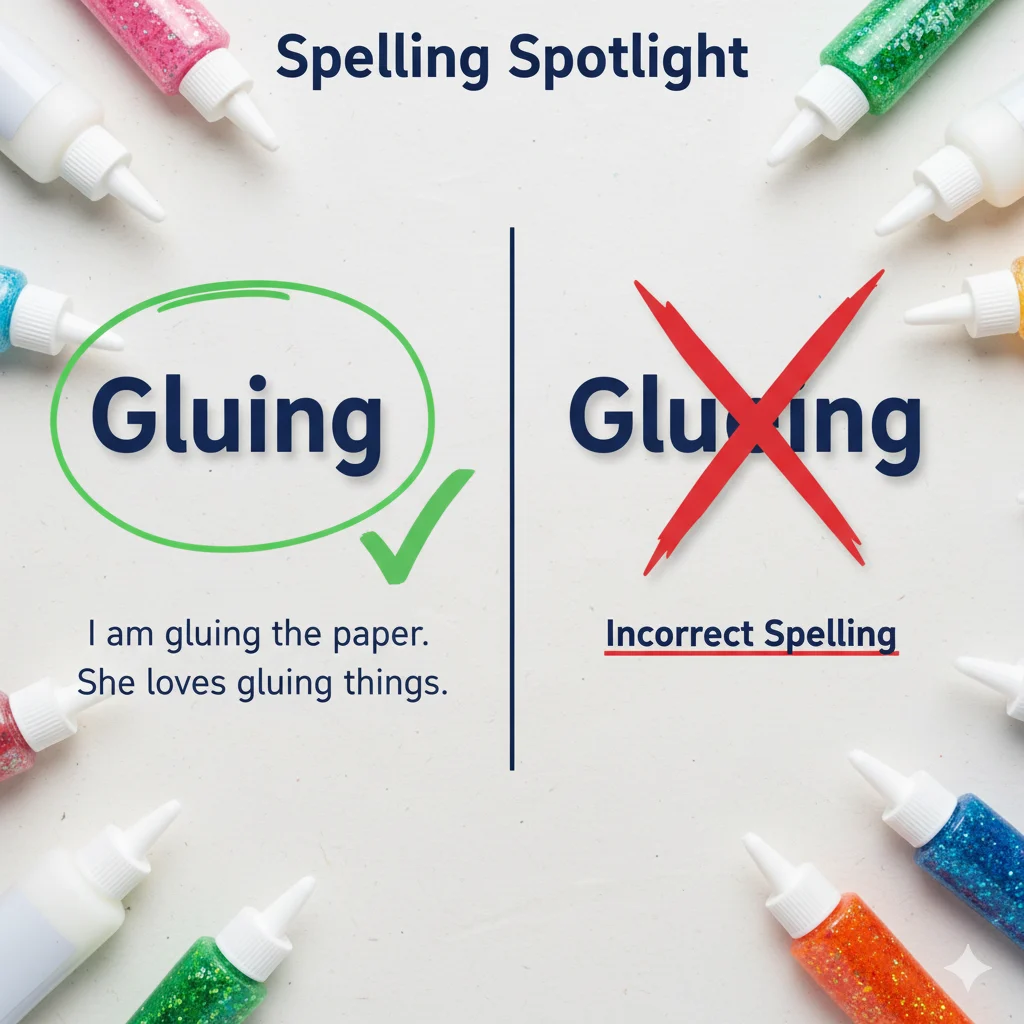
“Gluing” is the present participle of the verb “glue”, which means to stick or attach things together using glue.
It’s the form you use when describing the action happening right now.
Examples:
- She is gluing the paper hearts to the wall.
- I spent the morning gluing broken pieces of the vase.
- He’s gluing wood to make a small birdhouse.
🔹 Glueing
“Glueing” is an older or less common spelling of gluing.
It means the same thing — but this version is rarely used today, especially in American and modern British English.
Examples:
- She is glueing the labels onto the jars. (Older spelling)
- He kept glueing the photos in the scrapbook. (Not preferred today)
- They were glueing posters before the art fair. (Outdated)
In short: both words mean the same thing, but one is preferred in modern writing.
🔍 The Key Difference Between Gluing and Glueing
The main difference lies in spelling and usage, not meaning.
| Feature | Gluing | Glueing |
|---|---|---|
| Correctness | ✅ Accepted spelling | ⚠️ Outdated/rare spelling |
| Meaning | Attaching things using glue | Same meaning |
| Region | Used globally (US, UK, etc.) | Rare, older UK usage |
| Example | “I’m gluing the model pieces together.” | “I’m glueing the model pieces together.” |
| Grammar Tip | Drop the e before adding “-ing” | Keeps the e, but unnecessary |
Quick Tip to Remember:
When adding -ing to words ending with “e,” you usually drop the e — just like make → making or ride → riding.
So:
glue → gluing (not glueing)

❌ Common Mistakes and How to Avoid Them
Let’s look at a few common mix-ups learners make:
Mistake 1:
❌ I am glueing the papers together.
✅ I am gluing the papers together.
Why? Because we drop the “e” before adding “-ing.”
Mistake 2:
❌ She’s glueing decorations for the party.
✅ She’s gluing decorations for the party.
Tip: Think of it like “writing,” “baking,” “making.” We don’t keep the “e.”
Mistake 3:
❌ He was glueing his fingers by mistake!
✅ He was gluing his fingers by mistake!
Remember: “Glueing” might look right, but it’s old-fashioned — modern English prefers “gluing.”
🪄 When to Use “Gluing”
Always use “gluing” when describing an action that involves using glue.
It’s the standard spelling accepted in American, British, Canadian, and Australian English.
Examples:
- The teacher is gluing the chart pieces.
- We spent hours gluing the model airplane.
- She loves gluing rhinestones on her clothes.
- They’re gluing paper chains for the classroom.
- I accidentally started gluing my fingers together. 😅
Memory Hack:
Drop the “e” — just like in making and baking!
🧷 When to Use “Glueing”
Technically, “glueing” is not wrong — but it’s rarely used today.
You might still find it in older British books or historical writing, but modern grammar rules prefer “gluing.”
Use “glueing” only if:
- You’re quoting old texts.
- You’re showing historical spelling.
- You’re studying older English styles.
Examples (for reference only):
- The 19th-century artist wrote about glueing his canvas.
- The old manual mentioned glueing wood panels.
Visual Trick:
Imagine the “e” as extra glue — not needed anymore!
🔁 Quick Recap: Gluing vs Glueing
Here’s a quick summary you can save for future reference:
- Gluing → ✅ Correct modern spelling
- Glueing → ⚠️ Outdated spelling
- Rule: Drop the “e” before adding “-ing”
- Meaning: Both mean “sticking things using glue”
- Usage: Use “gluing” in all modern writing and speech
Easy Trick to Remember:
“If it ends with E, let it go before you glue!”
💡 Advanced Tips
- Origin: The word glue comes from Latin gluten, meaning “sticky substance.”
- Grammar Rule: Words ending in silent “e” usually drop the “e” before adding endings like -ing or -ed (e.g., write → writing, bake → baking).
- Formal Writing: Always use “gluing” in essays, instructions, or exams — it’s the correct standard form.
- Casual Use: In texting or informal messages, “gluing” is still preferred. “Glueing” may look like a typo.
Ingrained or Engrained? The Truth You’ve Been Getting Wrong!
📝 Mini Quiz — Test Yourself!
Choose the correct word for each blank:
- She is _______ the photos in her scrapbook.
- The teacher was _______ the papers on the board.
- He kept _______ the cardboard pieces together.
- I burned my fingers while _______ the wood.
- The kids are busy _______ buttons on the card.
✅ Answers: 1. gluing, 2. gluing, 3. gluing, 4. gluing, 5. gluing
❓ FAQs
1. Which is correct — gluing or glueing?
“Gluing” is the correct and modern spelling. “Glueing” is older and rarely used today.
2. Why is the “e” dropped in gluing?
In English, we usually drop a silent “e” before adding “-ing.” For example, make → making, glue → gluing.
3. Is glueing ever used in British English?
It used to be seen in older British writing, but even in the UK, “gluing” is now the standard spelling.
4. Can both spellings be correct?
Technically yes, but “gluing” is the form accepted in dictionaries and modern grammar.
5. How can I remember which one to use?
Remember the rule: Drop the e and add -ing. So glue → gluing.
🎯 Conclusion
Now you know the difference between gluing and glueing — and which one to use!
While both mean the same thing, only “gluing” is correct in modern English.
So next time you’re writing about crafts, art, or repairs, remember:
Drop the “e” before you glue!
Keep practicing little grammar differences like this every day — soon, you’ll be writing English confidently and correctly!

Mira Loxley is a passionate language and writing expert at Definevs.com, turning tricky words and grammar into clear, engaging guides for every reader.