Have you ever seen both “flakey” and “flaky” written online and wondered — which one is right? 🤔
Don’t worry, you’re not alone! Many English learners (and even native speakers) mix these two up because they look almost the same and sound identical.
In this simple guide, we’ll explain:
- The meaning of both “flakey” and “flaky”
- The difference between them
- Which spelling is correct
- Real-life examples and usage tips
By the end, you’ll know exactly when to use each word — and never get confused again!
📚 What Does Each Word Mean?
Flaky (Correct Spelling)
Part of speech: Adjective
Meaning:
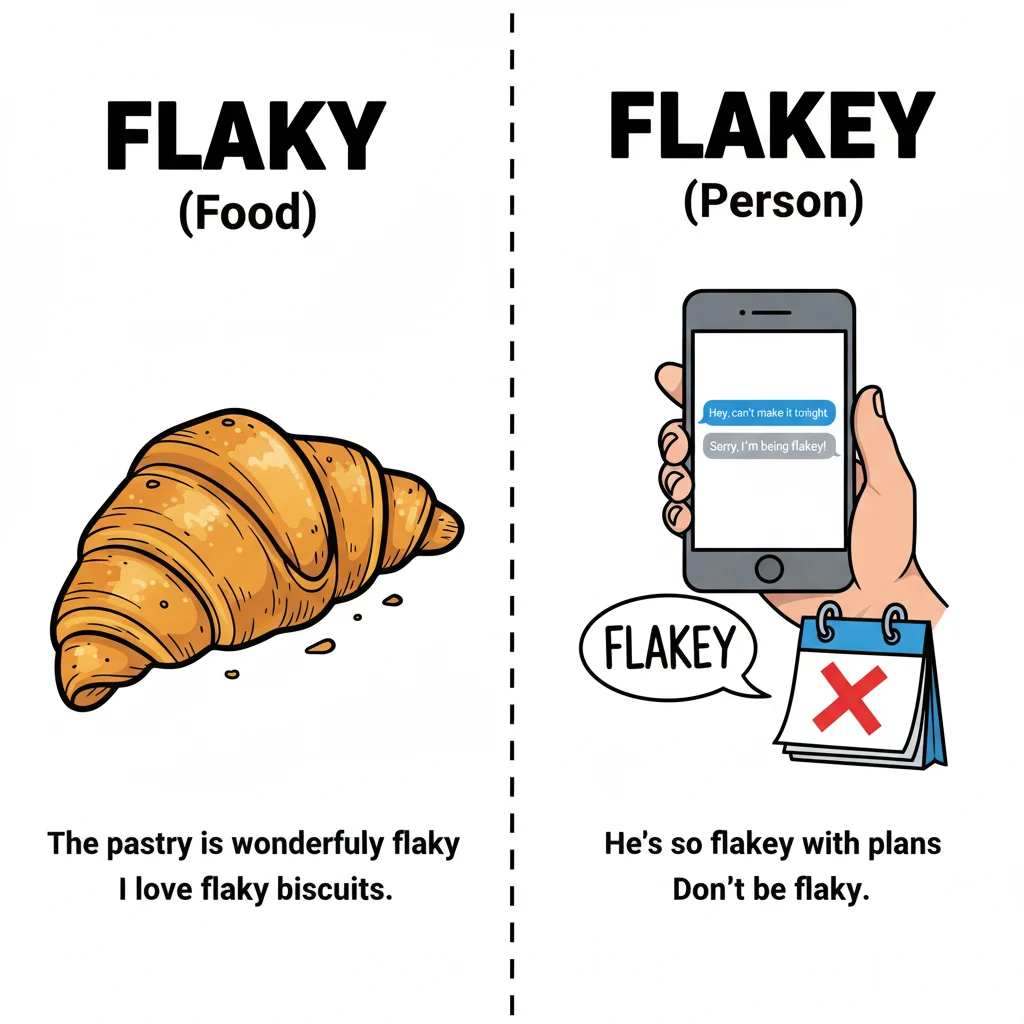
“Flaky” means something that easily breaks into small, thin pieces — or, when describing a person, someone unreliable or forgetful.
Examples:
- The pastry was light and flaky.
- Don’t trust him with plans; he’s kind of flaky.
- My skin gets flaky in winter.
👉 Think of “flakes” — small bits that fall off. “Flaky” describes something full of flakes or that behaves like flakes.
Flakey (Common Misspelling)
Part of speech: Adjective (informal or variant spelling)
Meaning:
“Flakey” is simply an alternative spelling of “flaky.” It means the same thing but is less common and often considered incorrect in formal writing.
Examples:
- That croissant was so flakey! (informal)
- She’s been acting flakey lately.
- His memory is getting kind of flakey.
🟡 Important: Most dictionaries list “flaky” as the standard and preferred spelling, especially in American and British English.
🔍 The Key Difference Between Flakey and Flaky
Here’s a simple side-by-side comparison to make it clear:
| Word | Meaning | Usage | Example | Correctness |
|---|---|---|---|---|
| Flaky | Breaks easily or unreliable (standard spelling) | Formal + Informal | “The paint is flaky.” | ✅ Correct |
| Flakey | Same meaning, but alternate spelling | Informal only | “She’s so flakey!” | ⚠️ Not standard |
🧠 Quick Tip to Remember:
Think of “flake” + “-y” = flaky.
Just like “cake” → “cakey,” but with an “e,” it stays simple. No need to add an extra “e” in “flaky.”

🚫 Common Mistakes and How to Avoid Them
❌ Mistake 1: Using “flakey” in formal writing
- Wrong: The crust was very flakey.
- ✅ Right: The crust was very flaky.
Why: “Flaky” is the dictionary-approved form used in school, work, and professional writing.
❌ Mistake 2: Thinking they mean different things
Both spellings mean the same thing — the only difference is that “flaky” is standard, while “flakey” is informal or regional.
❌ Mistake 3: Forgetting that “flaky” can describe people too
- “Flaky” isn’t only about food! You can call someone flaky if they often cancel plans or forget commitments.
Example: “He promised to help but didn’t show up — so flaky!”
Busing vs Bussing – The One Tiny Difference Everyone Misses!
✏️ When to Use “Flaky”
Use “flaky” when you want to sound correct, formal, or professional. It works in all types of writing, from school essays to job emails.
Examples:
- My friend is nice but a little flaky sometimes.
- This old paint is starting to look flaky.
- The pastry chef made perfect, flaky croissants.
- His excuses are so flaky — I never believe them.
- My dog’s fur got flaky in the cold weather.
Quick memory trick:
If it’s a flake — it’s flaky!
(No extra “e” needed.)
✍️ When to Use “Flakey”
You might see “flakey” used online, especially in casual texts, tweets, or memes.
It’s not technically wrong in informal settings — but it’s not standard English.
Examples:
- “Sorry I canceled again, I’m being so flakey 😅.”
- “These biscuits are super flakey, OMG!”
- “Don’t count on him — too flakey.”
🧠 Memory Hack:
Think of “flakey” as the lazy internet version of “flaky.” Okay for DMs or captions, but not for essays or emails.
🧩 Quick Recap: Flakey vs Flaky
- ✅ Flaky = Correct spelling
- ⚠️ Flakey = Informal variant (less common)
- Both mean the same thing: something that breaks apart easily or someone unreliable
Quick Summary Table:
| Feature | Flaky | Flakey |
|---|---|---|
| Correctness | ✅ Standard | ⚠️ Informal/variant |
| Used in formal writing | Yes | No |
| Common in social media | Yes | Yes |
| Meaning | Same | Same |
| Memory Trick | “Flake + y” = Flaky | Add “e” = mistake |
💡 Advanced Tips
- Origin: The word “flaky” comes from “flake,” which means a small, thin piece of something. It first appeared in the 19th century to describe thin layers, then later was used to describe unreliable people.
- Regional use: “Flakey” appears more often in informal American or Australian writing, but “flaky” dominates in dictionaries and media.
- In formal writing: Always use “flaky.”
- In texting or online: You can use “flakey” casually, but remember, it’s less professional.
🧠 Mini Quiz: Test Your Knowledge
Fill in the blanks with flaky or flakey 👇
- My friend promised to come but didn’t — she’s so ________.
- The snowflakes were light and ________.
- That pie crust looks buttery and ________.
- You shouldn’t write ________ in your school essay.
- His story sounds a bit ________ to me.
(Answers: 1. flaky, 2. flaky, 3. flaky, 4. flakey (as an example of incorrect usage), 5. flaky)
❓ FAQs
1. What’s the difference between flakey and flaky?
They mean the same thing, but “flaky” is the correct spelling in standard English. “Flakey” is an informal or misspelled version.
2. Is flakey wrong?
Not exactly — it’s a nonstandard spelling. It’s fine for texting or informal messages, but not for essays or official writing.
3. Can flaky describe people?
Yes! “Flaky” can describe someone who forgets plans or acts unpredictably. Example: “He’s too flaky to rely on.”
4. Which spelling do dictionaries prefer?
All major English dictionaries (American and British) list “flaky” as the correct form.
5. How can I remember the correct one?
Think: flake + y = flaky. Drop the extra “e”!
🧾 Conclusion
Now you know the difference between flakey and flaky — and which one to use!
Remember, “flaky” is the correct and standard spelling, while “flakey” is an informal variant best left for casual texts.
Keep practicing these small distinctions, and your English writing will keep getting better — one “flake” at a time! 🌟

Arwen Blythe is a passionate language and culture enthusiast, crafting clear, engaging guides on words, phrases, and modern English for Definevs.com readers.