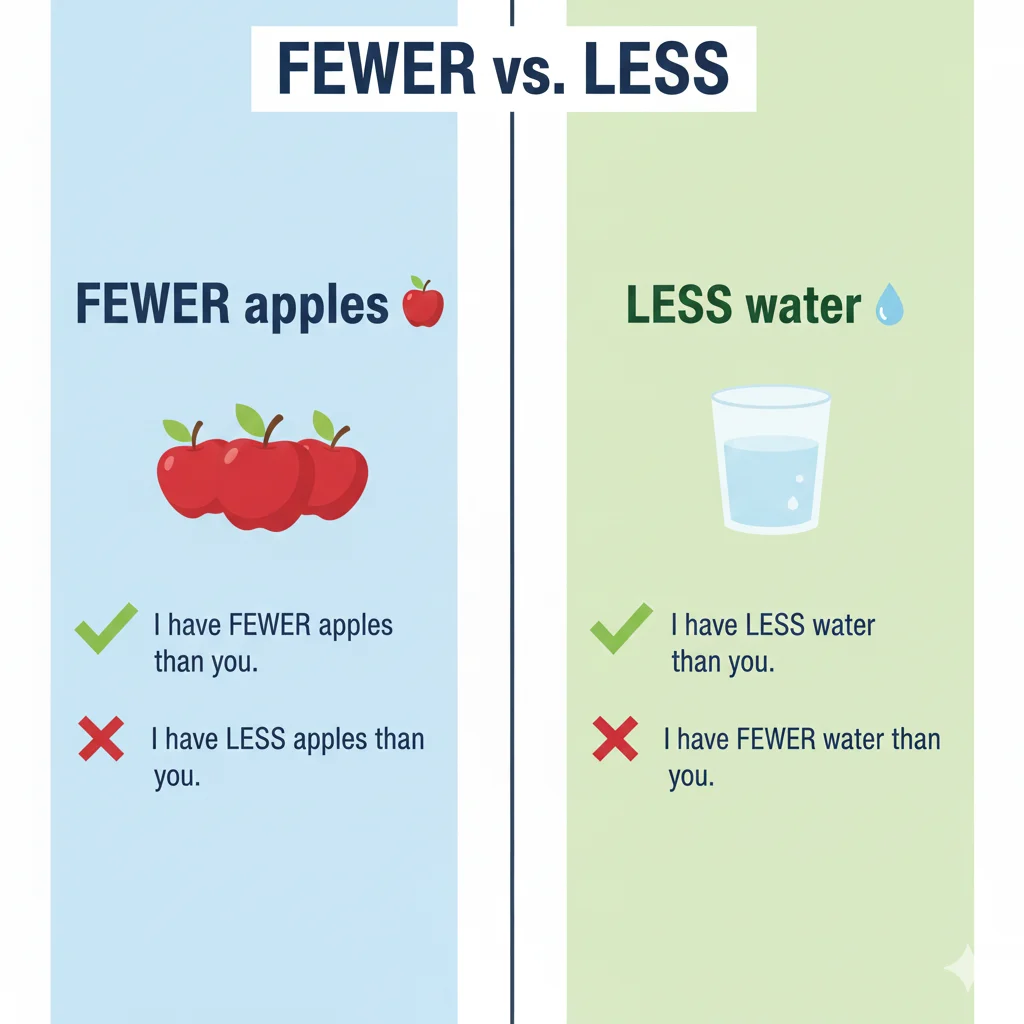
Have you ever wondered whether to say fewer or less? 🤔
You’re not alone! Many English learners — even native speakers — get confused between these two words. Both are used to talk about amounts or quantities, but their correct usage depends on what you’re counting.
In this easy guide, we’ll explore the difference between fewer and less, understand their meanings, learn when to use each word, and fix some common grammar mistakes. By the end, you’ll know exactly how to use them in school writing, conversations, and even professional emails. Let’s make this fun and simple! 🌟
📘 What Does Each Word Mean?
✨ Fewer
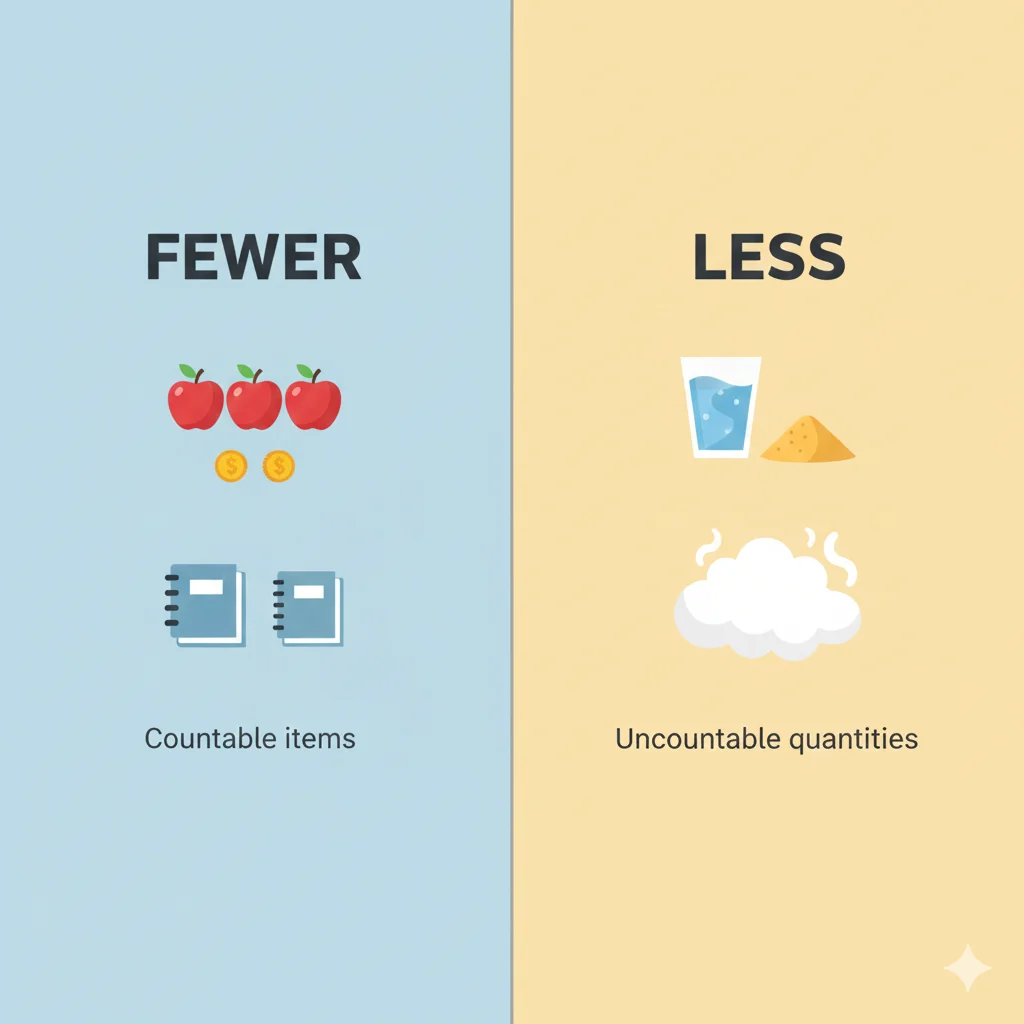
“Fewer” means a smaller number of things — things you can count one by one.
It’s used with countable nouns (like apples, books, or pencils).
🧩 Examples:
- I have fewer pencils than you.
- There are fewer cars on the road today.
- We should eat fewer sweets to stay healthy.
Think of it like counting pieces — if you can count them, use fewer! 🍎🍏🍎
💧 Less
“Less” means a smaller amount — something you can’t count individually.
It’s used with uncountable nouns (like water, sugar, or time).
🧩 Examples:
- I drank less water today.
- We have less time before the movie starts.
- Please use less sugar in my tea.
If you can’t count it easily (like sand or milk), use less! 🥛
⚖️ The Key Difference Between Fewer and Less
Here’s a simple comparison to make it crystal clear:
| Feature | Fewer | Less |
|---|---|---|
| Used with | Countable nouns | Uncountable nouns |
| Describes | Number | Amount |
| Example | Fewer apples | Less water |
| Question Example | How many? 🍎 | How much? 💧 |
| Example Sentence | “There are fewer chairs in the room.” | “There is less furniture in the room.” |
💡 Quick Tip to Remember:
👉 If you can count it, use fewer.
👉 If you measure it, use less.
🚫 Common Mistakes and How to Avoid Them
- ❌ There are less students in class today.
✅ There are fewer students in class today.
(Students can be counted.) - ❌ I have fewer money than you.
✅ I have less money than you.
(Money is uncountable.) - ❌ We need less chairs for the meeting.
✅ We need fewer chairs for the meeting.
(Chairs can be counted.)
🧠 Why these mistakes happen:
People often mix up the two because both describe smaller quantities. But remembering the “count it or measure it” rule helps every time!
🍎 When to Use Fewer
Use fewer when talking about things you can count — like objects, people, or individual items.
✅ Examples:
- Fewer people attended the concert this year.
- I need fewer books in my backpack.
- She made fewer mistakes this time.
- We saw fewer birds in the park today.
- Fewer toys were left on the floor after cleanup.
🎯 Memory Trick:
Think “few = number.” If there’s a number involved, fewer is your word!
🌊 When to Use Less
Use less for things that can’t be counted easily — like liquids, feelings, or abstract ideas.
✅ Examples:
- Please talk less during class.
- There’s less milk in the fridge.
- I have less interest in that game now.
- This job takes less effort than before.
- We should spend less time online.
💡 Memory Hack:
If you ask “how much?” and not “how many?” — choose less!
🔍 Quick Recap: Fewer vs Less
Here’s a simple summary you can remember easily:
- 🧮 Fewer = smaller number (countable things)
👉 Fewer apples, fewer students, fewer cars. - ⚗️ Less = smaller amount (uncountable things)
👉 Less water, less time, less sugar. - 🪄 Trick: Count it → Fewer. Measure it → Less.
🌍 Advanced Tips & Grammar Insight
Even though fewer and less are clear in most cases, real-life English sometimes bends the rule a bit!
✨ Exceptions where “less” is okay with numbers:
- It’s less than ten miles away.
- He earns less than $500 a week.
➡️ In measurements, money, and time, “less” is often acceptable.
📜 Origin Insight:
“Fewer” comes from Old English fēawra meaning “not many.”
“Less” comes from lǣs, meaning “not as much.”
Both have been used since the 10th century — and people have been mixing them up ever since! 😅
✍️ In Writing and Exams:
Using them correctly shows strong grammar skills. Teachers, editors, and examiners notice this!
📱 In Casual Talk or Texts:
People often say “less” for both — like “less people.” But in formal writing or exams, always stick to the grammar rule.
🧩 Mini Quiz — Test Yourself!
Choose the correct word (fewer or less):
- There are ___ cookies left in the jar. 🍪
- I have ___ patience today. 😅
- We saw ___ stars because of the clouds. 🌧️
- Drink ___ soda and more water. 🥤
- She got ___ marks than last time. 📚
- We spent ___ hours on homework today. ✏️
- I have ___ pencils than you. ✏️
Answers: 1. fewer, 2. less, 3. fewer, 4. less, 5. fewer, 6. less, 7. fewer ✅
💬 FAQs about Fewer vs Less
1. What is the main difference between fewer and less?
Fewer is for countable things; less is for uncountable things.
2. Can I use less with numbers?
Yes, in expressions about time, money, or distance (e.g., less than five minutes).
3. Why do people say “less people” instead of “fewer people”?
It’s common in everyday speech, but “fewer people” is grammatically correct.
4. Which word should I use in formal writing?
Always use fewer for countable and less for uncountable nouns in essays or exams.
5. What’s an easy way to remember the rule?
If you can count it → fewer.
If you measure it → less.
🌟 Conclusion
The words fewer and less may look similar, but they describe different kinds of quantities.
Use fewer when counting things you can see and number, and use less when talking about things you measure or can’t count.
With practice, you’ll start using them naturally — and your grammar will sound smooth, confident, and correct. 💪
Keep learning little grammar tips like this every day — they make a big difference in how clearly you express yourself! 🌈

Mira Loxley is a passionate language and writing expert at Definevs.com, turning tricky words and grammar into clear, engaging guides for every reader.