Have you ever read something online and wondered, “Is that a fact or an opinion?” 🤔
You’re not alone! Many people — students, writers, and even adults — often mix these two up because they sound similar in everyday use.
But here’s the good news: by the end of this guide, you’ll easily understand the difference between fact and opinion, know how to use each one correctly, and spot them instantly in writing or conversation.
This simple explanation will make things clear for everyone — even if you’re just starting to learn English.
🧠 What Does Each Word Mean?
Let’s start with the basics.
✅ What Is a Fact?
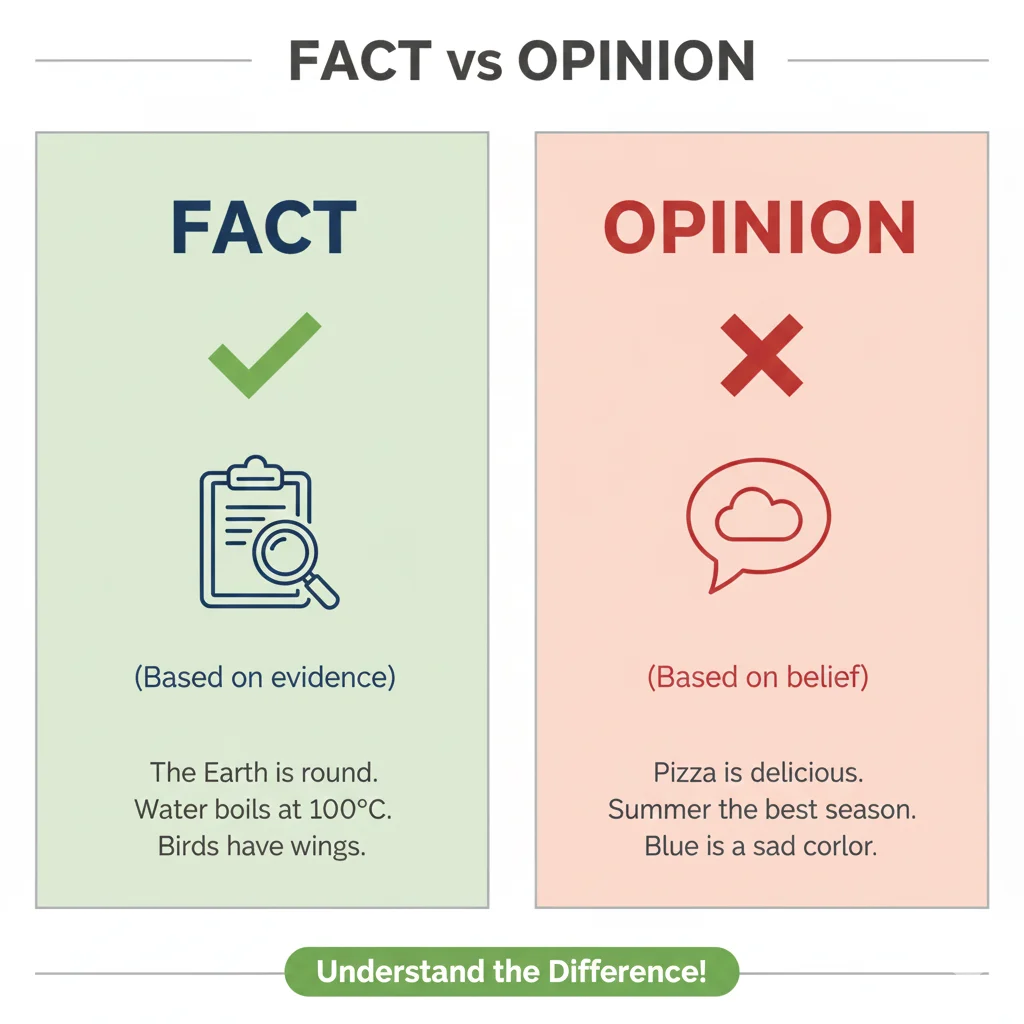
A fact is something that is true and can be proven.
Facts don’t change based on what people think or feel. They are based on evidence, data, or reality.
Part of speech: Noun
Examples:
- The sun rises in the east.
- Water boils at 100°C.
- Pakistan is in South Asia.
👉 These statements can be checked and proven. That’s what makes them facts.
💬 What Is an Opinion?
An opinion is what someone believes, feels, or thinks.
It’s not always true for everyone, and you can’t prove it with evidence. Opinions can differ from person to person.
Part of speech: Noun
Examples:
- Vanilla ice cream is the best flavor.
- Math is the hardest subject.
- Cats are friendlier than dogs.
👉 These statements show personal feelings or beliefs — not facts.
📘 Quick Tip:
If you can prove it — it’s a fact.
If you believe it — it’s an opinion.
⚖️ The Key Difference Between Fact and Opinion
Here’s a simple table to make it crystal clear:
| Feature | Fact | Opinion |
|---|---|---|
| Definition | A statement that is true and can be proven | A statement that shows personal beliefs or feelings |
| Based on | Reality and evidence | Emotions and thoughts |
| Can be proven? | ✅ Yes | ❌ No |
| Example | “The earth orbits the sun.” | “The earth is the most beautiful planet.” |
💡 Quick Tip to Remember:
If everyone agrees because it’s true → it’s a fact.
If people might disagree because it’s a feeling → it’s an opinion.
🚫 Common Mistakes and How to Avoid Them
Even native speakers mix up facts and opinions sometimes. Let’s fix that!
| ❌ Wrong | ✅ Correct | Why It’s Wrong |
|---|---|---|
| “Chocolate is the best food in the world.” (fact) | “Chocolate is my favorite food.” (opinion) | “Best” is a personal feeling, not a proven truth. |
| “Dogs are better than cats.” (fact) | “In my opinion, dogs are better than cats.” (opinion) | There’s no proof that one is “better” — it’s a preference. |
| “The Eiffel Tower is tall.” (opinion) | “The Eiffel Tower is 330 meters tall.” (fact) | The number can be measured — that makes it a fact. |
👉 Always ask yourself: Can I prove this? If yes — fact. If no — opinion.
📚 When to Use “Fact”
Use the word “fact” when you talk about something that can be checked, proven, or measured.
Examples:
- It’s a fact that birds can fly.
- The fact is, water covers most of the Earth’s surface.
- Scientists deal with facts, not guesses.
- It’s a known fact that exercise helps your health.
- The teacher asked us to list five facts about our country.
💡 Memory Hack:
Think of “fact” as something firm and fixed — it doesn’t change no matter who says it.
💭 When to Use “Opinion”
Use “opinion” when you share what you think, feel, or believe. It’s often used with words like I think, I believe, I feel, or in my opinion.
Examples:
- In my opinion, books are better than movies.
- Everyone has a different opinion about fashion.
- That’s just your opinion, not a fact.
- My opinion is that kids should play outside more.
- What’s your opinion on this topic?
💡 Memory Hack:
An opinion comes from the heart, not the head.
🔍 Quick Recap: Fact vs Opinion
Here’s a short summary to keep it simple:
- Fact: True, proven, based on evidence.
- Opinion: Personal belief, based on feelings.
How to tell the difference:
- If it can be measured or tested → Fact
- If it shows personal preference → Opinion
✅ Fact Example: The sky is blue because of light scattering.
❌ Opinion Example: The sky looks prettier in summer.
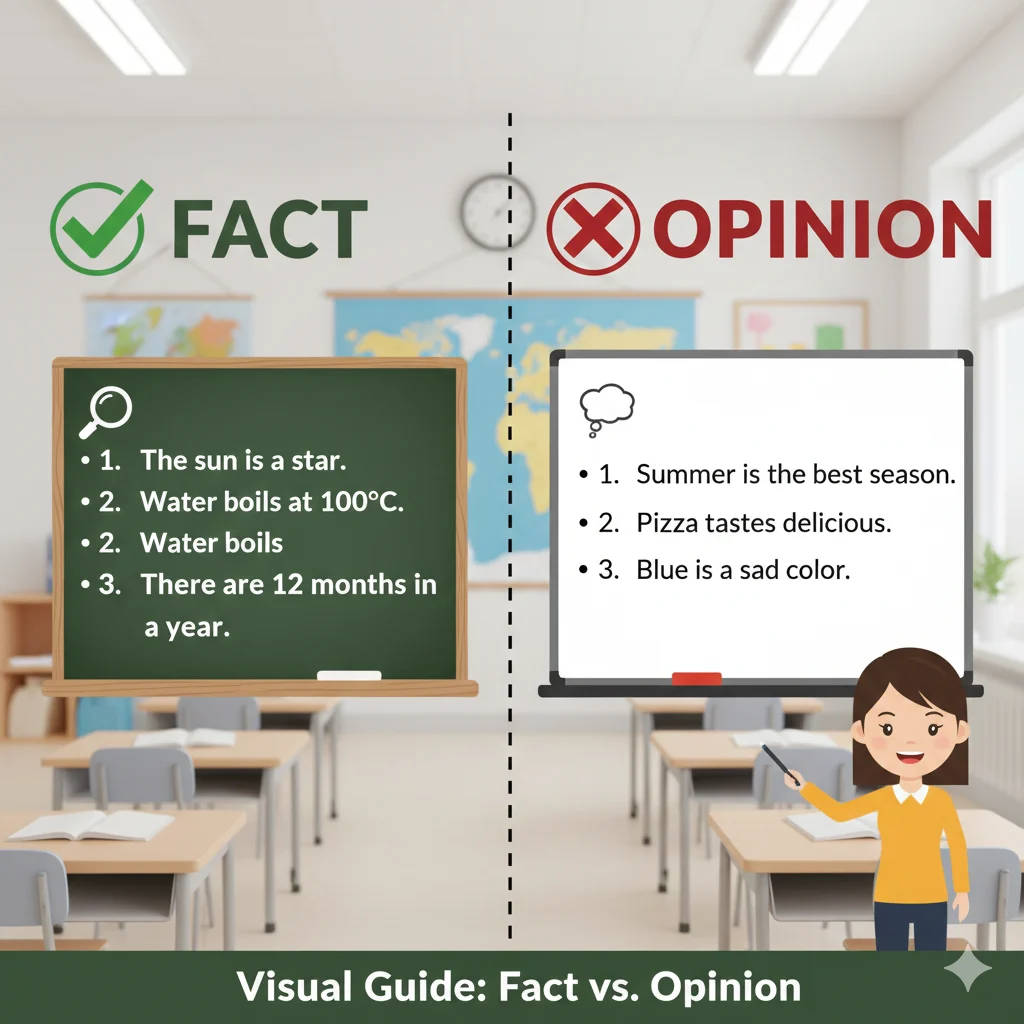
📸 Visual Suggestion:
A poster-style image showing:
- “Fact = Proven Truth”
- “Opinion = Personal Thought”
🧩 Advanced Tips
Want to sound like an English expert? Here are a few pro tips:
- In writing and essays: Use facts to support your argument and opinions to show your perspective.
- Example: Fact: “Plastic takes hundreds of years to decompose.”
Opinion: “We should ban plastic to save the environment.”
- Example: Fact: “Plastic takes hundreds of years to decompose.”
- In exams: When a question says “Give one fact and one opinion,” make sure your fact can be checked!
- In social media or debates: Always separate what’s true from what’s believed — this helps you sound more credible.
- Origin:
- Fact comes from the Latin “factum,” meaning “something done or made.”
- Opinion comes from Latin “opinionem,” meaning “judgment or belief.”
📝 Mini Quiz — Test Yourself!
Fill in the blanks with Fact or Opinion:
- _______: The moon goes around the Earth.
- _______: Pizza is the most delicious food ever.
- _______: There are seven continents in the world.
- _______: I think winter is better than summer.
- _______: Water freezes at 0°C.
- _______: Dogs are cuter than cats.
🧩 Answers:
- Fact
- Opinion
- Fact
- Opinion
- Fact
- Opinion
❓ FAQs
1. What is the main difference between a fact and an opinion?
A fact is something true that can be proven, while an opinion is what someone believes or feels.
2. Can an opinion become a fact?
Sometimes — if it’s proven with evidence later. But most opinions remain personal thoughts.
3. How do I know if something is a fact?
Ask: “Can I prove it with data, research, or observation?” If yes, it’s a fact.
4. Why is it important to know the difference?
It helps you think critically, avoid false information, and write better essays.
5. Can facts change over time?
Yes — if new discoveries prove old facts wrong. For example, people once thought the Earth was flat (opinion), but now we know it’s round (fact).
🏁 Conclusion
Now you know the difference between fact and opinion — it’s actually simple!
A fact is something you can prove, and an opinion is something you feel or believe.
The next time you read or write something, ask: “Can this be proven?” That small question will make you smarter, more confident, and a better communicator.
✨ Keep practicing — because improving your English is always a fact worth celebrating!

Kael Donovan is a language enthusiast and writer at Definevs.com, simplifying complex words and grammar rules into fun, easy-to-understand guides for readers.