Have you ever stopped while writing and wondered: should I say “every one” or “everyone”? 🤔
You’re not alone! These two phrases look almost identical but have different meanings and grammar rules in English.
Many learners (and even native speakers) confuse them because both refer to people or things — yet how and when you use them changes the entire meaning of your sentence.
In this guide, we’ll explain:
- What “every one” and “everyone” mean
- The difference between them
- When to use each (with real-life examples)
- Common mistakes and how to avoid them
By the end, you’ll never mix them up again — promise! 🌟
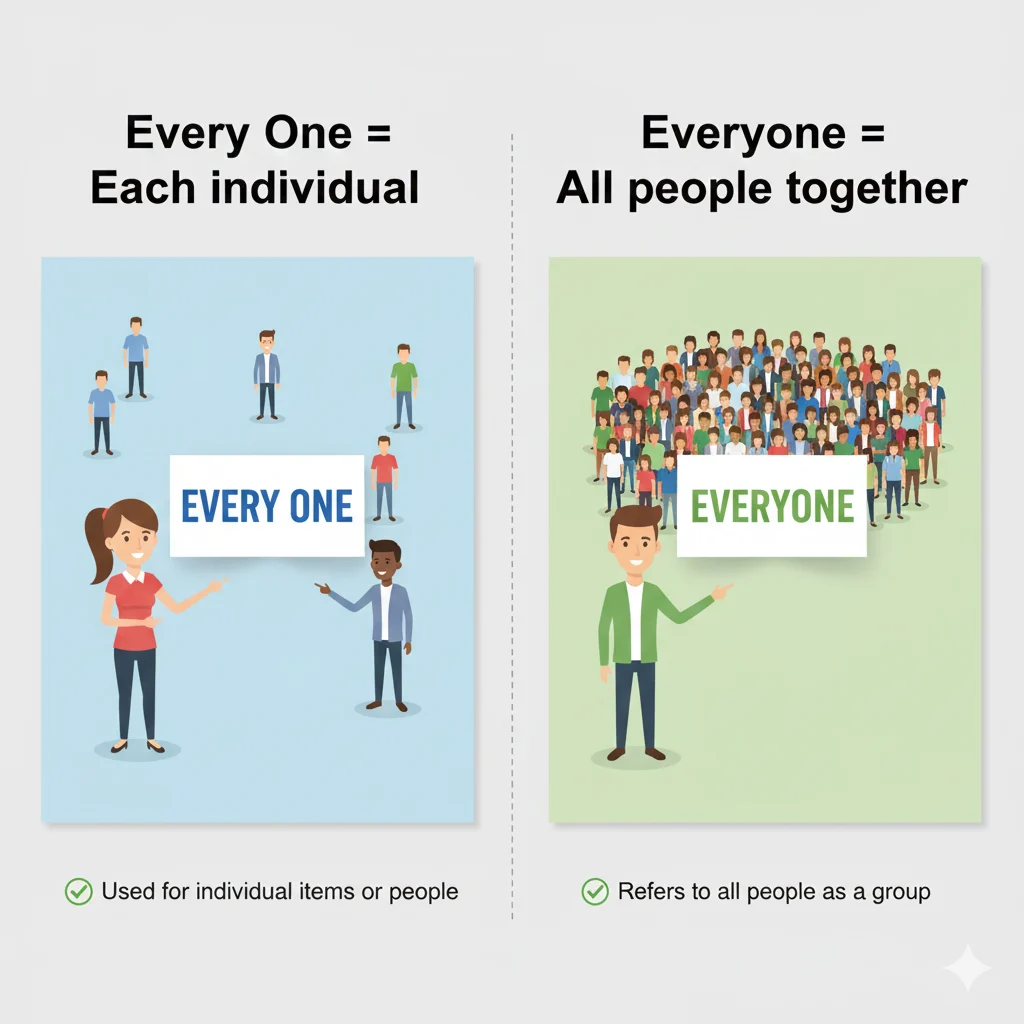
🧐 What Does Each Word Mean?
Let’s start by learning the meanings of both. They look similar, but one is a two-word phrase, and the other is a single word.
✅ “Everyone” — One Word
Part of Speech: Pronoun
Meaning: “Everyone” means all people or every person in a group. It’s used when you talk about a group as a whole.
Examples:
- Everyone loves pizza. 🍕 (All people love it.)
- Everyone in class passed the test. 🎓
- I want everyone to be happy. 😊
Think of “everyone” as a collective word — it talks about a group, not individuals separately.
✅ “Every one” — Two Words
Part of Speech: Determiner + Noun (Every + One)
Meaning: “Every one” means each individual person or thing — you’re emphasizing each member of the group separately.
Examples:
- Every one of the cookies was eaten. 🍪 (Each cookie, not all at once.)
- She checked every one of her messages. 📱
- Every one of you matters to me. ❤️
Think of “every one” as focusing on individuals in a group — not the group as a whole.
🔍 The Key Difference Between “Every One” and “Everyone”
Here’s a quick and easy comparison:
| Feature | Every One | Everyone |
|---|---|---|
| Type | Two words | One word |
| Meaning | Each individual person or thing | All people (as a group) |
| Focus | Individual members | The group together |
| Common Use | Often followed by “of” (every one of…) | Never followed by “of” |
| Example | “She greeted every one of the guests.” | “Everyone had a great time.” |
💡 Quick Tip to Remember:
👉 If you can replace it with “each one”, use “every one.”
👉 If you mean “all people,” use “everyone.”
❌ Common Mistakes and How to Avoid Them
Let’s look at a few common errors English learners make — and how to fix them.
| ❌ Wrong | ✅ Correct | Explanation |
|---|---|---|
| Everyone of the students passed. | Every one of the students passed. | “Everyone” can’t be followed by “of.” |
| She called every one to the meeting. | She called everyone to the meeting. | Here, you mean “all people,” not individuals. |
| Every one likes ice cream. | Everyone likes ice cream. | “Everyone” refers to all people together. |
🧠 Tip: Always check if “of” follows the phrase.
If it does → “every one.”
If it doesn’t → “everyone.”
📗 When to Use “Every One”
Use “every one” when you want to emphasize each person or thing separately.
It often appears before “of” and sounds more formal or detailed.
Examples:
- Every one of the books was returned on time.
- He thanked every one of his teammates.
- Every one of the lights was turned off.
- Every one of us needs to try harder.
- She admired every one of his paintings.
🎯 Memory Hack:
Think of “every one” as “each one.” If the sentence still makes sense when replaced, you’re right!
➡️ Every one (each one) of the cookies is delicious.
📘 When to Use “Everyone”
Use “everyone” when you talk about all people together — as a whole group.
Examples:
- Everyone enjoyed the concert. 🎤
- Good morning, everyone! ☀️
- Everyone is welcome here. 🤝
- I told everyone the good news. 📰
- Everyone agreed with the plan. 🗓️
🎯 Memory Hack:
If you can replace it with “all people,” use “everyone.”
➡️ All people enjoyed the concert → Everyone enjoyed the concert.
🧾 Quick Recap: Every One vs Everyone
- Every one = each individual
- Often followed by “of.”
- Can be replaced with “each one.”
- Example: “Every one of the apples is fresh.” 🍎
- Everyone = all people together
- Never followed by “of.”
- Can be replaced with “all people.”
- Example: “Everyone loves apples.” 🍏
🧩 Summary Table:
| Rule | “Every One” | “Everyone” |
|---|---|---|
| Meaning | Each person or thing | All people as a group |
| Common Pair | “of” → every one of | Never “of” |
| Replace With | “Each one” | “All people” |
| Example | “Every one of them tried.” | “Everyone tried.” |
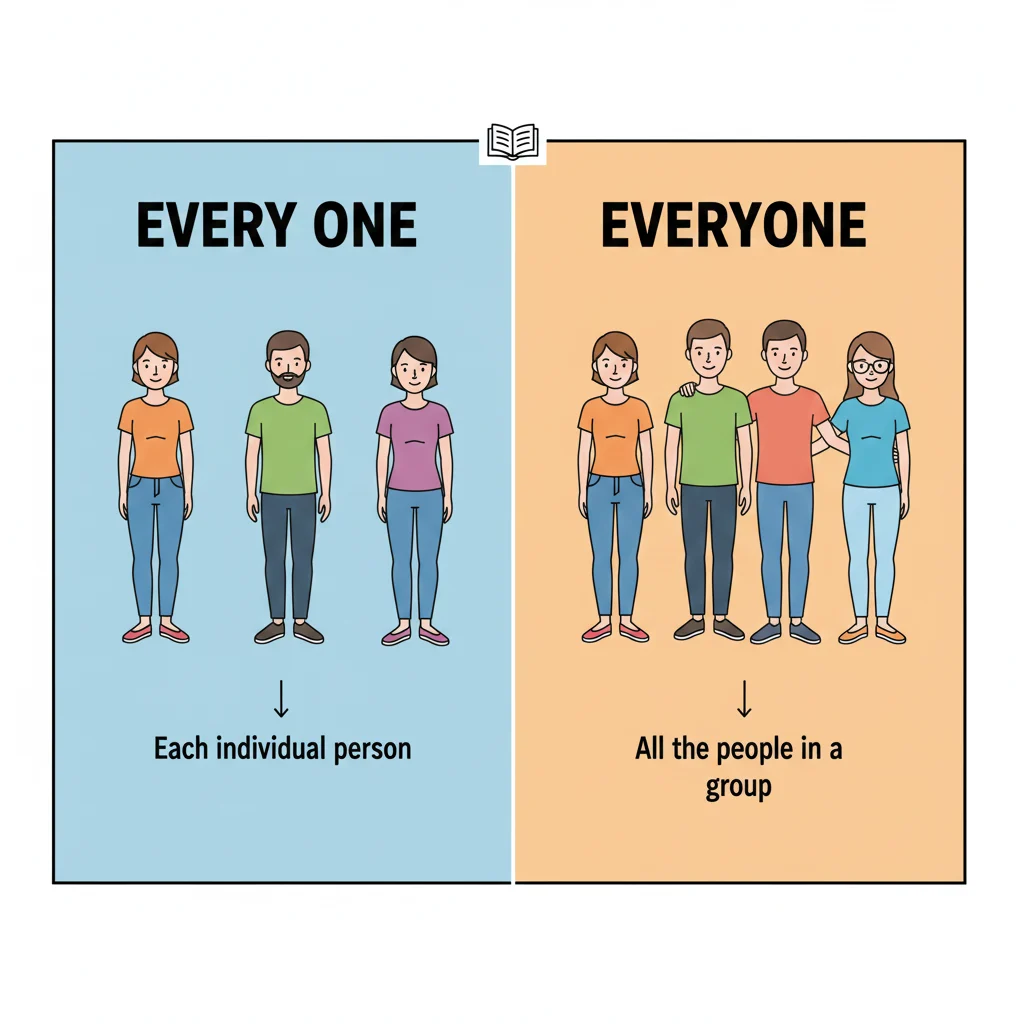
📖 Advanced Tips and Grammar Insight
Even though “everyone” and “every one” look similar, their origins are slightly different:
- “Everyone” evolved from “every” + “one” joining together over time — becoming a pronoun.
- “Every one” stayed as a phrase with its literal meaning intact: every single one.
🧠 Usage in Formal Writing:
- In essays or speeches, “everyone” is common when addressing groups (“Everyone must participate”).
- “Every one” fits better when you need precision (“Every one of the points was considered”).
⚠️ In texting or online chat, people sometimes shorten “everyone” to “every1.” That’s fine in casual talk, but not in formal writing.
📝 Mini Quiz: Test Yourself!
Fill in the blanks with every one or everyone.
- ______ of you did a great job today!
- ______ loves a kind person.
- She checked ______ of the emails carefully.
- ______ should respect others.
- The teacher praised ______ of her students.
- ______ in the room clapped loudly.
- He looked at ______ of the photos twice.
✅ Answers:
- Every one
- Everyone
- Every one
- Everyone
- Every one
- Everyone
- Every one
All of a Suddenly / All of the Sudden: What You’re Saying Wrong ❗
❓ FAQs
1. What’s the difference between “every one” and “everyone”?
“Every one” means each person or thing individually. “Everyone” means all people as a group.
2. Can I say “everyone of the students”?
No ❌. You must say “every one of the students.” “Everyone” is never followed by “of.”
3. How can I remember the difference easily?
If you mean each one separately, use “every one.”
If you mean all people together, use “everyone.”
4. Is “everyone” singular or plural?
“Everyone” is singular, even though it refers to many people.
Example: “Everyone is happy.” (Not are.)
5. Can “every one” refer to things, not just people?
Yes! Example: “Every one of the chairs was broken.”
🏁 Conclusion
Now you know the clear difference between “every one” and “everyone.”
Remember — if you’re talking about individuals, use “every one.”
If you mean all people together, use “everyone.”
These tiny grammar details make your English sound clear and confident.
Keep practicing, and soon choosing the right word will feel natural — for real! 🌟

Kael Donovan is a language enthusiast and writer at Definevs.com, simplifying complex words and grammar rules into fun, easy-to-understand guides for readers.