Do you ever stop mid-sentence and wonder, “Should I say effect or affect?” 😅 You’re not alone!
These two tiny words look and sound similar — but they don’t mean the same thing. Even native English speakers often mix them up.
In this guide, we’ll break down the difference between “effect” and “affect” in the simplest way possible. You’ll learn:
- What each word means
- When to use “effect” and when to use “affect”
- Common grammar mistakes and easy memory tricks
- Real-life examples and a quick recap chart
By the end, you’ll never confuse these two again — promise! 🌟
💡 What Does Each Word Mean?
Let’s start simple.
Effect (noun)
“Effect” means a result or an outcome — something that happens because of something else.
It’s usually a noun, which means it names a thing.
✅ Examples:
- The rain had a calming effect on everyone.
- The movie’s ending had a strong effect on me.
- Lack of sleep can have a bad effect on your health.
Quick meaning: Effect = result or outcome.
Affect (verb)
“Affect” means to change or influence something.
It’s usually a verb, which means it’s an action word.
✅ Examples:
- The cold weather affected my mood.
- Her kind words affected him deeply.
- The storm affected many people in the city.
Quick meaning: Affect = to influence or make a change.
⚖️ The Key Difference Between Effect and Affect
Here’s the easiest way to remember the difference:
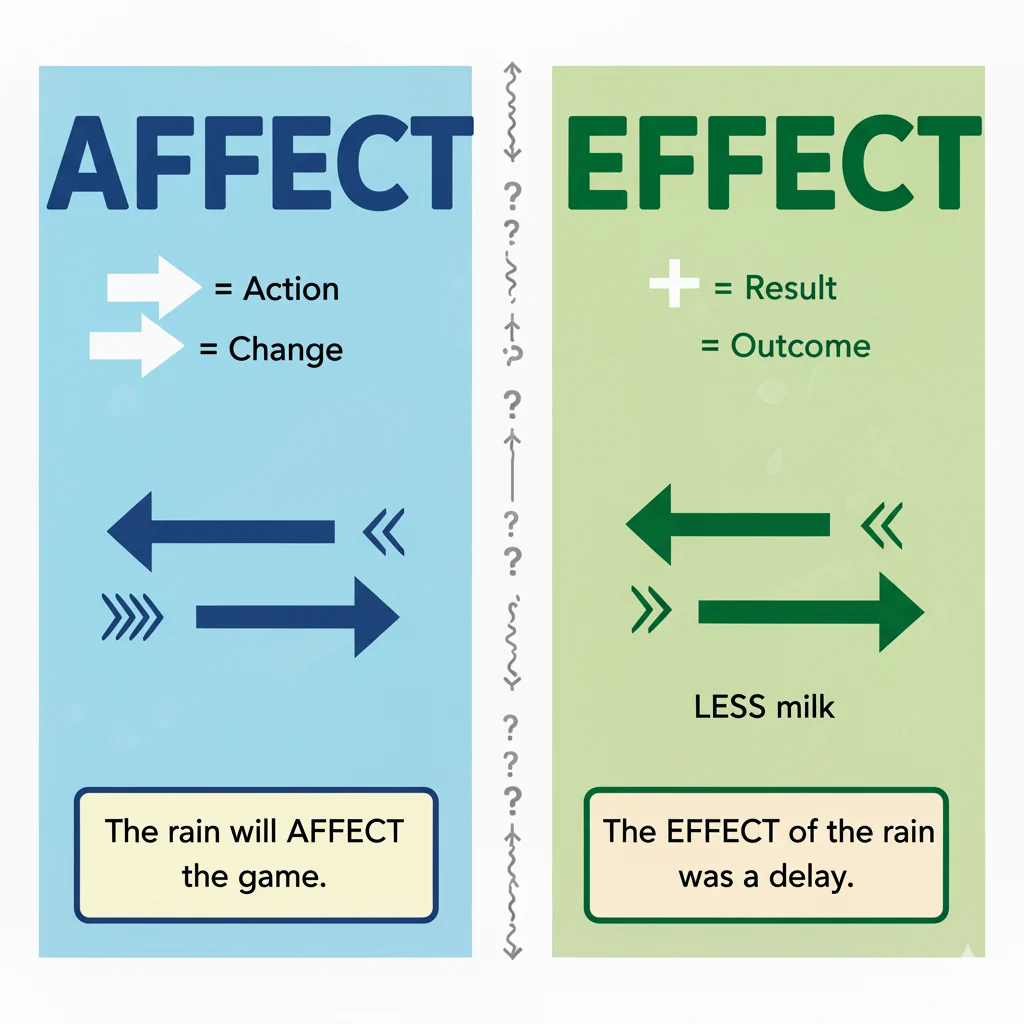
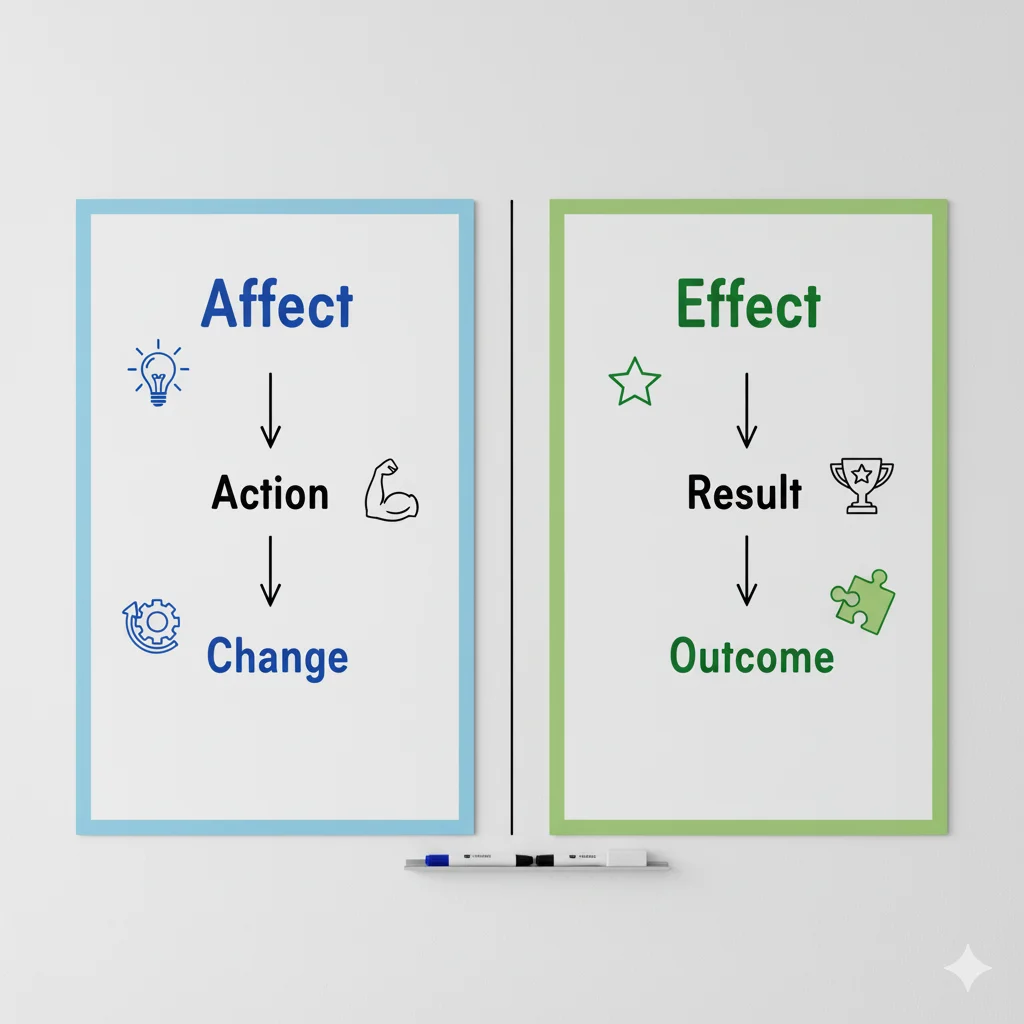
💬 “Affect” is an action. “Effect” is a result.”
| Word | Part of Speech | Meaning | Example Sentence |
|---|---|---|---|
| Affect | Verb (action) | To change or influence something | The weather affects my mood. |
| Effect | Noun (thing/result) | The result or outcome of something | The new law had a big effect on businesses. |
Quick Tip to Remember:
👉 If you can replace the word with “influence,” use affect.
👉 If you can replace it with “result,” use effect.
❌ Common Mistakes and How to Avoid Them
Here are the most frequent mix-ups:
🚫 Wrong: The weather had a strong affect on my plans.
✅ Right: The weather had a strong effect on my plans.
(You’re talking about a result → noun → “effect”)
🚫 Wrong: The news effected everyone deeply.
✅ Right: The news affected everyone deeply.
(You’re describing an action → verb → “affect”)
Why it happens:
Both words sound alike and deal with cause and result. The trick is to think — “Am I describing the action or the outcome?”
🕒 When to Use “Effect”
Use effect when you’re talking about a result, outcome, or consequence.
Examples:
- Studying has a positive effect on your grades.
- The medicine had no side effects.
- The speech had an emotional effect on the crowd.
- Pollution has long-term effects on the planet.
- Your smile has a magical effect on people.
Memory Trick:
🔹 Think “E” for End result → Effect
⚙️ When to Use “Affect”
Use affect when you mean to influence, change, or act upon something.
Examples:
- Loud noise can affect your hearing.
- The teacher’s words affected her students.
- His mood affects everyone around him.
- The cold weather affects my energy levels.
- Your attitude affects your success.
Memory Trick:
🔹 Think “A” for Action → Affect
🔁 Quick Recap: Effect vs Affect
Here’s your simple cheat sheet 👇
- Affect = Verb = To change or influence something.
- Example: The sunlight affects how plants grow.
- Effect = Noun = The result or outcome.
- Example: The sunlight has a great effect on plants.
🌟 In one line:
“Affect” is something you do.
“Effect” is something that happens.
🧠 Advanced Tips (For Curious Learners)
While “affect” is usually a verb and “effect” a noun, there are a few exceptions:
1. “Effect” as a verb
Sometimes “effect” can be a verb meaning to cause or bring about.
- Example: The new manager will effect major changes in the company.
(Here it means “to make happen.”)
2. “Affect” as a noun
Rarely, “affect” can be a noun in psychology, meaning a person’s emotional state or expression.
- Example: The patient displayed a flat affect during the session.
These are advanced uses — you don’t need them for everyday writing, but they help you understand English on a deeper level.
Formal Writing Tip:
In essays or exams, make sure to double-check which word fits the sentence logically. Using the wrong one can completely change your meaning!
✏️ Mini Quiz: Test Yourself!
Fill in the blanks with either effect or affect 👇
- The new law will ______ small businesses.
- The medicine had a strange ______ on me.
- His words really ______ed my confidence.
- The sound of rain has a calming ______.
- Don’t let failure ______ your next decision.
(Answers: 1. affect, 2. effect, 3. affected, 4. effect, 5. affect)
🧩 FAQs
1. What is the main difference between “effect” and “affect”?
“Effect” is a noun meaning result or outcome, while “affect” is a verb meaning to influence or change something.
2. How can I remember “effect” vs “affect”?
Use this trick: Affect = Action (verb), Effect = End result (noun).
3. Can “effect” ever be a verb?
Yes, but rarely. It means to cause or bring about. Example: “The new policy will effect change.”
4. Which one should I use in a sentence like ‘The weather _____ my mood’?
Use affects, because the weather influences your mood.
5. Why are “effect” and “affect” so commonly confused?
They sound similar, are spelled alike, and both describe cause and result — but their grammar roles (noun vs. verb) are different.
🏁 Conclusion
Now you know the real difference between effect and affect! 🎉
- Use affect when you mean an action — to influence something.
- Use effect when you mean a result — the outcome of that action.
With a little practice, you’ll never second-guess yourself again. Keep learning one word pair at a time — and soon, your English will have a powerful effect on others! 😉

Isla Merrin is a language and writing expert at Definevs.com, creating simple, engaging guides to help readers master words, grammar, and modern English usage.