Have you ever wondered whether to put a comma before or after “so” in a sentence? You’re not alone! Many English learners — even native speakers — get confused about this tiny punctuation mark.
“So” can connect ideas, show cause and effect, or simply start a sentence. That’s why knowing when to use a comma before “so” (and when not to) is important for clear, correct writing.
In this simple guide, you’ll learn:
- What “so” means in different sentences
- When to use a comma before “so”
- When you shouldn’t use one
- Easy examples, grammar tips, and memory tricks
By the end, you’ll be able to write confidently and never second-guess your commas again!
🔍 What Does “So” Mean?
The word “so” is one of the most common — but tricky — words in English.
It has several meanings depending on how it’s used. Let’s look at them simply:
1. “So” as a Conjunction (joining ideas)
“So” connects two clauses — a cause and a result.
Example:
- I was tired, so I went to bed early.
- She studied hard, so she passed the exam.
- It rained, so we stayed inside.
2. “So” for Emphasis (showing degree or feeling)
Here, “so” means very or extremely.
Example:
- That cake was so delicious!
- I’m so happy you came.
- He’s so tall!
3. “So” to Start a Sentence (showing conclusion or continuation)
“So” can begin a sentence in conversation or writing to continue a thought.
Example:
- So, what are you doing this weekend?
- So, that’s why I couldn’t call you.
- So, let’s get started!
⚖️ The Key Difference: Comma Before or After “So”?
Here’s where it gets interesting! The comma rule for “so” depends on how it’s used.
| Use of “So” | Comma Rule | Example |
|---|---|---|
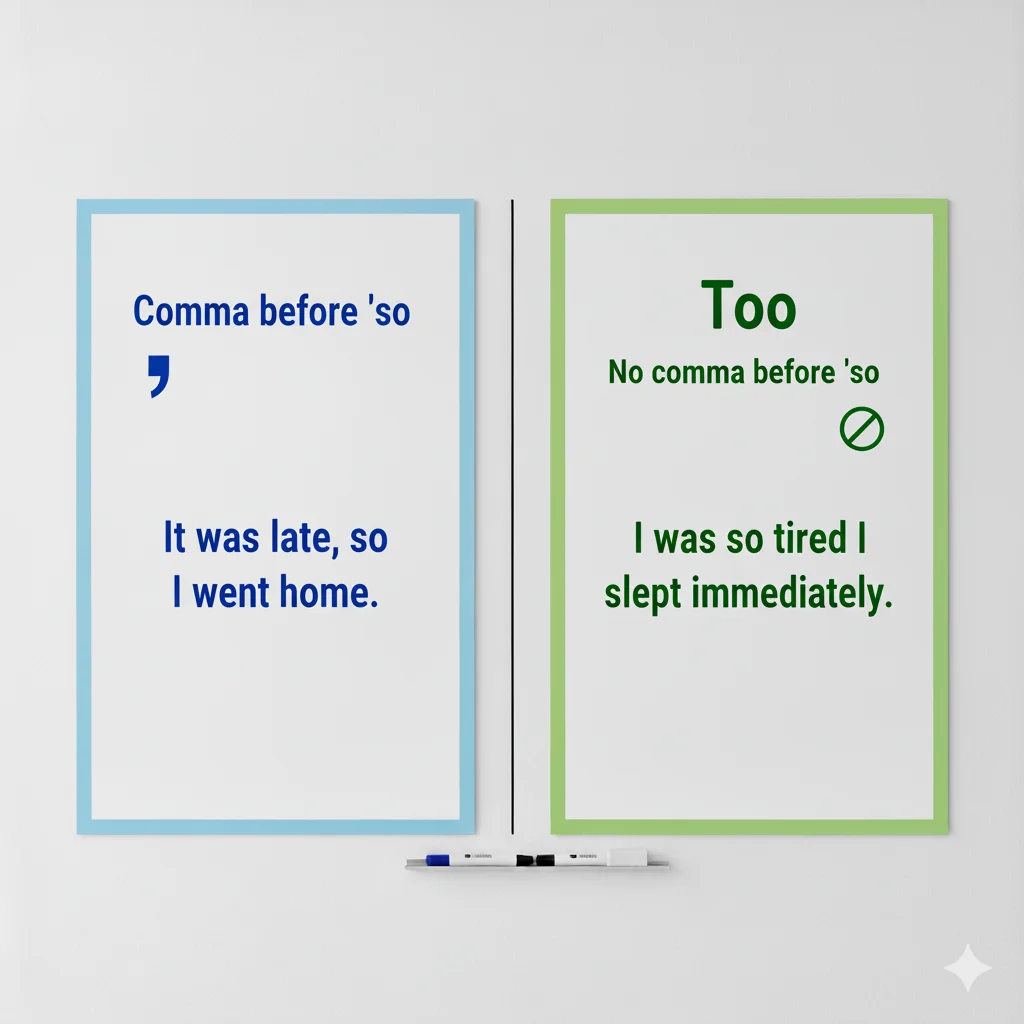
| To show cause and effect (conjunction) | ✅ Use a comma before “so” | I was hungry, so I made a sandwich. |
| To show result or emphasis in a short sentence | ❌ No comma | I was so tired I fell asleep instantly. |
| At the beginning of a sentence (transitional use) | ✅ Comma after “so” | So, what did you decide? |
| In informal speech (short expressions) | ❌ No comma | So what? |
💡 Quick Tip to Remember:
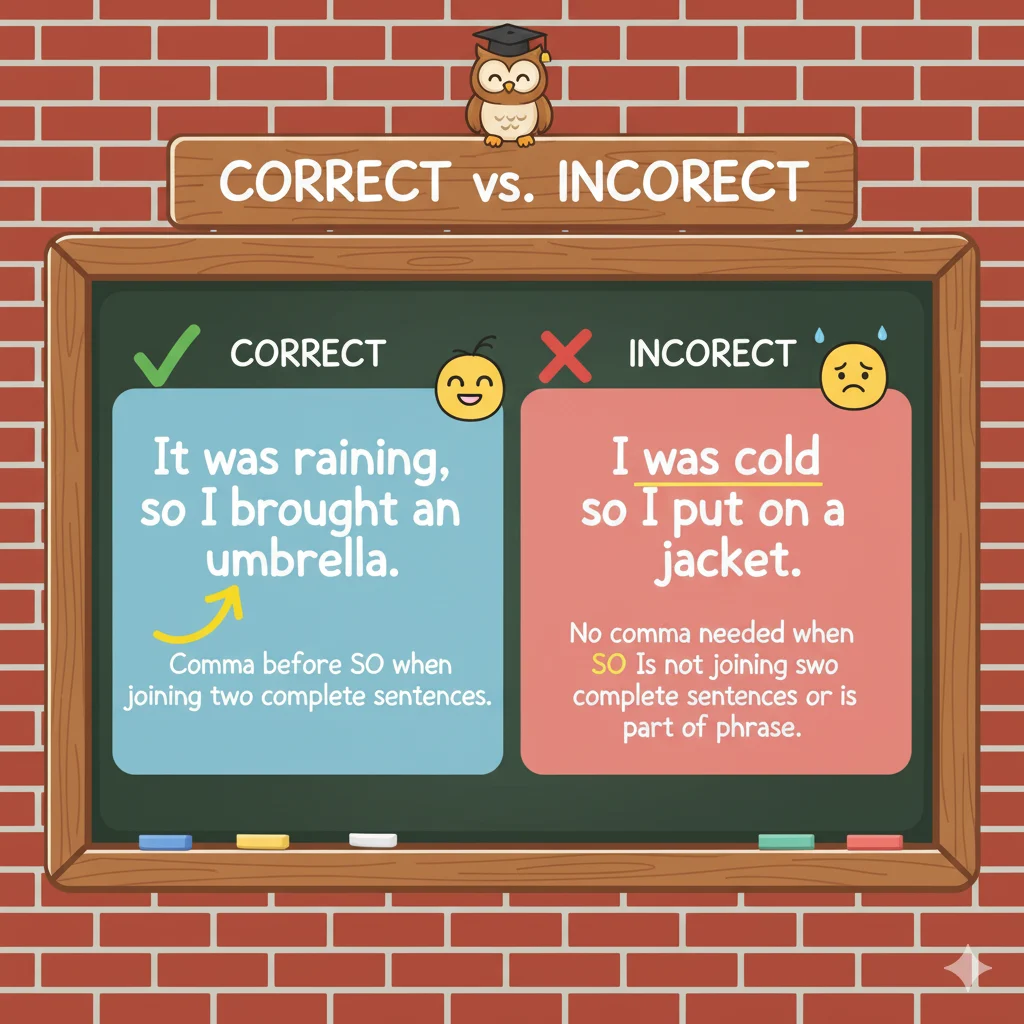
If “so” connects two complete sentences, put a comma before it.
If it only adds emotion or continues speech, skip the comma.
🚫 Common Mistakes and How to Avoid Them
Let’s look at some common errors with “so” and commas:
❌ Incorrect: I was tired so, I went to bed.
✅ Correct: I was tired, so I went to bed.
👉 Why? The comma should come before “so,” not after.
❌ Incorrect: So I went home.
✅ Correct: So, I went home.
👉 Why? When “so” starts a sentence, add a comma after it.
❌ Incorrect: I’m, so happy for you.
✅ Correct: I’m so happy for you.
👉 Why? No comma needed — “so” here only adds emotion.
✏️ When to Use a Comma Before “So”
Use a comma before “so” when it joins two complete thoughts (independent clauses).
Examples:
- I wanted ice cream, so I went to the store.
- He missed the bus, so he walked to school.
- It was raining, so we stayed inside.
- She studied hard, so she passed her exam.
- We ran out of time, so we skipped dessert.
🧠 Memory Trick:
If you can replace “so” with “therefore,” then add a comma before it.
I was tired, therefore I went to bed → I was tired, so I went to bed.
✍️ When NOT to Use a Comma Before “So”
Skip the comma when “so” shows degree, emotion, or emphasis, or when it connects a phrase — not two full sentences.
Examples:
- I’m so excited for your birthday!
- That dog is so cute!
- She’s so smart that everyone asks her for help.
- The movie was so long it felt endless.
- I’m so tired I could sleep for a week.
🧠 Memory Hack:
If “so” means very or extremely, don’t use a comma.
🔁 Quick Recap: Comma Before or After “So”
- ✅ Comma before “so” → when joining two full sentences.
Example: I was late, so I took a taxi. - ✅ Comma after “so” → when starting a new sentence.
Example: So, what do you think? - ❌ No comma → when “so” means very or extremely.
Example: She’s so kind.
Simple Rule:
👉 If “so” joins ideas, use a comma before it.
👉 If “so” adds feeling, skip the comma.
📚 Advanced Tips
🔹 In Formal Writing
It’s best to avoid starting sentences with “so” in essays or reports. Instead, use alternatives like “therefore” or “as a result.”
Example:
- Informal: So, we decided to leave early.
- Formal: Therefore, we decided to leave early.
🔹 In Texting or Conversations
It’s perfectly fine to start with “so” in casual chats.
Example:
- So, are you coming tonight?
🔹 Fun Fact
The word “so” has been used in English for over 1,000 years! Its use as a sentence starter became especially popular in modern speech and social media.
🧠 Mini Quiz: Test Your Knowledge!
Fill in the blanks with or without a comma:
- I was cold ___ I turned on the heater.
- ___ what are you doing later?
- I’m ___ hungry I could eat a horse.
- It started raining ___ we ran inside.
- ___ that’s how we met!
Answers:
- , so
- So,
- so
- , so
- So,
❓ FAQs
1. Do I need a comma before “so”?
Use a comma before “so” if it connects two complete ideas (independent clauses).
2. Should I put a comma after “so”?
Only when “so” begins a new sentence or thought — like “So, what happened next?”
3. Can I start a sentence with “so”?
Yes, especially in conversations or informal writing. Just add a comma after it.
4. What’s the difference between “so” and “therefore”?
Both show cause and effect, but “therefore” is more formal.
5. How do I know when not to use a comma with “so”?
If “so” means very or extremely (like “so happy”), skip the comma.
🪶 Conclusion
Now you know when to use a comma before or after “so”!
Remember the golden rule: if “so” connects two full ideas, add a comma before it. If it only adds emotion or starts a new sentence, skip or place the comma after it.
Practice a few examples each day — soon, using commas with “so” will feel natural and easy. Keep learning, keep improving, and enjoy mastering English one small rule at a time!

Isla Merrin is a language and writing expert at Definevs.com, creating simple, engaging guides to help readers master words, grammar, and modern English usage.