Have you ever paused while writing and wondered, “Should I put a comma before or after so?” 🤔 Don’t worry — you’re not alone! Many people get confused about comma before or after so because “so” can be used in different ways.
In this simple guide, we’ll explain the meaning, difference, and correct usage of commas before and after “so,” using easy grammar tips and examples. Whether you’re writing an essay, text message, or story, this lesson will help you understand when a comma is needed — and when it’s not. By the end, you’ll feel confident using “so” correctly every time! 🌟
💡 What Does “So” Mean?
The word “so” is a small but powerful connector. It joins ideas, shows cause and effect, or adds emphasis. Depending on its job in a sentence, you may or may not need a comma before it.
Let’s explore its main meanings:
1️⃣ “So” Showing Cause and Effect (Conjunction)
“So” can mean therefore or as a result.
Example:
- I was hungry, so I made a sandwich.
- She studied hard, so she passed the test.
- It was raining, so we stayed inside.
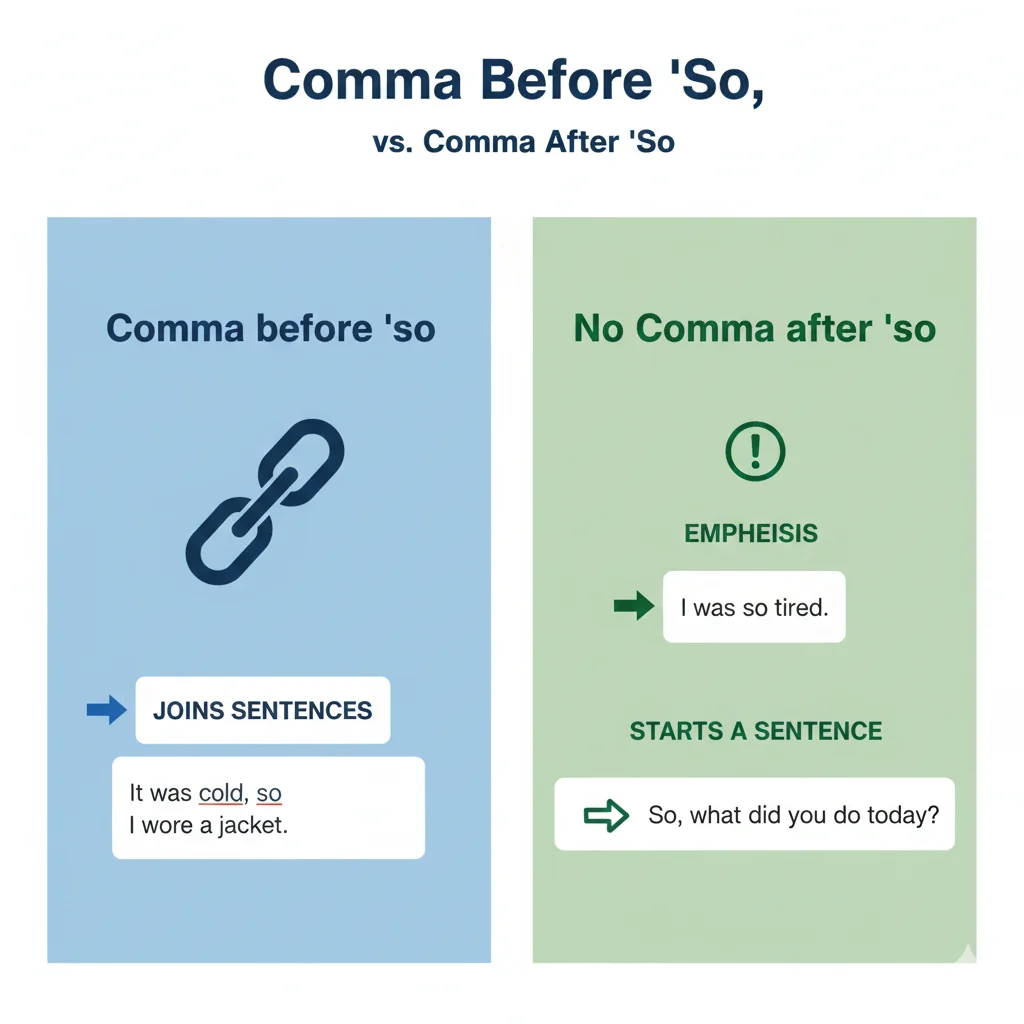
Here, “so” connects two complete sentences. Notice the comma before “so.”
2️⃣ “So” for Emphasis (Adverb)
“So” can also mean very or extremely.
Example:
- That movie was so funny!
- I’m so excited for my birthday.
- It’s so cold outside.
In these cases, there is no comma because “so” is just modifying an adjective or adverb.
🧠 The Key Difference Between “Comma Before” and “Comma After So”
Here’s a quick comparison to make things crystal clear 👇
| Use of “So” | Comma Needed? | Example Sentence | Explanation |
|---|---|---|---|
| When joining two complete sentences (cause & effect) | ✅ Yes, comma before “so” | I was tired, so I went to bed early. | Two independent clauses are connected. |
| When emphasizing (like very) | ❌ No comma | She was so happy to see her friend. | “So” modifies an adjective, not linking clauses. |
| When “so” starts a sentence | ❌ Usually no comma after | So I decided to try again. | It starts an idea; no comma after unless for pause or emphasis. |
| When “so” adds an afterthought | ✅ Sometimes comma after “so” | So, what are we doing today? | Used conversationally as a transition. |
✨ Quick Tip to Remember:
➡️ If “so” means therefore, put a comma before it.
➡️ If “so” means very or starts a sentence, no comma needed (except for style).
⚠️ Common Mistakes and How to Avoid Them
Let’s look at a few common mix-ups that happen with commas and “so.”
❌ Incorrect: I was late so, I missed the bus.
✅ Correct: I was late, so I missed the bus.
👉 Explanation: “So” joins two complete thoughts; the comma goes before it, not after.
❌ Incorrect: So, I’m so tired today.
✅ Correct: So I’m so tired today.
👉 Explanation: You don’t always need a comma after “so” when it starts a sentence — only use it for dramatic pause or emphasis in informal writing.
❌ Incorrect: She was, so, happy to see them.
✅ Correct: She was so happy to see them.
👉 Explanation: When “so” means very, it doesn’t take commas around it.
🧩 When to Use a Comma Before “So”
You should add a comma before “so” when it connects two complete sentences. Each part could stand alone with its own meaning.
Examples:
- It started to rain, so we went inside.
- She wanted to help, so she joined the team.
- I was late, so I took a taxi.
- He didn’t study, so he didn’t pass the exam.
- The cake looked delicious, so I tried a piece.
💡 Memory Hack:
If you can replace “so” with “therefore,” a comma goes before it!
🪄 When to Use a Comma After “So”
A comma after “so” is rare — but it’s okay in informal writing or speech when you want a pause or conversational tone.
Examples:
- So, what are we watching tonight?
- So, you finally made it!
- So, that’s how it ends.
- So, you agree with me?
- So, let’s get started!
These are usually used at the beginning of sentences to introduce ideas or continue conversations.
💭 Visual Trick:
Imagine “so” as a friendly hand wave before you speak — a comma after it gives a little pause.
🔁 Quick Recap: Comma Before or After “So”
Here’s a short and easy reminder list 📝
- ✅ Use a comma before “so” when joining two full sentences.
- ❌ No comma before “so” when it means very or extremely.
- ✅ Comma after “so” only when starting a casual sentence.
- ⚡ Replace “so” with “therefore” to test if a comma fits.
- 🎯 Keep writing natural — don’t overuse commas!
🌍 Advanced Tips: Grammar and Usage in Writing
📜 Origin: The word “so” comes from Old English swā, meaning “in this way.” It’s been used for centuries to connect thoughts and show results.
✍️ Formal Writing Tip: In essays or reports, use “so” carefully. You can often replace it with “therefore,” “thus,” or “consequently” for a more academic tone. Example:
- Informal: I missed the bus, so I was late.
- Formal: I missed the bus; therefore, I was late.
💬 In Texting: “So” is often used alone (“So… what now?”) to sound casual or dramatic — that’s fine in messages but avoid it in essays.
🎯 Mini Quiz — Test Your Understanding!
Fill in the blanks with or without commas.
- I was sleepy ___ so I went to bed early.
- ___ so what are you doing later?
- She was ___ so happy to meet them!
- We forgot the tickets ___ so we had to go back.
- ___ so let’s start the game!
✅ Answers:
- , so
- So,
- so
- , so
- So,
🌅 Conclusion
Using commas correctly with “so” is easier than it looks! 🎉 Just remember: if “so” connects two sentences, add a comma before it. If it means very or starts a new thought, usually no comma is needed.
Understanding comma before or after so helps your writing sound clear, natural, and professional. Practice a few sentences every day, and soon you’ll master it effortlessly. 🌟
❓ FAQs
1. Do you put a comma before “so”?
Yes, when “so” connects two full sentences, use a comma before it.
2. Do you need a comma after “so”?
Only in informal writing for a pause, like “So, what’s next?”
3. What if “so” means very?
Then no comma is needed — it’s just an adverb. Example: “I’m so happy!”
4. Is “so” a conjunction or an adverb?
It can be both — a conjunction (connecting sentences) or an adverb (showing degree).
5. What’s an easy way to remember?
If “so” = therefore → comma before it. If “so” = very → no comma.

Isla Merrin is a language and writing expert at Definevs.com, creating simple, engaging guides to help readers master words, grammar, and modern English usage.