Ever stared at your keyboard and wondered, “When do I use a colon, and when do I use a semicolon?” You’re not alone! Many people — even native English speakers — mix these two punctuation marks up. They look similar but serve different purposes in writing.
In this simple guide, you’ll learn:
- What a colon (:) and a semicolon (;) mean
- The difference between colon and semicolon
- How and when to use each correctly
- Common mistakes, easy examples, and quick memory tips
By the end, you’ll use both marks like a pro — whether for school essays, emails, or online writing.
🔍 What Does Each Punctuation Mark Mean?
✴️ What Is a Colon (:)?
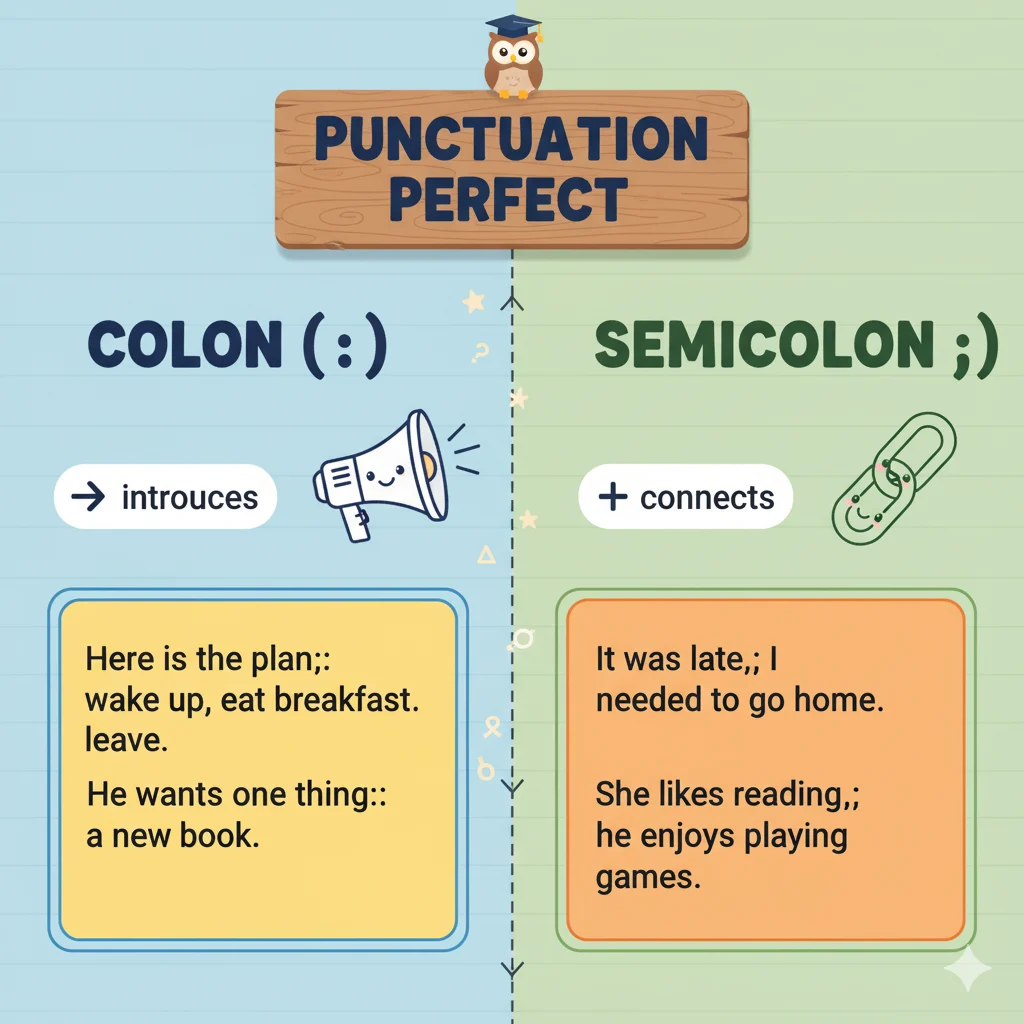
A colon is used to introduce something — like a list, explanation, or example.
It tells the reader, “Hey, what comes next explains or expands on what I just said.”
Part of speech: Punctuation mark (not a word — it connects ideas).
Examples:
- I bought three things: apples, oranges, and bananas.
- She had one goal: to win the race.
- Remember this: practice makes perfect.
Think of a colon like a drum roll 🥁 — it builds up to something important.
⚪ What Is a Semicolon (;)?
A semicolon is used to connect two related sentences or ideas.
It’s stronger than a comma but not as final as a period.
Part of speech: Punctuation mark connecting two related thoughts.
Examples:
- I love reading; it helps me relax.
- He didn’t study; he still passed the test.
- It’s raining outside; bring your umbrella.
A semicolon is like a soft stop — it links two complete thoughts that belong together.
⚖️ The Key Difference Between Colon and Semicolon
Here’s the simple difference:
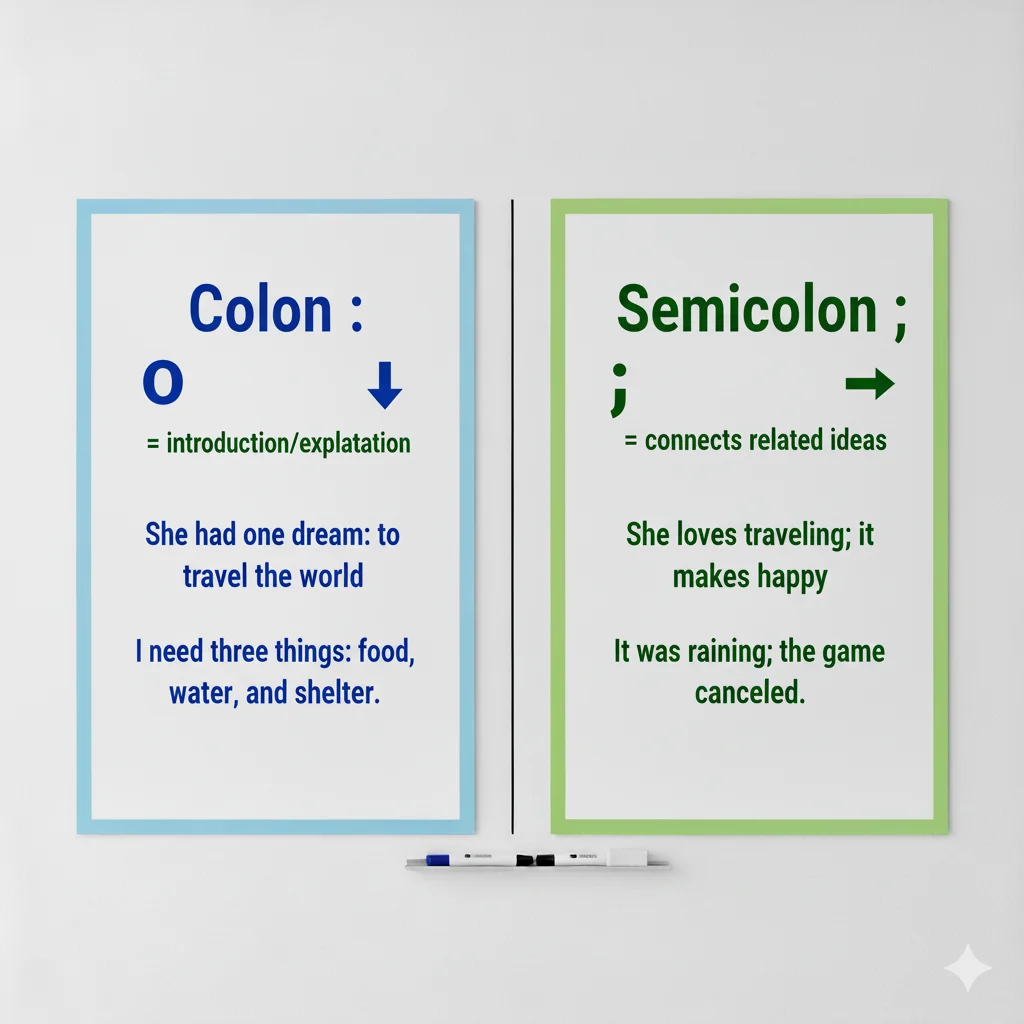
- Colon (:) → Introduces or explains something.
- Semicolon (;) → Connects related ideas.
| Feature | Colon (:) | Semicolon (;) |
|---|---|---|
| Main Purpose | Introduces lists, explanations, or details | Connects two related sentences |
| Sentence Before It | Usually complete | Always complete |
| Sentence After It | Can be a phrase, list, or full sentence | Must be a complete sentence |
| Example | She had one dream: to travel the world. | She loves traveling; it makes her happy. |
Quick Tip:
👉 If what follows is a list or explanation, use a colon.
👉 If it’s another complete idea, use a semicolon.
❌ Common Mistakes and How to Avoid Them
Let’s fix some of the most common mix-ups:
Mistake 1:
❌ I bought: apples, oranges, and bananas.
✅ I bought three things: apples, oranges, and bananas.
(You need a complete thought before a colon.)
Mistake 2:
❌ It was cold; and windy.
✅ It was cold and windy.
(Don’t use a semicolon before “and” — use a comma instead.)
Mistake 3:
❌ She loves reading: it’s her hobby.
✅ She loves reading; it’s her hobby.
(Use a semicolon here because both sides are complete sentences.)
Tip:
If both sides can stand alone as full sentences, use a semicolon.
If the second part explains the first, use a colon.
🕰️ When to Use a Colon (:)
Use a colon when you want to introduce, explain, or emphasize something.
✅ Examples of Correct Colon Usage:
- Before a list:
I need to buy: milk, eggs, and bread. - Before an explanation:
He finally understood why he failed: he hadn’t studied enough. - Before a quote:
She said it best: “Never give up on your dreams.” - For emphasis:
There’s only one thing you should remember: be kind. - In titles or time:
Meeting starts at 3:00 PM.
💡 Memory Hack:
A colon points forward → it says, “Look at what comes next!”
🕰️ When to Use a Semicolon (;)
Use a semicolon to join two closely related sentences or to separate complex items in a list.
✅ Examples of Correct Semicolon Usage:
- To join two related sentences:
The sky is clear; the stars are bright. - To contrast ideas:
He wanted to go out; she preferred to stay in. - To link cause and effect:
She worked hard; she got the promotion. - To separate long items in a list:
We visited Lahore, Pakistan; Dubai, UAE; and Paris, France.
💡 Memory Hack:
A semicolon links two ideas equally — like holding hands between two sentences.
🧠 Quick Recap: Colon vs Semicolon
- Colon (:) → Introduces or explains.
🟢 Example: She has one dream: to be a doctor. - Semicolon (;) → Connects related complete sentences.
🟢 Example: She wants to be a doctor; she studies very hard.
Easy Trick to Remember:
👉 Colon = clue (it gives more information)
👉 Semicolon = connection (it joins sentences together)
💡 Advanced Tips: For Writers and Students
- In formal writing, colons often appear before quotes, lists, and explanations.
- Semicolons are useful in academic writing or essays when connecting complex ideas smoothly.
- In texting or casual writing, people rarely use semicolons — but colons often show up in emojis (like
:-)). - Overusing semicolons can make writing sound stiff; use them sparingly.
- In exams, teachers often test these two marks because they’re easy to confuse — but now you know the difference!
✏️ Mini Quiz: Test Yourself!
Fill in the blanks with colon (:) or semicolon (;)
- I have one goal___ to finish this book.
- She loves ice cream___ she eats it every day.
- My favorite colors are___ blue, red, and green.
- It’s late___ we should go home.
- He said___ “You did a great job!”
Answers: 1: colon, 2: semicolon, 3: colon, 4: semicolon, 5: colon ✅
❓ FAQs About Colon and Semicolon
1. What’s the main difference between a colon and a semicolon?
A colon introduces or explains something; a semicolon joins two related complete sentences.
2. Can I use a semicolon instead of a colon?
No. A colon introduces, while a semicolon connects. Using the wrong one can confuse readers.
3. Is a semicolon stronger than a comma?
Yes. A semicolon creates a pause longer than a comma but shorter than a period.
4. Can I start a list with a semicolon?
No. Lists follow colons, not semicolons.
5. How can I remember the difference easily?
Think: Colon = Clue (explains next), Semicolon = Connection (joins ideas).
🏁 Conclusion
Now you know the difference between a colon and a semicolon — and when to use each.
A colon introduces something important, while a semicolon links related thoughts.
Practice using them in your writing, and soon it’ll feel natural.
Remember: good punctuation makes your writing clear, confident, and easy to read.
Keep learning, keep practicing, and you’ll master English punctuation — one mark at a time!

Kael Donovan is a language enthusiast and writer at Definevs.com, simplifying complex words and grammar rules into fun, easy-to-understand guides for readers.