Have you ever looked at a colon (:) or a semicolon (;) and wondered, “Wait… which one should I use here?” 😕 Don’t worry — you’re not alone! Many English learners (and even native speakers!) mix up these two punctuation marks.
This easy guide will help you finally understand the difference between colon and semicolon, their correct usage, and lots of examples that even a 4th grader can follow. You’ll learn when to use each mark, how to remember their rules, and how they make your writing more clear and powerful. 🖊️
By the end, you’ll be using colons and semicolons like a grammar pro — with confidence! 💪
📘 What Does Each Punctuation Mark Mean?
Let’s start simple — before learning the difference, we need to know what each mark actually does.
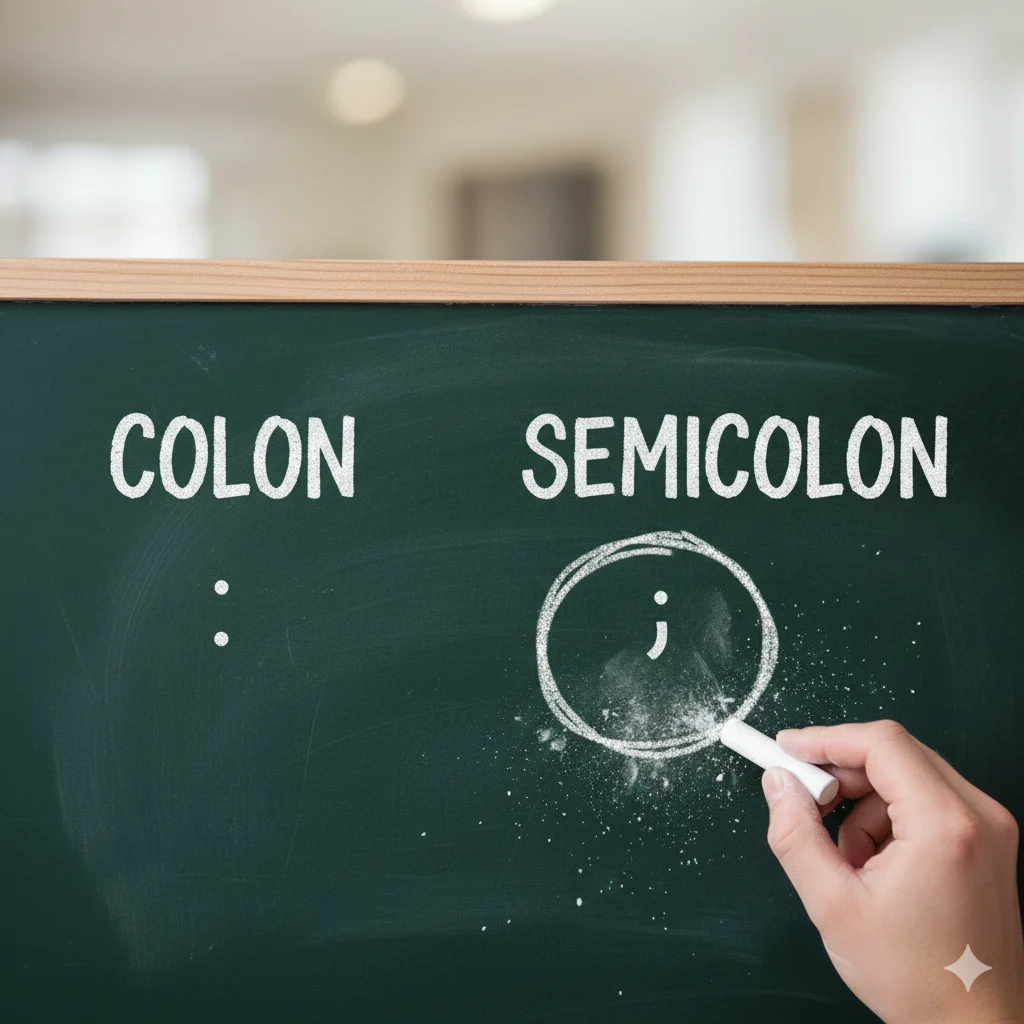
✴️ Colon (:) — The Introducer
A colon (:) is used to introduce something: a list, an explanation, or an example. Think of it as saying, “Here it comes!”
Part of Speech: It’s a punctuation mark, not a word.
Meaning: It introduces or explains what comes next.
3 Easy Examples:
- I have three pets: a dog, a cat, and a rabbit.
- Remember the rule: always be kind.
- She brought everything she needed: paper, pencils, and paint.
💡 Memory Trick: A colon likes to “announce” or “introduce” something important!
❇️ Semicolon (;) — The Connector
A semicolon (;) connects two related but complete sentences. It’s stronger than a comma but weaker than a period.
Meaning: It links ideas that are closely connected in meaning.
3 Easy Examples:
- It’s raining; we should stay inside.
- I love tea; my sister prefers coffee.
- He didn’t study; however, he still passed.
💡 Memory Trick: A semicolon is like a bridge — it connects two ideas that belong together. 🌉
📊 The Key Difference Between Colon and Semicolon
Here’s a quick comparison to make it super easy to understand 👇
| Feature | Colon (:) | Semicolon (;) |
|---|---|---|
| Purpose | Introduces or explains something | Connects two related sentences |
| Think of it as | Saying “Here’s what I mean” | Saying “These two ideas go together” |
| Example | I have one goal: to win. | I was tired; I went to bed early. |
| Used before a list? | ✅ Yes | ❌ No |
| Used to link ideas? | ❌ Not usually | ✅ Yes |
💭 Quick Tip:
👉 Use a colon to show what comes next.
👉 Use a semicolon to join related ideas that could be two separate sentences.

🚫 Common Mistakes and How to Avoid Them
Let’s fix some everyday errors 👇
❌ Incorrect: I like fruits; apples, bananas, and grapes.
✅ Correct: I like fruits: apples, bananas, and grapes.
(Why? Because you’re introducing a list — use a colon!)
❌ Incorrect: I went to school: I was late.
✅ Correct: I went to school; I was late.
(Why? These are two complete sentences — use a semicolon!)
❌ Incorrect: Here’s what I bought; milk, bread, and eggs.
✅ Correct: Here’s what I bought: milk, bread, and eggs.
💡 Rule of Thumb: If you can replace it with a period, use a semicolon. If you’re introducing something, use a colon.
🟡 When to Use a Colon (:)
Colons are great for showing that something important is coming next. Use them to:
- Introduce a list:
- We packed for the trip: snacks, water, and sunscreen.
- Introduce an explanation or reason:
- She had one wish: to see the ocean.
- Introduce a quote:
- My teacher always said: “Never stop learning.”
- Separate title and subtitle:
- Grammar Made Easy: A Guide for Beginners.
- Emphasize something:
- Only one thing mattered: winning.
💡 Visual Trick: Think of a colon as a drum roll before the big reveal! 🥁
🔵 When to Use a Semicolon (;)
Semicolons connect ideas that belong together. Use them when:
- Joining two complete sentences without ‘and’ or ‘but’:
- The storm passed; the sun came out.
- Before linking words like however, therefore, or meanwhile:
- She was tired; however, she finished the project.
- When your list already includes commas:
- I’ve been to Lahore, Pakistan; Paris, France; and Tokyo, Japan.
- To show close connection:
- He loves soccer; his brother prefers cricket.
💡 Memory Hack: The semicolon is a “soft stop” — not as final as a period, not as light as a comma. ⚖️
📎 Quick Recap: Colon vs Semicolon
Here’s a simple summary to lock it in your mind 🧠
- ✅ Colon (:) → Introduces or explains.
- ✅ Semicolon (;) → Connects related ideas.
- ❌ Don’t use colons before every list (only after a complete sentence).
- ⚡ Semicolons work best when two thoughts are closely related.
Mini Example Recap:
- Colon → “She knew one thing: she had to try.”
- Semicolon → “She was nervous; she still smiled.”
🧠 Advanced Tips for Curious Learners
✨ Origin:
Both marks come from ancient Greek punctuation systems used in the 1400s — the colon for “announcement,” and the semicolon for “connection.”
📘 In formal writing:
- Use colons in essays, reports, and resumes to introduce examples or explanations.
- Use semicolons in academic or creative writing to show complex relationships between ideas.
📱 In texting or casual writing:
- People sometimes skip semicolons, but using them correctly shows strong grammar skills.
- Example: “I’m tired; let’s rest” looks smarter than “I’m tired, let’s rest.”
🧩 Mini Quiz — Test Your Knowledge!
Fill in the blanks with a colon (:) or semicolon (;)
- I know what I want ___ peace and quiet.
- It’s raining outside ___ we can’t play football.
- He brought his tools ___ hammer, nails, and saw.
- She was shy ___ her friend was very outgoing.
- My dream is simple ___ to be happy.
- We traveled to Rome, Italy ___ Madrid, Spain.
- Here’s the truth ___ I forgot my homework!
(Answers: 1: colon, 2: semicolon, 3: colon, 4: semicolon, 5: colon, 6: semicolon, 7: colon)
💬 FAQs
1. What is the difference between a colon and a semicolon?
A colon introduces or explains, while a semicolon connects related sentences.
2. Can I use a colon instead of a semicolon?
No. They serve different purposes — a colon introduces, a semicolon joins.
3. How do I know when to use a semicolon?
If both parts could be sentences on their own, use a semicolon to connect them.
4. Should I capitalize after a colon?
Only if what follows is a full sentence or a proper noun.
5. Why do writers use semicolons in essays?
They make writing smoother by connecting related ideas clearly.
✨ Conclusion
Now you know the difference between colon and semicolon, when to use each, and how to remember their roles easily. The colon introduces, and the semicolon connects — that’s your golden rule! 🌟
Keep practicing with your own examples, and soon your writing will be clear, polished, and professional. Remember, great writing isn’t about using fancy words — it’s about using the right punctuation in the right place. 🖋️
💬 Keep learning, keep writing, and let your grammar shine every day!

Arwen Blythe is a passionate language and culture enthusiast, crafting clear, engaging guides on words, phrases, and modern English for Definevs.com readers.