Have you ever paused before typing and wondered — is it “cancelled” or “canceled”? 🤔
You’re not alone! This is one of the most common spelling confusions in English. Both words look right, both are used widely, and even spellcheckers sometimes accept either version.
So which one should you use?
In this simple guide, you’ll learn:
- The meaning of “cancelled” and “canceled”
- The difference between them
- When to use each spelling
- Examples, grammar tips, and a quick way to remember the rule
By the end, you’ll never mix them up again — promise!
📚 What Does Each Word Mean?
Let’s start with the basics. Both “cancelled” and “canceled” come from the verb “cancel,” which means to stop something that was planned from happening.
✴️ Meaning of “Canceled”
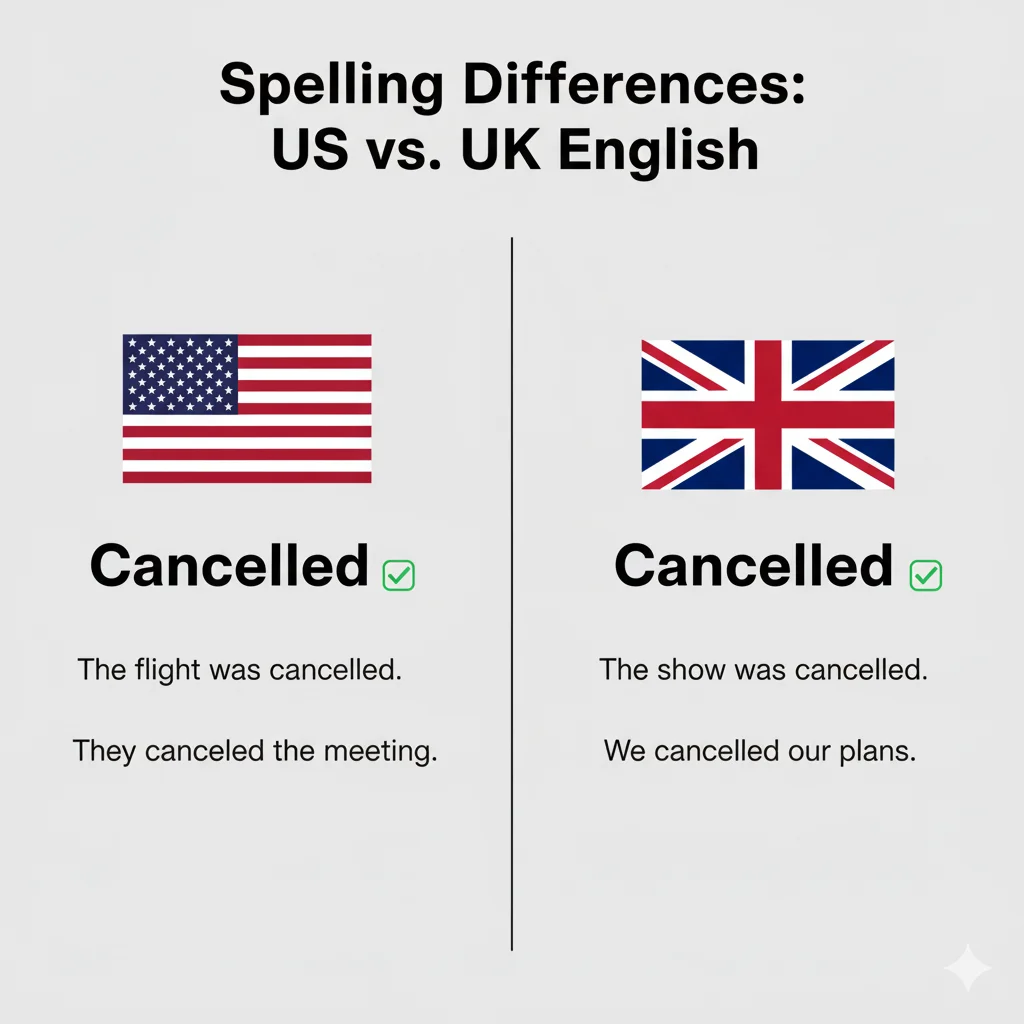
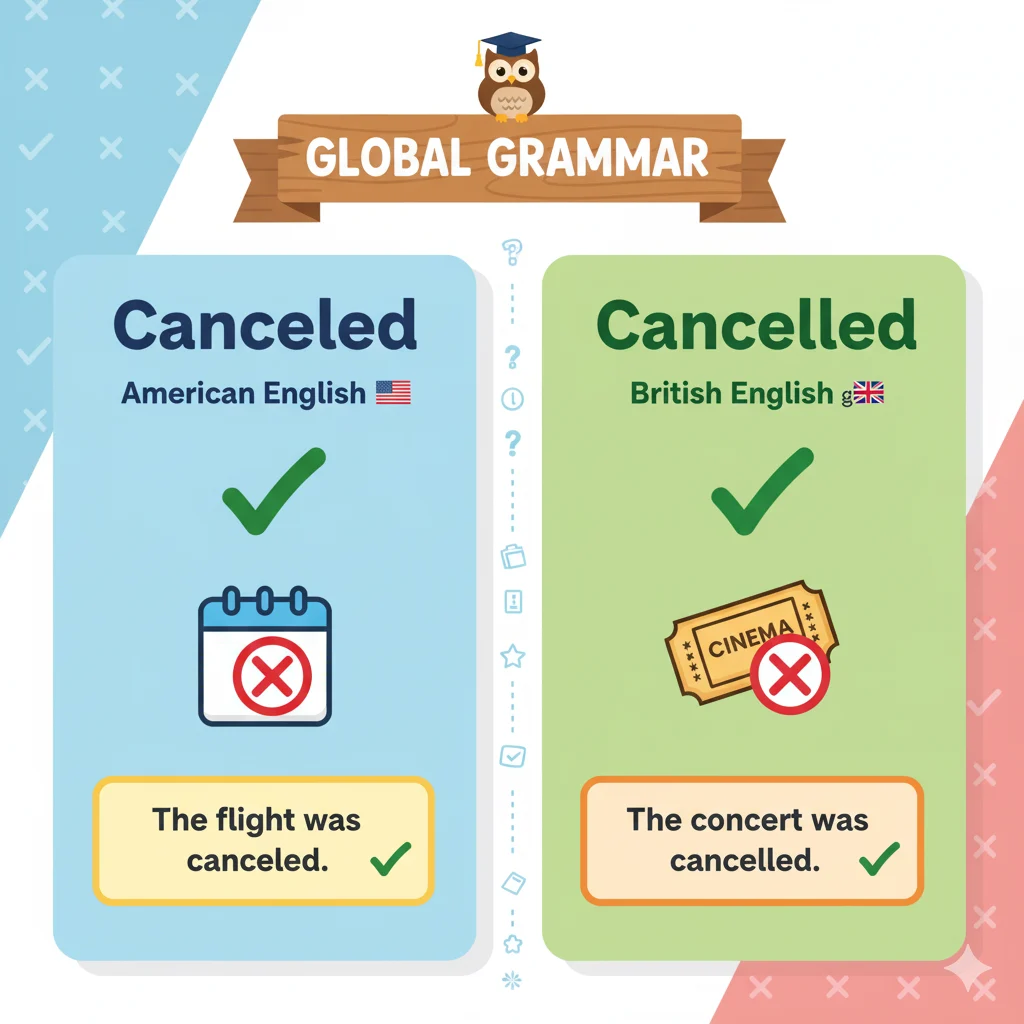
“Canceled” is the American English spelling of the past tense of cancel.
It’s used mainly in the United States.
Examples:
- The class was canceled because of heavy rain.
- My flight got canceled last night.
- She canceled her gym membership.
✴️ Meaning of “Cancelled”
“Cancelled” is the British English spelling of the same word.
It’s common in the UK, Canada, Australia, and other Commonwealth countries.
Examples:
- The football match was cancelled due to bad weather.
- Our train got cancelled, so we had to take a taxi.
- He cancelled his trip to London at the last minute.
💡 Both mean the exact same thing — the only difference is spelling.
⚖️ The Key Difference Between “Cancelled” and “Canceled”
Here’s a quick and easy way to compare the two:
| Feature | Canceled | Cancelled |
|---|---|---|
| Used in | American English | British English |
| Spelling pattern | Single “L” | Double “L” |
| Example sentence | The meeting was canceled. | The meeting was cancelled. |
| Correct in | USA | UK, Canada, Australia |
| Meaning | Same – past tense of cancel | Same – past tense of cancel |
✅ Quick Tip to Remember:
If you’re writing for an American audience, use canceled (one L).
If you’re writing for a British or international audience, use cancelled (two Ls).
🚫 Common Mistakes and How to Avoid Them
Even fluent English speakers get this wrong! Let’s look at some common mix-ups.
❌ Incorrect: The concert was canceling tomorrow.
✅ Correct: The concert is being canceled tomorrow.
👉 Reason: “Canceling” or “cancelled” are used with proper tense forms.
❌ Incorrect: I cancelled my flight to New York. (in U.S. English writing)
✅ Correct: I canceled my flight to New York.
👉 Reason: American English uses single “L.”
❌ Incorrect: The match got canceled because of rain. (in British writing)
✅ Correct: The match got cancelled because of rain.
👉 Reason: British English uses double “L.”
💡 Grammar Tip:
If you’re writing for a global audience, both are technically correct — just be consistent throughout your writing!
🎓 Bachelor’s Degree or Bachelors Degree: What’s the Correct Way to Write It?
🗓️ When to Use “Canceled”
Use “canceled” if you’re writing in American English — like in U.S. schools, business communication, or websites targeting U.S. readers.
Examples:
- The teacher canceled the quiz.
- My doctor’s appointment was canceled.
- They canceled the meeting after the manager left.
- Our favorite show got canceled after one season.
- The parade was canceled because of rain.
🧠 Memory Trick:
“America” has one L in it → Canceled (one L) = American spelling.
🌍 When to Use “Cancelled”
Use “cancelled” in British English and other Commonwealth-style writing — used in the UK, Canada, India, Australia, and more.
Examples:
- The wedding was cancelled due to illness.
- Our holiday was cancelled at the last minute.
- The headteacher cancelled today’s assembly.
- The train service was cancelled because of snow.
- He cancelled his plans to stay home.
🧠 Memory Trick:
“Britain” has two syllables, so think two Ls → cancelled.
🧾 Quick Recap: Cancelled vs Canceled
Here’s a short and easy summary to remember:
- Canceled (1 L) → American English
- Cancelled (2 Ls) → British English
- Both mean: “to stop something from happening”
- Be consistent! Don’t mix both spellings in one piece of writing.
- Tip: Always check your audience before deciding which one to use.
⚖️ Totaled, Totaling, or Totalling — What’s the Difference and Which One Is Correct?
💡 Advanced Tips
- The verb form “cancel” comes from Latin cancellare, meaning “to make crossed lines” (like canceling out something).
- In formal essays or international documents, either version works as long as you use it consistently.
- In online writing or social media, people often don’t mind — but official documents and schools do care.
- Some other words follow the same pattern:
- Travelled / Traveled
- Modelled / Modeled
- Fuelled / Fueled
So, if you understand this rule, you’ll also understand many other similar spelling differences!
✏️ Mini Quiz — Test Yourself!
Choose the correct word for each blank:
- The flight was __________ because of bad weather.
- Our teacher __________ the test for next week.
- The football game got __________ due to rain.
- My meeting was __________, so I went home early.
- She __________ her trip to London.
Answers:
- Canceled / Cancelled (both correct depending on region)
- Canceled / Cancelled
- Cancelled (British)
- Canceled (American)
- Cancelled (British)
🧠 5 FAQs About “Cancelled” vs “Canceled”
1. What’s the main difference between “cancelled” and “canceled”?
They mean the same thing. The only difference is spelling: “canceled” (US) and “cancelled” (UK).
2. Which one is grammatically correct?
Both are correct — it depends on whether you’re using American or British English.
3. Is “cancelled” old-fashioned?
No, it’s still standard in British and Commonwealth countries today.
4. Which is used more worldwide?
“Cancelled” appears more in international writing, but “canceled” dominates U.S. media and publications.
5. Can I use both in the same document?
It’s best not to. Pick one version and stay consistent throughout your writing.
🏁 Conclusion
Now you know the truth behind “cancelled” vs “canceled.”
Both spellings are correct — they just belong to different styles of English. Remember:
- Canceled = American English
- Cancelled = British English
Use this rule, stay consistent, and your writing will always look polished and professional.
Keep practicing your English every day — small steps like this make a big difference! 🌟

Mira Loxley is a passionate language and writing expert at Definevs.com, turning tricky words and grammar into clear, engaging guides for every reader.