Have you ever come across the words buyback and lemon when talking about cars and wondered what they mean? 🤔 Many people confuse these two terms because both are used in the context of vehicles, especially when something goes wrong with a car. But don’t worry — this guide will make everything crystal clear!
In this article, you’ll learn the difference between buyback and lemon, their meanings, correct usage in sentences, and some simple tips to remember which is which. Whether you’re a student, a new driver, or just curious about English expressions, you’ll find this easy and fun to understand. 🚗💡
🧠 What Does Each Word Mean?
Let’s start by breaking down both words in the simplest way possible.
🚘 Buyback — Meaning and Usage
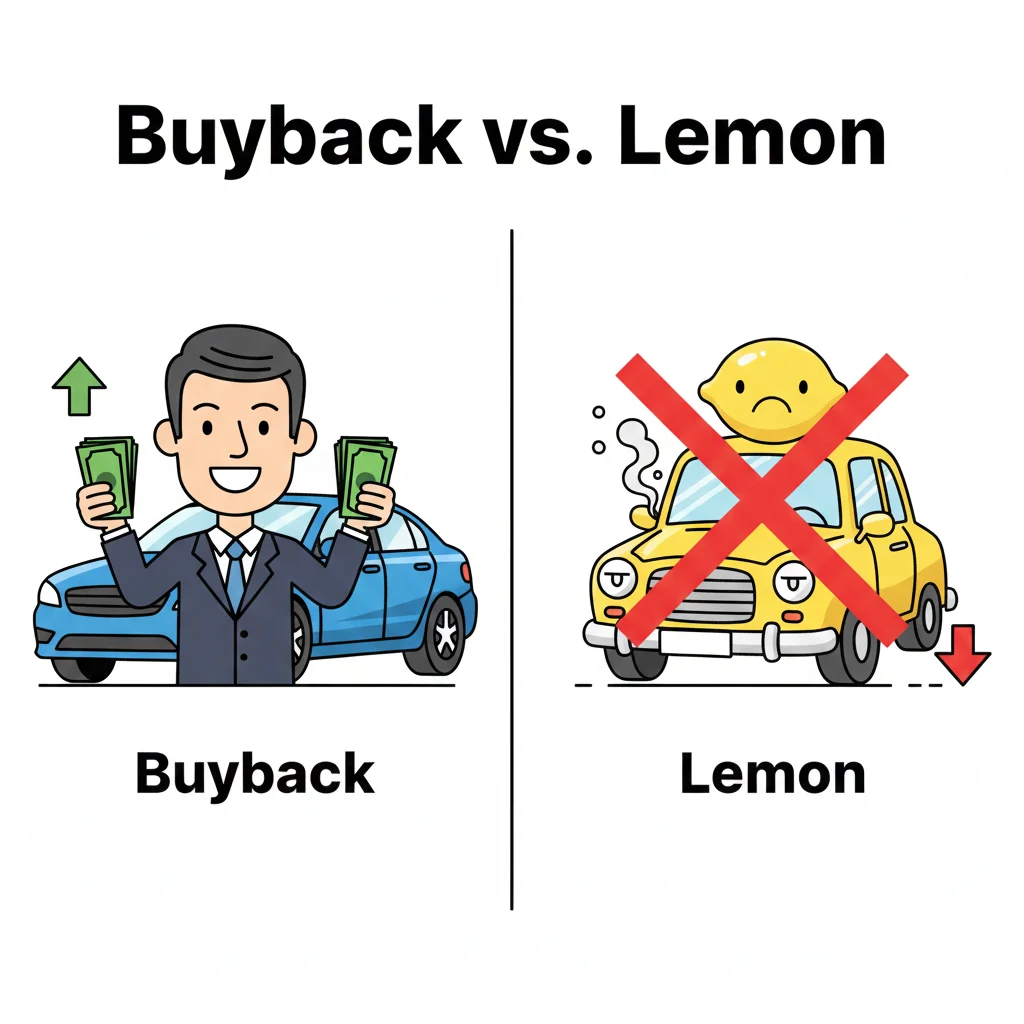
A buyback is when a company or dealer buys something back from a customer. The word comes from “buy” + “back”, meaning to repurchase. In car terms, a buyback car is a vehicle that the manufacturer has taken back from the owner, often because of repeated problems or recalls.
Part of Speech: Noun / Verb (depending on use)
Examples:
- The company offered a buyback on the defective model.
- Apple has a buyback program for old iPhones.
- The manufacturer decided to buy back the faulty vehicles.
🧩 In short: A buyback happens when the seller takes the product back — usually to replace, fix, or refund it.
🍋 Lemon — Meaning and Usage
A lemon is a slang term used to describe a bad product, especially a car with many problems. When someone buys a “lemon,” it means the item doesn’t work properly or keeps breaking down.
Part of Speech: Noun
Examples:
- The car looked perfect but turned out to be a lemon.
- I bought a phone that keeps freezing — it’s a lemon!
- No one wants to spend money on a lemon vehicle.
🧩 In short: A lemon is a product, especially a car, that has serious faults.
⚖️ The Key Difference Between Buyback and Lemon
Here’s a simple table to help you quickly see the difference between the two words:
| Feature | Buyback | Lemon |
|---|---|---|
| Meaning | When a manufacturer or company buys back a product | A defective product, especially a car with many problems |
| Part of Speech | Noun / Verb | Noun |
| Used For | The act of returning or repurchasing | Describing a bad product |
| Example Sentence | “The dealer offered a buyback for my car.” | “This old car is a total lemon!” |
| Key Idea | The action of taking back | The faulty product itself |
💡 Quick Tip to Remember:
If the company takes it back → Buyback
If the product keeps breaking → Lemon

❌ Common Mistakes and How to Avoid Them
Many English learners mix these two up because both are linked to faulty products. Here’s how to avoid that confusion:
⚠️ Mistake 1
❌ “My car was a buyback, it broke down again.”
✅ Correct: “My car was a lemon, it broke down again.”
📝 Explanation: A “buyback” isn’t a broken car — it’s what the company does with it.
⚠️ Mistake 2
❌ “I had a lemon offer from the company.”
✅ Correct: “I had a buyback offer from the company.”
📝 Explanation: Only “buyback” fits when a company offers to repurchase something.
🚗 When to Use “Buyback”
Use buyback when you’re talking about a situation where a company or dealer repurchases an item from a customer — often due to issues, recalls, or product programs.
Examples:
- The dealer announced a buyback program for old models.
- The company will buy back defective laptops from users.
- He got a full refund through the buyback policy.
- Tesla initiated a buyback after multiple software errors.
- The government sometimes offers buybacks for outdated vehicles.
💡 Memory Hack:
Think of buyback as “they buy it back from you.” The word literally tells you what it means!
🍋 When to Use “Lemon”
Use lemon when describing something that doesn’t work properly — often used for cars, electronics, or appliances that are disappointing or broken.
Examples:
- That new washing machine is a total lemon.
- Don’t buy that used car; it’s a lemon!
- The phone stopped working a week after I bought it — a real lemon.
- He returned the lemon laptop for a replacement.
- The company was sued for selling lemon vehicles.
💡 Memory Hack:
Think of a lemon’s sour taste — unpleasant, disappointing, and not what you expected! 🍋
🪄 Quick Recap: Buyback vs Lemon
Here’s an easy way to remember everything:
- Buyback = Company takes the product back.
- Lemon = The product itself is bad.
- Buyback is an action, lemon is a thing.
- Buyback happens after realizing something is wrong.
- Lemon describes the faulty product from the start.
✅ Example Combo:
“The car was a lemon, so the company offered a buyback.”
Perfect sentence, right? You just used both correctly! 🎯
🏛️ Advanced Tips: History and Real-Life Use
🔹 The word “lemon” for “bad product” has been used since the early 1900s in the U.S. It comes from the idea that lemons are sour and unpleasant — just like a disappointing product.
🔹 “Buyback” became common in business and auto industries, referring to programs where a company repurchases its goods to maintain quality or customer trust.
📚 Formal Writing Tip:
In essays or business reports, use buyback formally (e.g., “corporate buyback policy”), while lemon is informal and more common in conversation or media.
📱 Online Use:
People often write things like “This phone is a lemon!” in reviews. In customer service emails, you might read: “We’re offering a buyback for affected units.”
🧩 Mini Quiz — Test Your Understanding!
Fill in the blanks with buyback or lemon:
- The car broke down five times; it’s a ________.
- The company started a ________ program for recalled items.
- My laptop was a total ________, it never worked right.
- The dealer offered a full ________ after complaints.
- Customers returned several ________ phones last month.
- The manufacturer launched a ________ to maintain trust.
- The old TV was such a ________, we gave it away.
(Answers: 1. lemon 2. buyback 3. lemon 4. buyback 5. lemon 6. buyback 7. lemon)
🏁 Conclusion
Now you know the clear difference between buyback and lemon! 🚗🍋
A buyback is when a company takes something back, while a lemon is the faulty product itself. These words often appear in car discussions, but they can apply to many products. Understanding them helps you use English more accurately and confidently.
Next time you hear someone say, “My car was a lemon,” you’ll know exactly what they mean — and you might even say, “Did the company offer a buyback?” 😉
Keep practicing, keep learning, and you’ll soon master even the trickiest word pairs! 🌟
❓ FAQs
1. What does “buyback” mean in simple words?
It means when a company buys back or repurchases a product, often because of issues or recalls.
2. What does “lemon” mean in slang?
A “lemon” is a product, especially a car, that doesn’t work well or keeps breaking.
3. Can a lemon car be part of a buyback?
Yes! If a car is a lemon, the company may offer a buyback to fix or refund it.
4. Is “lemon” a negative word?
Yes — it describes something faulty, disappointing, or not worth the money.
5. How can I remember the difference easily?
Think: Lemon = Sour product, Buyback = They buy it back! 🍋💰

Kael Donovan is a language enthusiast and writer at Definevs.com, simplifying complex words and grammar rules into fun, easy-to-understand guides for readers.