Have you ever wondered whether it’s busing or bussing? 🤔
If you’ve seen both spellings, you’re not alone — even native English speakers mix them up! These two words look almost identical, but their meanings and uses can differ depending on the situation.
In this simple guide, you’ll learn:
- What busing and bussing each mean
- The difference between busing and bussing
- How to use them correctly in sentences
- Common mistakes and how to avoid them
- Fun memory tricks to remember the correct spelling
By the end, you’ll never confuse busing and bussing again — promise!
🧠 What Does Each Word Mean?
Let’s start with the basics — both busing and bussing come from verbs, but they’re used in slightly different ways depending on meaning and region.
Busing – One “s”
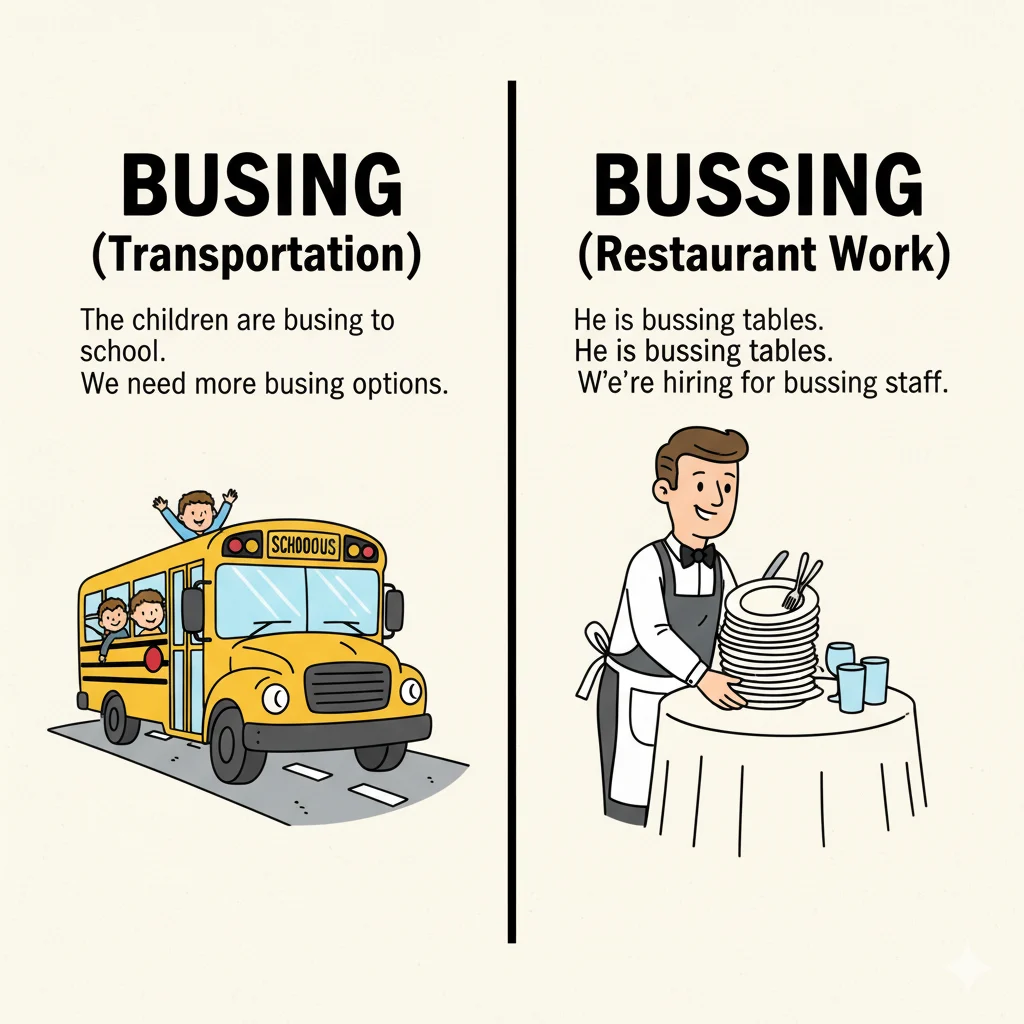
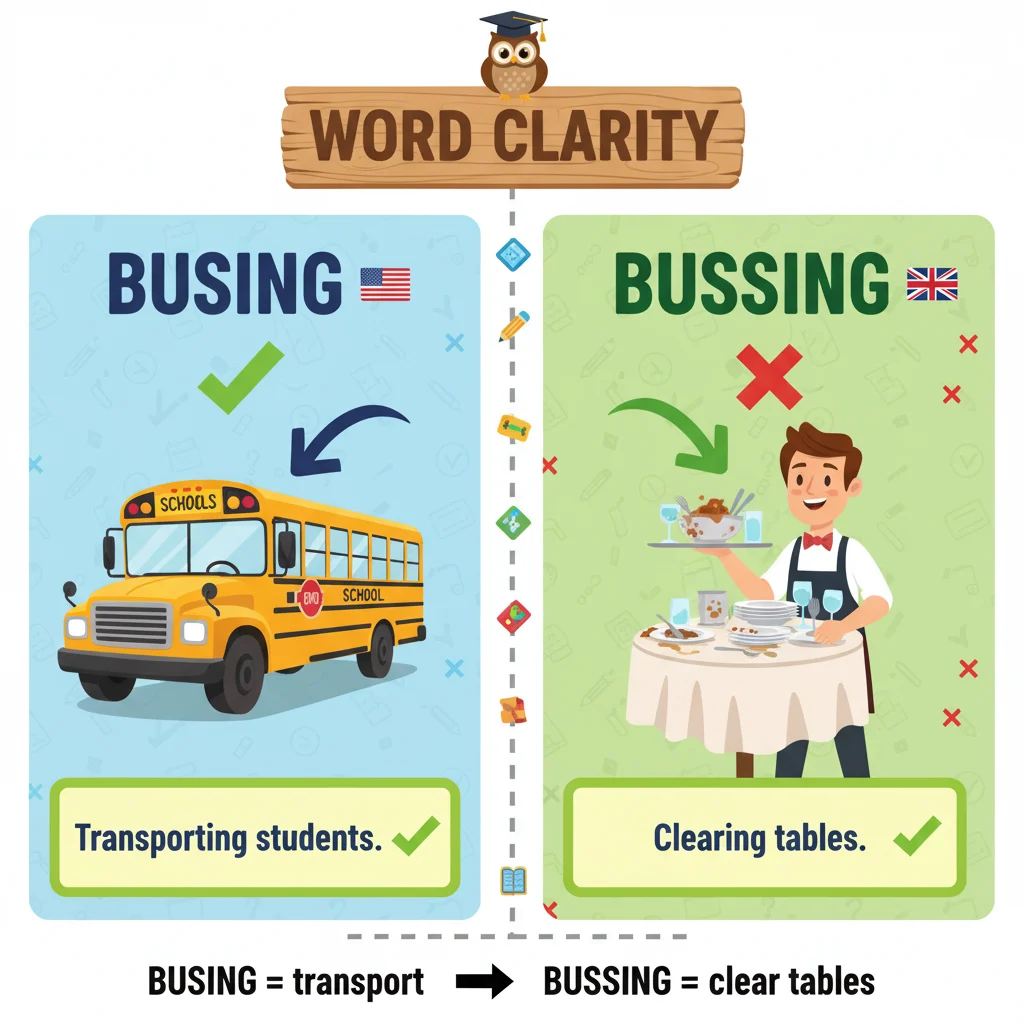
Busing is the correct spelling when talking about transporting people by bus.
It comes from the verb “to bus.”
Part of speech: Verb (present participle)
Meaning:
To transport someone by bus.
Examples:
- The school started busing students after the snowstorm.
- Workers are bused to the construction site every morning.
- The company is busing employees from the hotel to the venue.
Bussing – Double “s”
Bussing can mean two different things:
- To clear tables in a restaurant.
- (Less commonly) To kiss someone — from the old-fashioned word “buss.”
Part of speech: Verb (present participle)
Meanings:
- To clear used dishes or tables.
- To kiss someone (rare/old-fashioned).
Examples:
- The waiter is bussing tables after lunch.
- She was caught bussing her child goodbye.
- The staff is busy bussing dishes to the kitchen.
⚖️ The Key Difference Between Busing and Bussing
Here’s a simple breakdown of how they differ:
| Word | Meaning | Part of Speech | Example Sentence |
|---|---|---|---|
| Busing | Transporting people by bus | Verb | The city began busing passengers to the new terminal. |
| Bussing | Clearing tables or (rarely) kissing | Verb | The waiter was bussing tables after dinner. |
Quick Tip to Remember:
👉 If it’s about buses, use one “s.”
👉 If it’s about tables or kisses, use two “s.”
🚫 Common Mistakes and How to Avoid Them
Even advanced learners mix these up because both sound the same! Let’s look at some common mix-ups:
❌ Incorrect:
- The school started bussing students this year.
✅ Correct: - The school started busing students this year.
❌ Incorrect:
- The restaurant is busing tables quickly.
✅ Correct: - The restaurant is bussing tables quickly.
Why it happens:
Since both are pronounced “BUH-sing,” it’s easy to use the wrong spelling.
How to fix it:
Think of the extra “s” in “bussing” as the extra work of clearing tables.
🚌 When to Use “Busing”
Use busing when talking about transportation by bus.
It’s commonly used in schools, cities, companies, and events that involve travel.
Examples:
- The government is busing people to the vaccination center.
- The students are bused home after class.
- They began busing fans to the concert venue.
- Our company is busing staff to the training site.
- Public busing systems are essential for large cities.
Memory Hack:
👉 Think of “bus” — keep only one “s” when it’s about travel.
🍽️ When to Use “Bussing”
Use bussing when referring to clearing tables or, rarely, kissing (in older English).
You’ll often see it in restaurant settings or casual old-fashioned writing.
Examples:
- The waiter is bussing dishes between tables.
- She got a part-time job bussing tables after school.
- The restaurant staff is bussing the banquet hall.
- The old movie showed a couple bussing goodbye.
- After the rush hour, everyone helps with bussing tables.
Memory Trick:
👉 The word “bussing” has two “s” — like two dishes you’re carrying to clear a table!
🔁 Quick Recap: Busing vs Bussing
Here’s a super simple summary to help you remember:
- Busing = Bus transportation (one “s”)
- Bussing = Clearing tables or kissing (two “s”)
- Both sound the same, but meaning and spelling depend on context.
✅ In short:
- If it involves travel, spell it busing.
- If it involves restaurants or romance, spell it bussing.
📚 Advanced Tips and Background
- Origin:
“Bus” comes from omnibus, a Latin term meaning “for all.”
“Buss” (as a kiss) is an older English word dating back to the 16th century. - American vs British English:
In both American and British English, busing (one “s”) is correct for transportation.
“Bussing” for table-clearing is common everywhere. - In formal writing:
Always use busing when referring to transportation.
Avoid using bussing for “kissing” — it sounds old-fashioned in modern writing. - In texting or casual language:
People rarely use “bussing” for kissing anymore, but you may see slang like “bussin’” (meaning “really good” or “tasty”) — which is totally different and modern slang.
📝 Mini Quiz: Test Your Understanding!
Fill in the blanks with busing or bussing.
- The city started _______ residents to the festival grounds.
- The waiter is _______ the empty dishes from the tables.
- Our school provides free _______ for students in rural areas.
- After dinner, he began _______ tables to help the staff.
- The company is _______ employees from the hotel to the office.
✅ Answers: 1. busing, 2. bussing, 3. busing, 4. bussing, 5. busing.
❓ FAQs
1. What is the main difference between busing and bussing?
“Busing” means transporting by bus, while “bussing” means clearing tables or kissing.
2. Which is correct: busing or bussing?
Both are correct — but their meanings differ. Use busing for transportation and bussing for table clearing.
3. Is bussing a real word?
Yes! It means clearing tables in restaurants or, in older usage, kissing someone.
4. Can I use bussing for buses?
No. Always use busing (one “s”) when referring to transportation.
5. Why do both words sound the same?
Because they come from different roots but share a similar pronunciation — context tells you which one fits.
🏁 Conclusion
Now you know the difference between busing and bussing!
Remember — busing (one “s”) is for transportation, while bussing (two “s”) is for tables or old-fashioned kissing.
With these examples, tricks, and tips, you’ll never mix them up again.
Keep practicing — every word you learn brings you closer to mastering English! 🌟

Arwen Blythe is a passionate language and culture enthusiast, crafting clear, engaging guides on words, phrases, and modern English for Definevs.com readers.