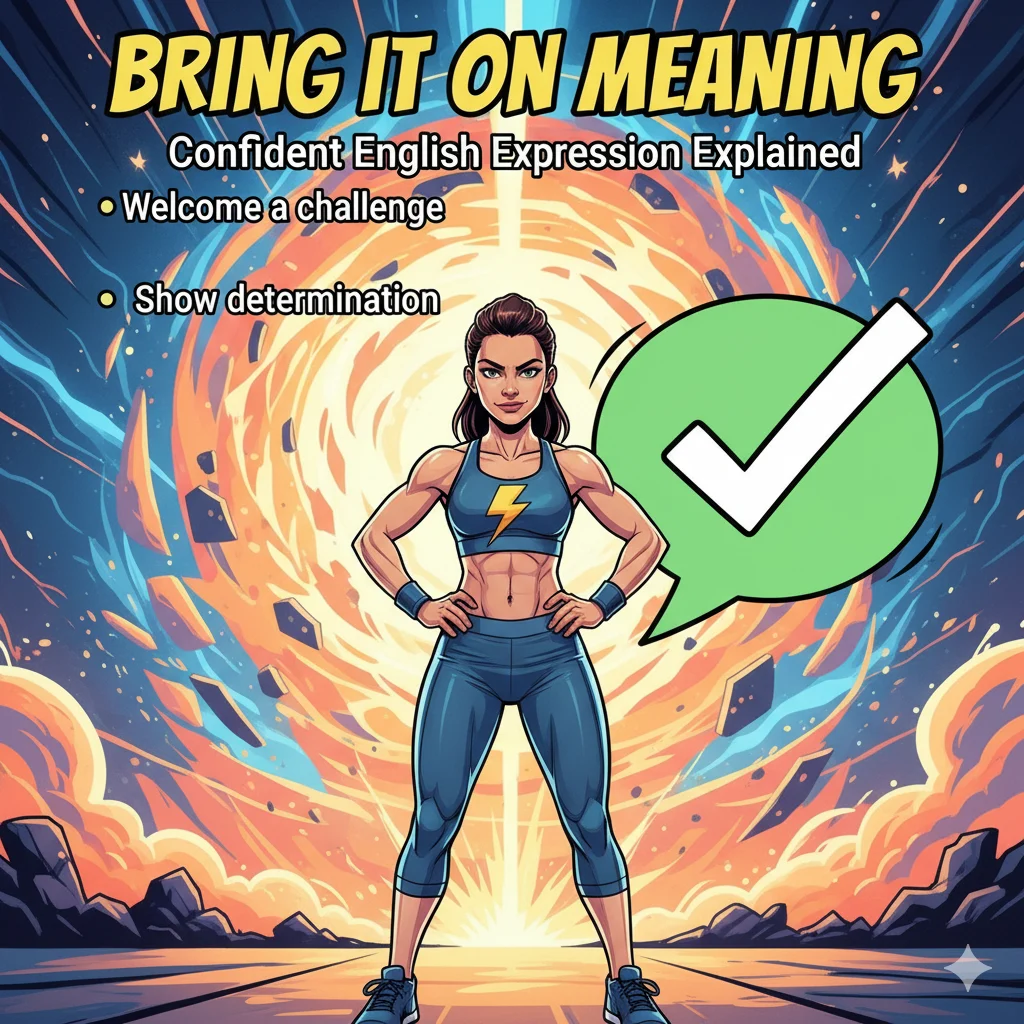
Have you ever heard someone confidently say, “Bring it on!” in movies, games, or everyday life — and wondered what it really means?
This short phrase sounds simple, but it’s full of energy, confidence, and challenge.
People often get confused about when or how to use it correctly. Does it mean “come here,” “let’s fight,” or “I’m ready”?
Don’t worry — this guide will explain everything about “bring it on” in easy English.
You’ll learn:
- What “bring it on” means
- How it’s different from “come on” or “do it”
- When to use it in real life
- Common mistakes and examples
By the end, you’ll feel 100% confident using “bring it on” naturally — just like a native speaker!
🧐 What Does “Bring It On” Mean?
“Bring it on” is an informal English phrase used to show confidence, readiness, or excitement before a challenge.
It means “I’m ready for it” or “I can handle whatever comes next.”
It’s often said when someone is about to face something difficult, like a competition, test, or argument.
✳️ Grammar Type:
- Phrase type: Expression / Idiom
- Tone: Informal, confident, motivational
✳️ Examples:
- “You think you can beat me? Bring it on!”
- “The final exam is tomorrow — bring it on!”
- “New challenges at work? Bring them on!”
In all these examples, the speaker shows courage or excitement — not fear.
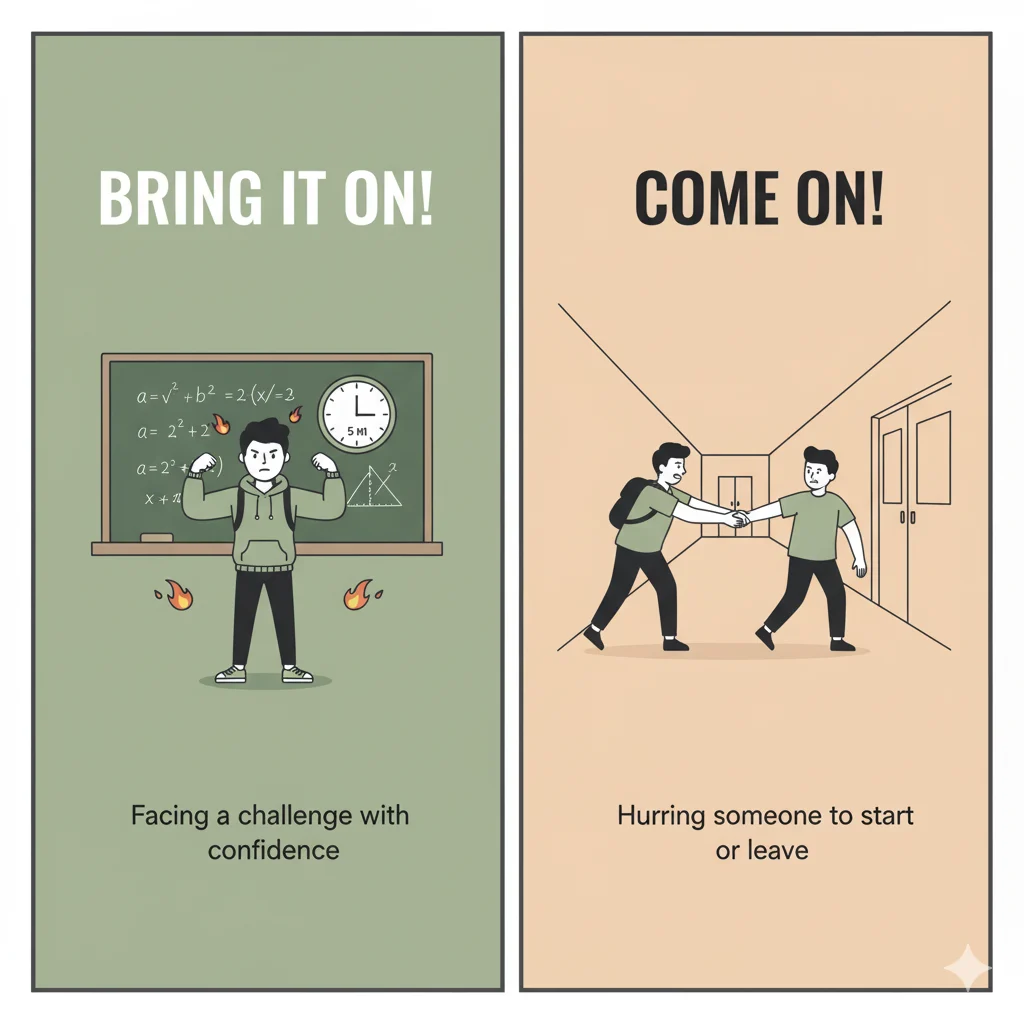
💡 “Bring It On” vs. “Come On” – The Key Difference
Many people confuse “bring it on” with “come on.”
Even though both sound similar, their meanings are quite different.
Here’s an easy comparison:
| Phrase | Meaning | Example | Tone |
|---|---|---|---|
| Bring it on | I’m ready for the challenge | “You want to race? Bring it on!” | Confident, brave |
| Come on | Hurry up / Let’s go / Are you serious? | “Come on, we’re going to be late!” | Impatient, casual |
✅ Quick Tip to Remember
Think of “bring it on” as a response — someone challenges you, and you say it to accept.
Think of “come on” as a command — you say it to push someone or express surprise.
❌ Common Mistakes and How to Avoid Them
Here are a few common mistakes learners make with this phrase:
| ❌ Incorrect | ✅ Correct | Why |
|---|---|---|
| “Bring on it!” | “Bring it on!” | The pronoun “it” goes in the middle — not after. |
| “I will bring it on tomorrow.” | “Bring it on!” | It’s a phrase, not a regular sentence — don’t add extra verbs. |
| “Bring on you!” | “Bring it on!” | “It” stands for a challenge or task, not a person. |
💬 Tip:
If you can replace the phrase with “I’m ready for it”, then “bring it on” will fit perfectly!
🕓 When to Use “Bring It On”
You can use “bring it on” anytime you want to sound confident, bold, or excited about a challenge.
✅ Examples in Real Life:
- Before a competition:
- “We’re ready for the match — bring it on!”
- Before a test:
- “Math exam tomorrow? Bring it on!”
- When starting something new:
- “New job, new city — bring it on!”
- When someone doubts you:
- “You think I can’t do it? Bring it on!”
- In movies or games:
- “The hero faced the villain and shouted, ‘Bring it on!’”
🧠 Memory Hack:
👉 Imagine you’re putting on boxing gloves before a challenge — you’re ready, confident, and saying to life:
“Come on, I’m ready — bring it on!”
🗣️ When Not to Use “Bring It On”
Avoid using “bring it on” in:
- Formal writing or professional emails
- Serious or sad situations (like illnesses or accidents)
It’s best for friendly, confident, or playful moments — not for polite or emotional topics.
🧾 Quick Recap: Bring It On Meaning and Usage
- Meaning: “I’m ready for a challenge!”
- Tone: Confident, bold, casual
- Type: Phrase / Idiom
- Common mistake: Saying “bring on it” (❌ wrong word order)
- Best used: In casual talk, movies, or motivation
✅ Shortcut Rule:
If you feel excited or challenged — say “Bring it on!”
If you want someone to hurry — say “Come on!”
📚 Advanced Tips
🔹 Origin of “Bring It On”
The phrase became popular in the 1990s and early 2000s, especially after the movie Bring It On (2000), about cheerleading competitions.
Since then, it’s been used in pop culture to show courage, positivity, and readiness.
🔹 In Formal Writing
Instead of “bring it on,” you can write:
- “I welcome the challenge.”
- “I am ready to face it.”
🔹 In Online or Text Language
You might see variations like:
- “BRING IT ONNN 🔥🔥🔥” (extra letters for excitement)
- “Bring it!” (shortened version)
Both mean the same thing — “I’m ready!”
🧩 Mini Quiz: Test Yourself!
Fill in the blanks with “Bring it on” or “Come on.”
- ________, let’s finish this project before lunch!
- You think your team can beat us? ________!
- The final round is tough, but I’m ready — ________!
- ________, you can do better than that!
- Life is full of challenges. I say, ________!
(Answers: 1. Come on, 2. Bring it on, 3. Bring it on, 4. Come on, 5. Bring it on)
❓ FAQs
1. What does “bring it on” mean in English?
It means “I’m ready for it” or “I accept the challenge.” It shows confidence or excitement.
2. Is “bring it on” slang or formal?
It’s informal and mostly used in casual speech, movies, or friendly conversations.
3. Can I say “bring on it”?
No. The correct phrase is “bring it on.” The word order matters.
4. What’s the difference between “bring it on” and “come on”?
“Bring it on” means “I’m ready.”
“Come on” means “Hurry up” or “You’re kidding.”
5. Can I use “bring it on” in professional situations?
Only if the setting is relaxed or motivational. For formal writing, say “I welcome the challenge.”
🏁 Conclusion
Now you know exactly what “bring it on” means — and how to use it like a native speaker!
It’s a fun, powerful phrase that shows confidence, courage, and positivity.
So next time someone challenges you — whether it’s an exam, a job, or life itself — smile and say:
“Bring it on!”
Keep learning new English expressions every day, and soon you’ll sound fluent and fearless — for real!

Isla Merrin is a language and writing expert at Definevs.com, creating simple, engaging guides to help readers master words, grammar, and modern English usage.