Have you ever written “bare with me” in a text or email and wondered if it’s right? You’re not alone!
Many English learners — and even native speakers — mix up “bear with me” and “bare with me” because they sound exactly the same.
But here’s the truth: only one of them is correct in most situations.
In this guide, you’ll learn:
- The meaning of both phrases
- The difference between bear and bare
- When and how to use each correctly
- Common mistakes, easy memory hacks, and real-life examples
🧠 What Does Each Word Mean?
Let’s start by understanding the two key words — bear and bare.
Even though they sound the same, they have very different meanings.
🐻 “Bear” — (Verb)
Meaning: To be patient with, tolerate, or carry something difficult.
Part of Speech: Verb
Examples:
- Please bear with me while I explain.
- I can’t bear the noise anymore.
- She bore the pain bravely.
👉 Think of “bear” as carrying or enduring something.
🩱 “Bare” — (Adjective / Verb)
Meaning: To uncover, expose, or make something naked.
Part of Speech: Adjective or verb
Examples:
- He walked on the bare floor without shoes.
- She decided to bare her feelings in her diary.
- The trees looked bare in winter.
👉 Think of “bare” as naked or uncovered.
⚖️ The Key Difference Between “Bear With Me” and “Bare With Me”
Here’s a simple comparison to make it crystal clear 👇
| Phrase | Correct / Incorrect | Meaning | Example Sentence |
|---|---|---|---|
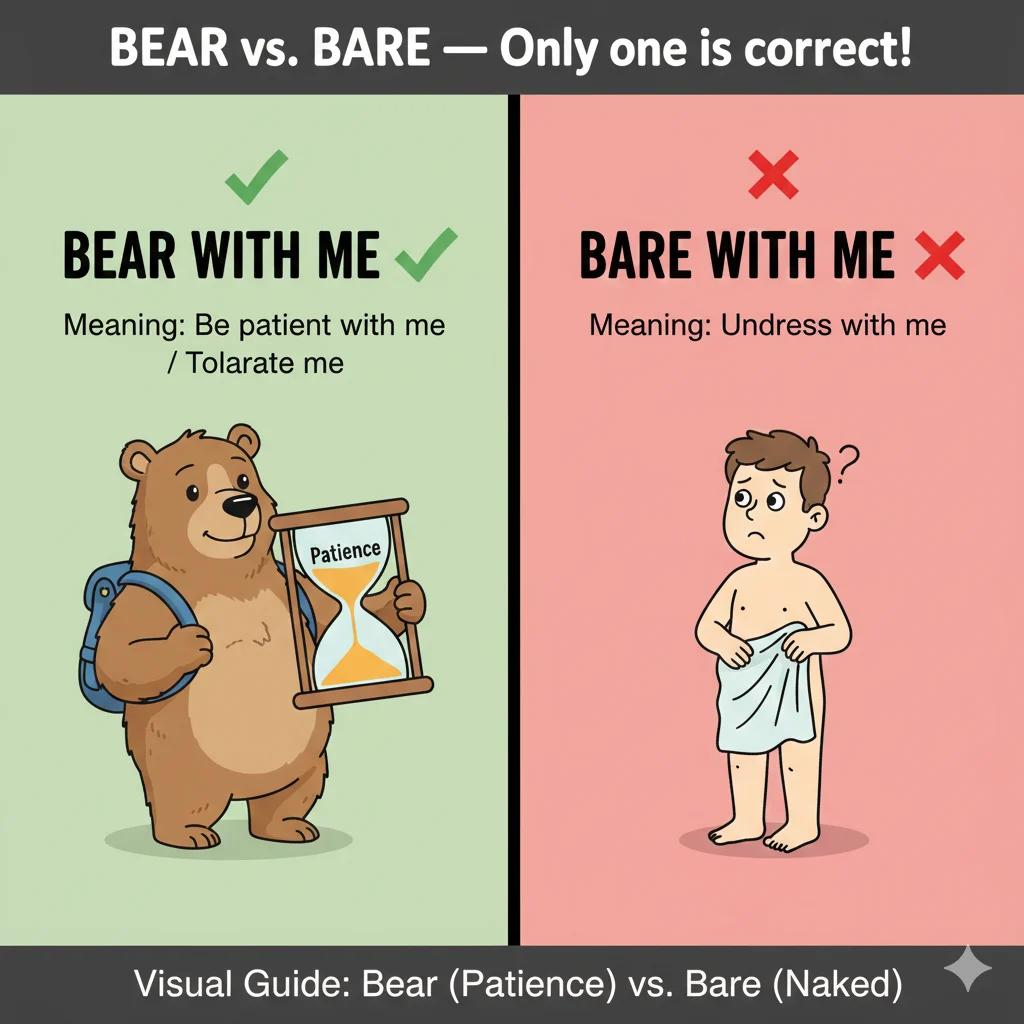
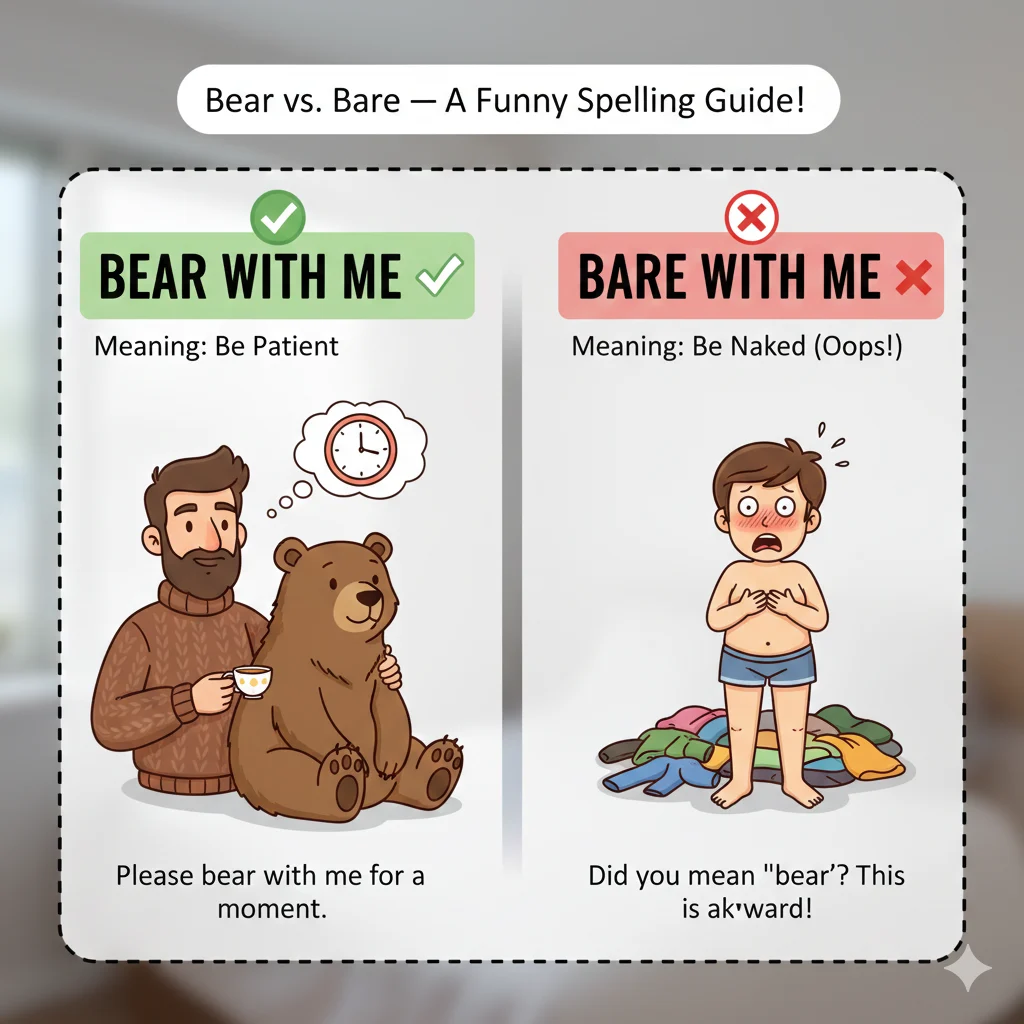
| Bear with me | ✅ Correct | Be patient with me / give me time | “Please bear with me while I fix this issue.” |
| Bare with me | ❌ Incorrect (usually) | Take off clothes with me / expose with me | “Bare with me” would mean “get naked with me.” (awkward!) |
💡 Quick Tip to Remember:
🐻 “Bear with me” means “be patient.”
🩱 “Bare with me” means “undress with me.”
So unless you’re in a very strange conversation — always use bear with me!
🚫 Common Mistakes and How to Avoid Them
❌ Mistake 1: Writing “bare with me” in formal messages
Incorrect: “Bare with me while I check your request.”
✅ Correct: “Bear with me while I check your request.”
Why it’s wrong: “Bare” means to uncover — not to wait patiently.
❌ Mistake 2: Assuming “bear” refers to the animal
Many people think “bear” only means the big furry animal.
But in “bear with me,” it’s a verb, meaning “to tolerate or be patient.”
✅ How to Fix These Mistakes:
- Always check the context — are you asking someone to wait or be patient? Then it’s bear with me.
- Remember the mental image: a bear (animal) carrying a heavy load patiently 🐻 → “bear with me.”
📚 When to Use “Bear With Me”
You use bear with me when you want someone to be patient while you finish or explain something.
Common Situations:
- When you need time to find something
→ “Please bear with me while I get the document.” - When you’re explaining something complicated
→ “Bear with me; this might sound confusing at first.” - During technical issues or delays
→ “Bear with us while we resolve this problem.” - When you make a small mistake and correct yourself
→ “Oops, bear with me — I meant to say 2025, not 2024.” - In polite business communication
→ “Bear with me as I finalize the report.”
💡 Memory Hack:
Imagine asking someone to “carry” patience — that’s what “bear with me” really means!
👕 When to Use “Bare With Me”
In almost every context, “bare with me” is wrong — unless you truly mean to undress or reveal something together.
Rare, Literal Uses:
- “He joked, ‘Bare with me for the photoshoot!’”
- “In the art class, the model said, ‘Bare with me while I pose.’”
These examples are literal and not commonly used in daily English.
🧩 Remember: In normal writing or conversation, “bare with me” sounds awkward or funny — so avoid it unless you truly mean “let’s uncover together.”
🔁 Quick Recap: “Bear With Me” vs “Bare With Me”
Let’s review everything simply:
- Bear with me = ✅ Correct → means be patient with me
- Bare with me = ❌ Incorrect (unless talking about uncovering)
- Bear = to carry, endure, tolerate
- Bare = to uncover, make naked
Easy Trick:
🐻 A bear can carry something heavy.
So, when you “bear with me,” you carry your patience a bit longer!
🧩 Advanced Tips & Background
- Origin: The phrase “bear with me” comes from the Old English “beran,” meaning to carry or endure.
- Formal Writing: Always use bear with me in emails, presentations, or customer messages.
Example:
“Thank you for bearing with us during this update.” - Texting & Casual Use: You can still say “bear with me” informally — it’s polite and friendly.
Example:
“Bear with me, I’m almost done editing!” - Why it matters: Using the correct form shows good grammar, professionalism, and clear communication.
🧠 Mini Quiz: Test Your Knowledge
Fill in the blanks with bear or bare 👇
- Please ______ with me while I restart my computer.
- The walls looked ______ after we removed the pictures.
- Can you ______ the noise from the construction?
- She decided to ______ her emotions in her diary.
- ______ with me; this story will make sense soon!
Answers:
- bear
- bare
- bear
- bare
- bear
❓ FAQs About “Bear With Me” vs “Bare With Me”
1. Which one is correct — bear with me or bare with me?
✅ The correct phrase is bear with me, meaning “be patient with me.”
2. Why do people confuse bear with bare?
Because they sound the same (homophones). But their meanings are totally different!
3. Can I use bare with me in jokes or creative writing?
Yes, but only intentionally — it often sounds funny or suggestive.
4. Is bear with me formal or informal?
It’s polite and works in both casual and formal contexts.
5. What’s an easy way to remember it?
Think of a bear carrying your patience — “bear with me.” 🐻
🏁 Conclusion
Now you know the real difference between bear with me and bare with me!
Always use “bear with me” when you’re asking someone to be patient or understanding.
And remember — “bare with me” changes the meaning completely (and often in a funny way!).
Keep practicing, read examples aloud, and soon you’ll never mix them up again.
Your English gets stronger every time you learn a small difference like this — so keep going, you’re doing great! 💪

Mira Loxley is a passionate language and writing expert at Definevs.com, turning tricky words and grammar into clear, engaging guides for every reader.