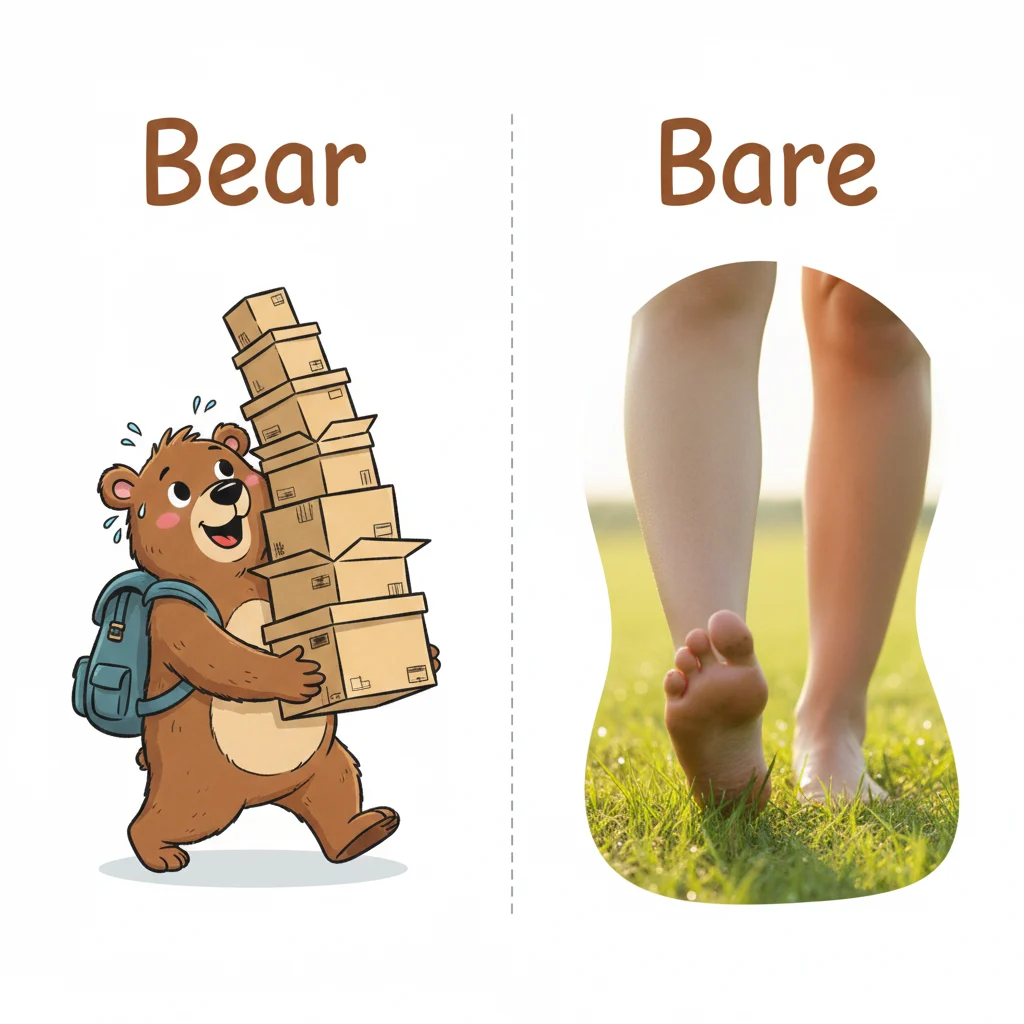
Have you ever wondered when to use bear and when to use bare? 🤔 These two words sound the same (they’re homophones), but they have very different meanings. People often mix them up when writing, especially in phrases like “I can’t bear it” or “bare hands.”
In this easy guide, we’ll explain the difference between bear and bare, their meanings, correct usage, and simple examples. Whether you’re a student, teacher, or English learner, this article will help you remember when to use each word correctly — without confusion! 📝
🧩 What Does Each Word Mean?
🐻 Bear — Meaning & Usage
The word bear can be both a noun and a verb.
1️⃣ As a noun, it refers to the large animal that lives in forests and mountains.
2️⃣ As a verb, it means to carry, support, or endure something.
✅ Examples of “Bear”:
- The bear in the forest is huge. 🐾
- I can’t bear the pain anymore.
- The bridge can bear heavy loads.
💡 Memory trick: Think of “bear” as something heavy to carry — you “bear” a burden, just like a strong bear can carry weight!
🌿 Bare — Meaning & Usage
The word bare is an adjective (describing word) or sometimes a verb.
It means not covered, empty, or without something.
✅ Examples of “Bare”:
- His feet were bare on the grass. 🌾
- The tree was bare in winter.
- She decided to bare her feelings to her friend. 💬
💡 Memory trick: “Bare” rhymes with “naked” — when something is bare, it’s uncovered or empty!
⚖️ The Key Difference Between Bear and Bare
| Feature | 🐻 Bear | 🌿 Bare |
|---|---|---|
| Part of Speech | Noun / Verb | Adjective / Verb |
| Meaning | To carry, endure, or the animal | To uncover, exposed, without covering |
| Examples | “I can’t bear the noise.” / “A big bear lives in the cave.” | “He walked on bare feet.” / “The walls were bare.” |
| Pronunciation | /beər/ | /beər/ (same sound!) |
| Quick Tip 🧠 | Think “bear” = carry or animal | Think “bare” = naked or uncovered |
💬 Quick Tip to Remember:
👉 If you mean “to carry or tolerate”, use bear.
👉 If you mean “not covered or empty”, use bare.

🚫 Common Mistakes and How to Avoid Them
1️⃣ Incorrect: I can’t bare the cold anymore.
✅ Correct: I can’t bear the cold anymore.
(You are enduring the cold, not uncovering it!)
2️⃣ Incorrect: The bear wall needs painting.
✅ Correct: The bare wall needs painting.
(The wall is uncovered, not an animal!)
3️⃣ Incorrect: Please bare with me for a moment.
✅ Correct: Please bear with me for a moment.
(“Bear with me” means “be patient.”)
💡 Tip: If patience or endurance is involved — it’s bear.
If you’re talking about something uncovered — it’s bare.
🐻 When to Use “Bear” (with Examples)
You should use bear when you’re talking about carrying, enduring, or tolerating something — or referring to the animal.
✅ Examples:
- I can’t bear loud noises. 🔊
- Please bear with me; I’m almost done.
- This tree can bear fruit in summer. 🍎
- The injured man couldn’t bear the pain.
- We saw a bear in the woods! 🐾
💡 Memory Hack: Imagine a bear carrying something heavy — just like how you “bear” weight or pain.
Equal or Less Than Sign: The Hidden Rule Everyone Gets Wrong 😮
🌿 When to Use “Bare” (with Examples)
Use bare when you mean not covered, empty, or without decoration.
✅ Examples:
- The floor was bare with no carpet.
- He washed his face with his bare hands. ✋
- Her room looked bare after she moved out.
- The winter trees stood bare and quiet. ❄️
- She decided to bare her secrets in the diary. 📖
💡 Memory Hack: “Bare” and “naked” both have four letters — both mean without cover!
📚 Quick Recap: Bear vs Bare
🔹 Bear (Verb/Noun) = to carry, endure, or an animal.
🔹 Bare (Adjective/Verb) = not covered, empty, or reveal.
Simple Rules to Remember:
✅ You bear a burden.
✅ You bare your skin.
✅ “Bear with me” = be patient.
✅ “Bare hands” = no gloves.
✅ “Bear” = strong animal.
✅ “Bare” = nothing on it.
🕰️ Advanced Tips for Curious Learners
- The word bear comes from Old English beran, meaning to carry or bring forth.
- Bare comes from bær, meaning naked or uncovered.
- In formal writing or exams, mixing them up can change your meaning completely!
Example:- “Bare with me” ❌ (means remove your clothes with me 😅)
- “Bear with me” ✅ (means be patient with me).
💡 Pro Tip: Always reread your sentence. If it talks about patience, endurance, or animals, choose bear. If it talks about uncovered things or revealing, go with bare.
🧠 Mini Quiz — Test Your Understanding!
Fill in the blanks with bear or bare:
1️⃣ Please ____ with me; I’ll explain soon.
2️⃣ The cold wind touched his ____ feet.
3️⃣ I can’t ____ this headache any longer!
4️⃣ The forest is home to a big brown ____.
5️⃣ The walls looked ____ after painting.
💬 Answers: 1. bear, 2. bare, 3. bear, 4. bear, 5. bare.
💬 FAQs
1. What’s the main difference between bear and bare?
“Bear” means to carry, endure, or the animal. “Bare” means uncovered or empty.
2. Which is correct: “Bear with me” or “Bare with me”?
The correct phrase is “Bear with me.” It means “please be patient.”
3. Can ‘bare’ be used as a verb?
Yes! “Bare” can mean to uncover or reveal — e.g., “She bared her heart.”
4. What type of word is ‘bear’?
“Bear” can be a noun (animal) or a verb (to carry or tolerate).
5. How can I remember the difference easily?
Think bear = carry / animal and bare = naked / uncovered.
More Than or Equal To Sign: The Hidden Rule Everyone Misses ❗
🌟 Conclusion
Now you know the real difference between bear and bare! 🎉
Remember — bear means to carry or endure, and bare means not covered or empty. Using them correctly makes your English clear and confident.
Keep practicing, notice how writers and speakers use these words, and soon you’ll never confuse them again. Every time you write, you’ll be as confident as a bear and as clear as something bare! 🐻🌿

Arwen Blythe is a passionate language and culture enthusiast, crafting clear, engaging guides on words, phrases, and modern English for Definevs.com readers.