Have you ever wondered whether it’s “bachelor’s degree” with an apostrophe or “bachelors degree” without one? 🤔
You’re not alone! Many students, professionals, and even writers get confused by this tiny punctuation mark. But here’s the truth — that little apostrophe makes a big grammatical difference.
In this simple guide, you’ll learn:
- The correct spelling and grammar rule
- What each version means
- Common mistakes and how to avoid them
- Easy examples and memory tricks to remember the difference
By the end, you’ll never question which one to use again — even in formal writing, emails, or resumes!
🧠 What Does Each Term Mean?
Let’s start by understanding both phrases clearly.
1. Bachelor’s Degree (Correct Form)
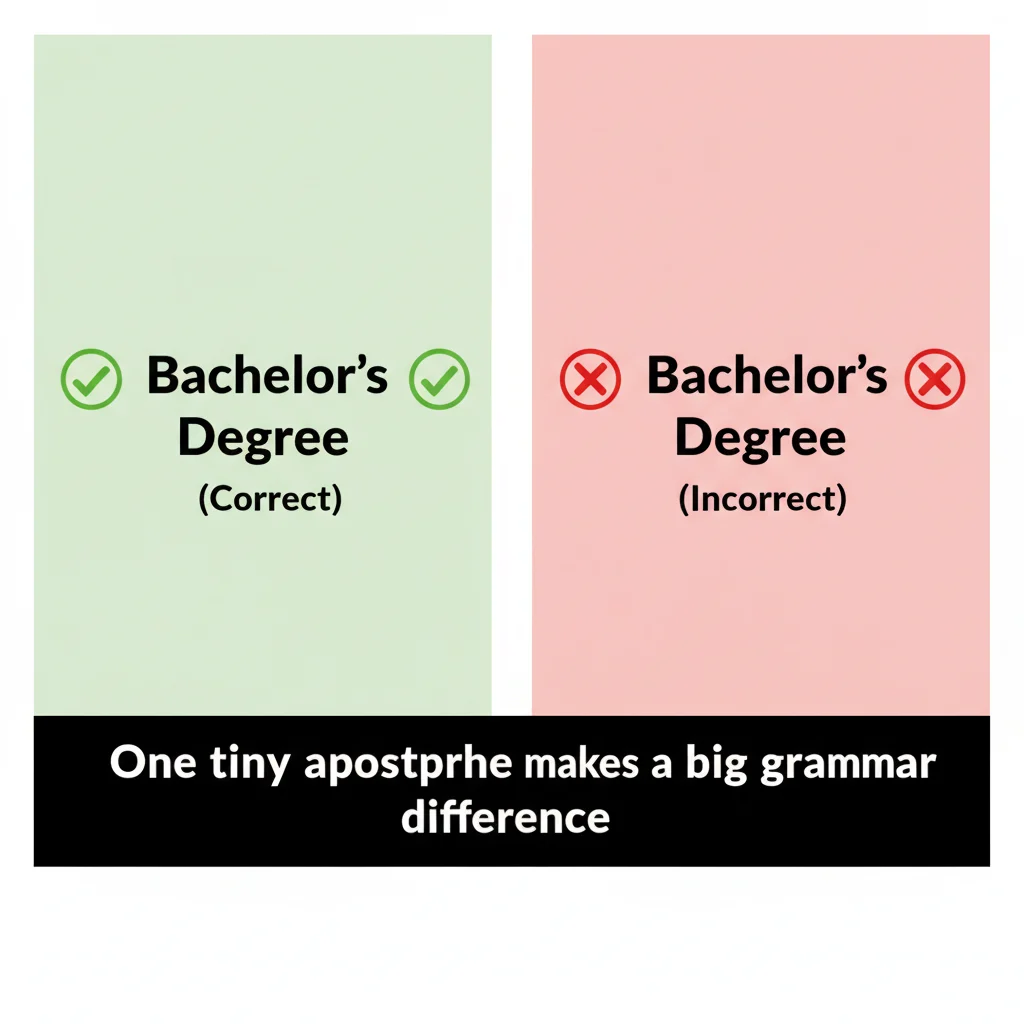
“Bachelor’s degree” is the correct spelling.
It includes an apostrophe + s (’s) because it shows possession — the degree of a bachelor.
Part of speech: Noun phrase
Meaning:
A bachelor’s degree is an undergraduate academic degree awarded by a college or university after completing a course of study.
Examples:
- She earned a bachelor’s degree in psychology.
- You need a bachelor’s degree to apply for that job.
- He’s the first in his family to get a bachelor’s degree.
2. Bachelors Degree (Incorrect Form)
“Bachelors degree” is grammatically incorrect.
It misses the apostrophe, which removes the possessive form — making the phrase incomplete.
Why it’s wrong:
It reads like “many bachelors degree,” which doesn’t make sense because “bachelors” here isn’t plural — it’s possessive.
Incorrect Examples:
- ❌ She finished her bachelors degree in English.
- ❌ I want to get my bachelors degree next year.
✅ Corrected: She finished her bachelor’s degree in English.
⚖️ The Key Difference Between Bachelor’s Degree and Bachelors Degree
| Feature | Bachelor’s Degree (Correct) | Bachelors Degree (Incorrect) |
|---|---|---|
| Apostrophe | Includes apostrophe (’s) | No apostrophe |
| Grammar Rule | Possessive noun (degree of a bachelor) | Plural noun used wrongly |
| Meaning | Correct academic title | Grammatical error |
| Example | “She earned her bachelor’s degree.” | “She earned her bachelors degree.” |
Quick Tip to Remember:
👉 If the word “degree” belongs to someone (the bachelor), it needs an apostrophe.
Think of it like this:
“The degree of a bachelor = bachelor’s degree.”
❌ Common Mistakes and How to Avoid Them
Here are the most common errors people make:
Mistake 1: Forgetting the Apostrophe
❌ I have a bachelors degree in computer science.
✅ I have a bachelor’s degree in computer science.
Why it happens:
People often skip punctuation in digital writing or assume it’s optional.
Fix: Always remember — degrees are possessive (of a bachelor).
Mistake 2: Capitalizing Both Words
❌ He completed his Bachelor’s Degree in Arts.
✅ He completed his bachelor’s degree in arts.
Grammar Tip:
Only capitalize the degree when you write the full title of a specific program:
✅ She earned a Bachelor of Arts in History.
❌ She earned a Bachelor’s Degree in History.
Mistake 3: Mixing Singular and Plural
❌ They both have bachelor’s degrees in Engineering. (Correct plural!)
✅ When plural, add “degrees” — not “bachelor’s degree’s.”
Right way:
- One bachelor’s degree
- Two bachelor’s degrees
🕹️ When to Use “Bachelor’s Degree”
Use bachelor’s degree when talking generally about an undergraduate degree, without naming a specific program.
Examples:
- I want to get a bachelor’s degree before starting my career.
- She holds a bachelor’s degree in English Literature.
- You need a bachelor’s degree to enter this field.
- My brother earned his bachelor’s degree online.
- A bachelor’s degree usually takes four years to complete.
In short:
Use “bachelor’s degree” whenever you mean a general type of degree.
🎓 When to Use “Bachelors Degree”
Technically, never — unless you’re referring to multiple bachelors (unmarried men) who each have a degree, which is extremely rare and not how the phrase is used in education.
Example (rare, literal meaning):
“Several bachelors’ degrees were displayed on the wall.”
Even here, note the apostrophe after the “s” because it’s plural possessive — belonging to many bachelors.
But in everyday English, you’ll almost always use the singular possessive: bachelor’s degree.
Memory Hack:
If it’s about education, always include the apostrophe → “bachelor’s degree.”
🧩 Quick Recap: Bachelor’s Degree vs Bachelors Degree
- Bachelor’s degree = ✅ Correct form
- Bachelors degree = ❌ Incorrect form
- The apostrophe (’s) shows possession → degree of a bachelor
- Use lowercase unless writing a specific program name
- Plural form: bachelor’s degrees
Mini Trick:
👉 Ask yourself: “Whose degree?”
Answer: The bachelor’s — so it needs the apostrophe!
💡 Advanced Tips
- The term “bachelor” comes from the Latin “baccalaureus,” meaning a young man or beginner at a craft.
- The phrase “bachelor’s degree” first appeared in the 14th century in universities.
- In formal writing (like resumes or academic essays), always use the correct capitalization:
- Correct: Bachelor of Science (B.S.)
- Correct: bachelor’s degree in science
- Incorrect: Bachelors degree or Bachelor’s Degree
Using the wrong form in applications or LinkedIn bios can look unprofessional, so it’s worth remembering the proper version!
🧠 Mini Quiz: Test Your Grammar!
Fill in the blanks with the correct form:
- I just earned my _______ in Business.
- She wants to get a _______ in Biology.
- He’s applying for jobs that require a _______.
- They both have _______ in Engineering.
- Is it “bachelor’s” or “bachelors”? Think: degree of a _______.
(Answers: 1–4: bachelor’s degree; 5: bachelor)
🏁 Conclusion
Now you know the difference between “bachelor’s degree” and “bachelors degree.”
That tiny apostrophe isn’t just decoration — it’s a key part of English grammar that changes meaning completely.
✅ Always write bachelor’s degree when referring to an academic qualification.
Avoid “bachelors degree” unless you’re literally talking about more than one bachelor (which almost never happens).
Keep practicing these small grammar details — they make your English more polished, professional, and confident every day!

Mira Loxley is a passionate language and writing expert at Definevs.com, turning tricky words and grammar into clear, engaging guides for every reader.