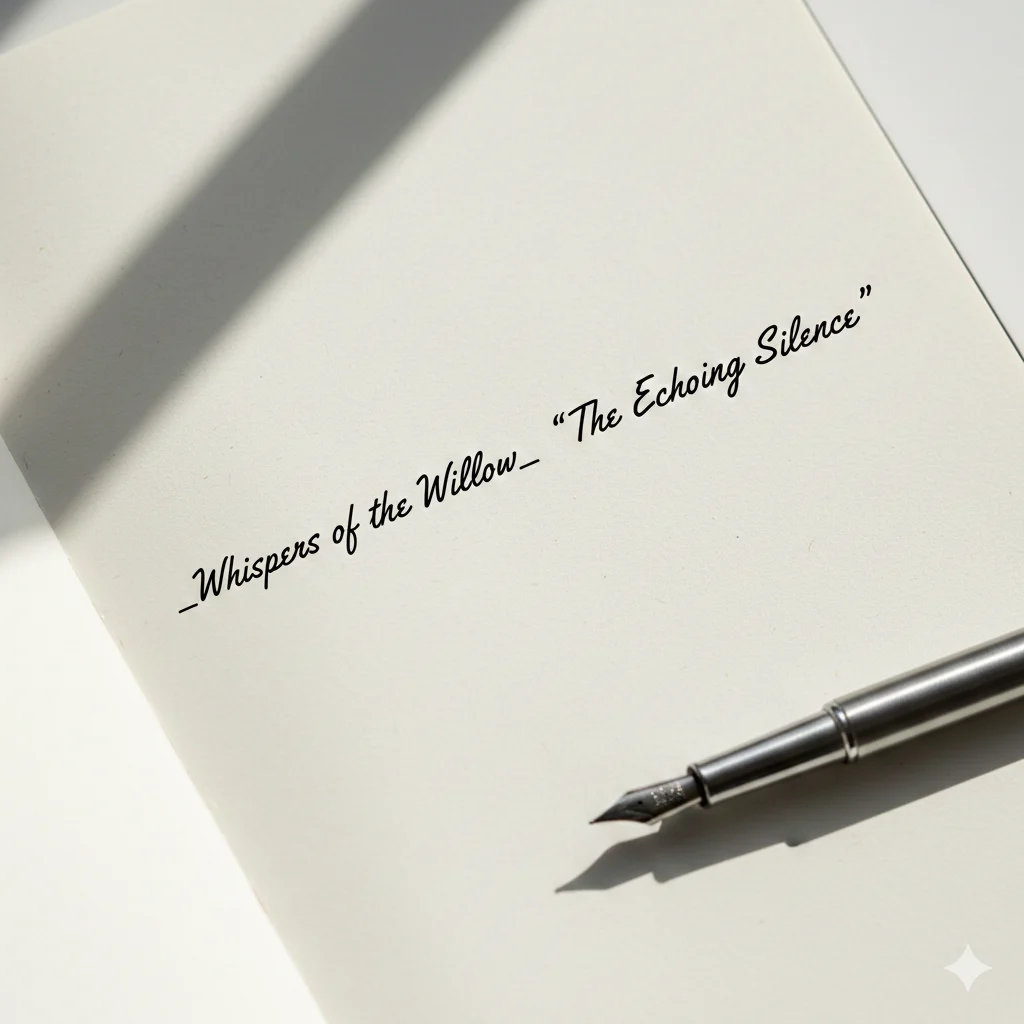
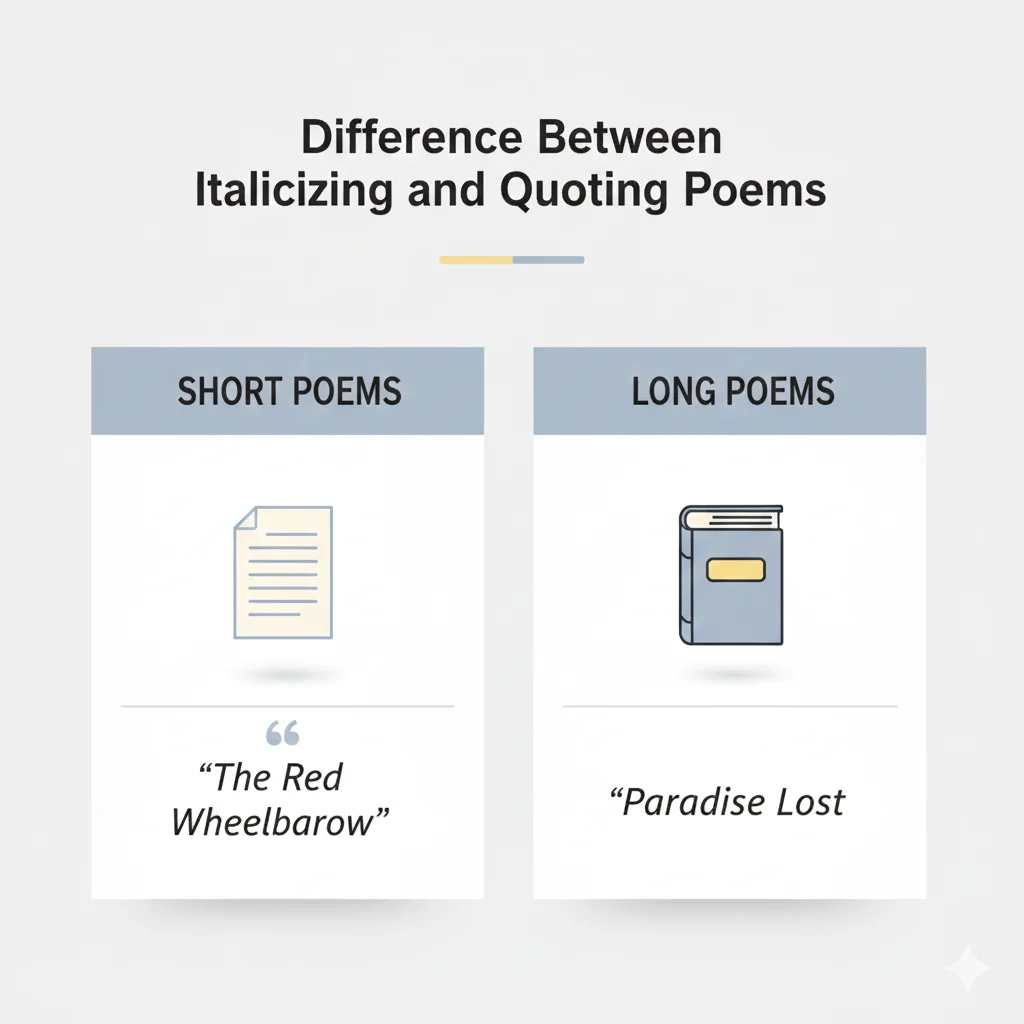
Short poems or poems that are part of a larger work → use quotation marks.
Long, standalone poems → use italics.
A simple rule: If the poem is short, quote it. If the poem stands alone, italicize it.
Many students, writers, and even adults get confused about one simple question: Are poems italicized or quoted? Don’t worry—this is one of the most common writing issues in English. The problem happens because different types of poems follow different rules. Some poems are short, some are long, and some are part of a bigger book. Because of this, people often mix up when to use italics and when to use “quotation marks.”
In this friendly, easy guide, you will learn the meaning of each rule, the difference between italicizing and quoting, and how to use them correctly in schoolwork, essays, and general writing. You’ll see simple examples, comparison tables, memory tricks, and real-life explanations that even a class 4 student can understand.
By the end, you will always know the correct way to write the title of any poem—short or long. Let’s make English simple!
What Does “Italicized” Mean? What Do “Quotation Marks” Mean?
Italicized — Meaning & Use
Italics are letters that slant to the right. Writers use italics to show that something is a big title or a complete standalone work.
Part of speech: Not a part of speech — it is a text formatting style.
Examples of italics:
- I read The Odyssey in class today.
- My teacher assigned Paradise Lost.
- She loves reading The Raven every October.
Quotation Marks — Meaning & Use
Quotation marks (“ ”) are used to show shorter works or pieces that are part of something bigger.
Part of speech: Also not a part of speech — it is a punctuation mark.
Examples of quotation marks:
- I studied “Stopping by Woods on a Snowy Evening” today.
- My favorite poem from the book is “Fire and Ice.”
- Have you read “The Road Not Taken”?
The Key Difference Between Italicizing and Quoting Poems
Here is the simple rule:
| Type of Poem | Formatting Rule | Example |
|---|---|---|
| Short poems (usually under a page) | Use quotation marks | “O Captain! My Captain!” |
| Poems within a larger book | Use quotation marks | “Annabel Lee” |
| Long poems (multi-page, book-length) | Use italics | The Divine Comedy |
| Epic or standalone poems | Use italics | Beowulf |
| Poem collections | Use italics | Leaves of Grass |
Quick Tip to Remember:
👉 If you can hold the poem like a book → italicize it.
👉 If the poem is small enough to fit inside another book → put it in quotes.
Common Mistakes and How to Avoid Them
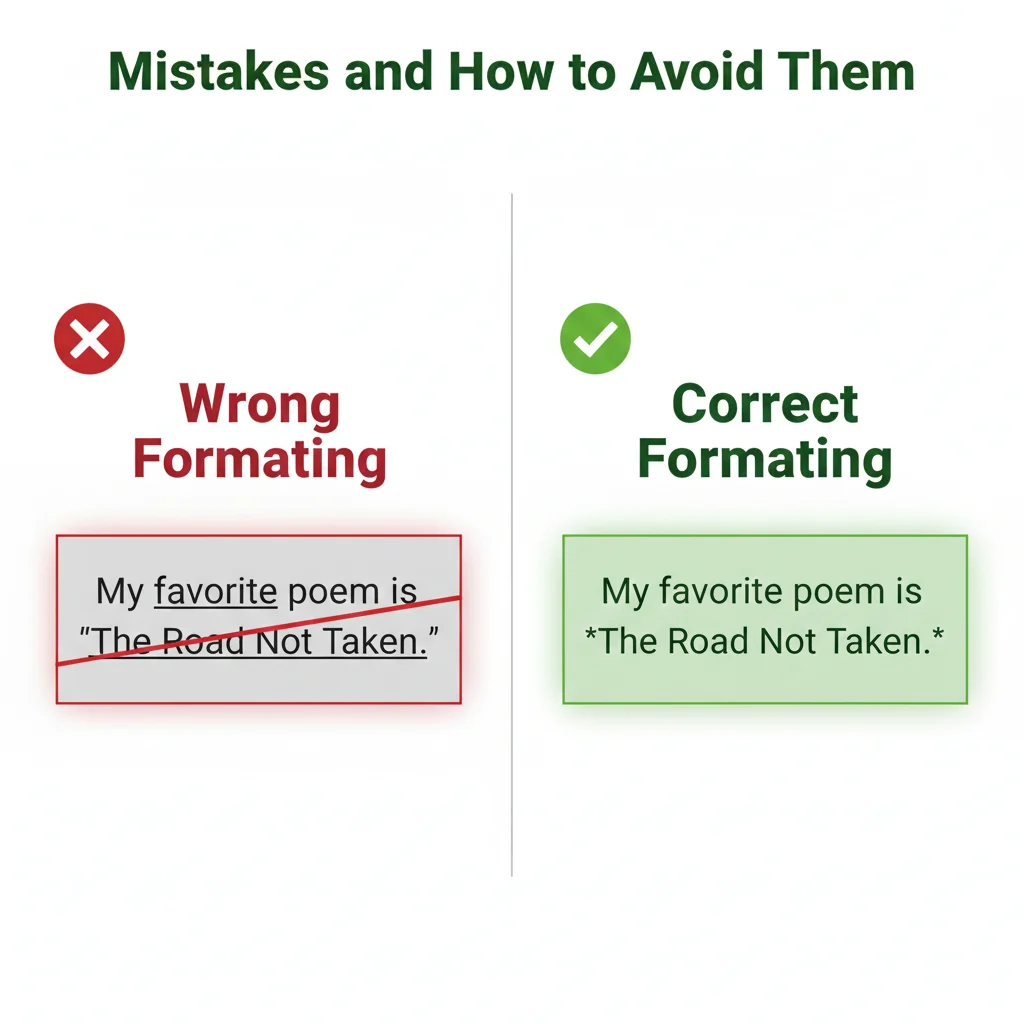
❌ Incorrect:
I love reading The Road Not Taken.
✔️ Correct:
I love reading “The Road Not Taken.”
Why?
Because it is a short poem inside a larger book.
❌ Incorrect:
“Paradise Lost” is a difficult poem.
✔️ Correct:
Paradise Lost is a difficult poem.
Why?
Because Paradise Lost is a long, book-length poem.
❌ Incorrect:
My favorite poem is Fire and Ice.
✔️ Correct:
My favorite poem is “Fire and Ice.”
Why?
Because it is a short poem.
When to Use Italics (Simple Rules & Examples)
Use italics when the poem is:
- Long
- Book-length
- Epic
- A standalone published work
- A complete collection of poems
Examples:
- We studied Beowulf in class.
- The exam asked us about The Iliad.
- She bought a copy of Leaves of Grass.
- My favorite long poem is The Divine Comedy.
- He wrote an essay comparing Paradise Lost and The Odyssey.
Memory Hack:
If the poem feels like a book → italicize it.
When to Use Quotation Marks (Simple Rules & Examples)
Use quotation marks when the poem is:
- Short
- Part of a collection
- Part of a school textbook
- Part of a poetry anthology
- Less than a page long
Examples:
- We read “Ozymandias” in English class.
- My teacher assigned “Harlem” today.
- I love “The Road Not Taken.”
- She memorized “If.”
- The book includes the poem “Still I Rise.”
Memory Hack:
If the poem is short enough to memorize → use quotation marks.
Quick Recap: Are Poems Italicized or Quoted?
- Short poems → Quotation marks
- Long poems → Italics
- Poems inside books → Quotation marks
- Epic poems → Italics
- Poem collections → Italics
Super Simple Version:
👉 Short = “Quoted”
👉 Long = Italicized
Advanced Tips
1. History of the Rule
In older printing, italics showed importance or separate titles. Quotation marks signaled smaller pieces of writing. This tradition continues today.
2. In Essays or Exams
Teachers expect students to follow MLA, APA, or Chicago style. All major styles use the same rule:
- Short poems → quotes
- Long poems → italics
3. In Online Writing
If italics do not work on a platform, some writers use ALL CAPS, but this is not recommended. Italics are always better.
4. Why Mixing Them Up Is a Problem
Using the wrong format can confuse the reader and make your writing look less professional.
Mini Quiz (With Answers Below)
Fill in the blanks with either italics or quotation marks.
- I love the poem The Iliad.
- My teacher asked me to read “Fire and Ice”.
- Have you finished The Divine Comedy?
- We studied the poem “Harlem” today.
- She wrote an essay about Beowulf.
Answers:
- The Iliad
- “Fire and Ice”
- The Divine Comedy
- “Harlem”
- Beowulf
FAQs
1. Do I italicize poem titles?
Yes, but only if the poem is long or book-length.
2. Do short poems use quotation marks?
Yes. Short poems and poems inside other books always use quotes.
3. How do I know if a poem is long enough to italicize?
If it is published as a standalone work or is several pages long, use italics.
4. Do I italicize poem collections?
Yes. Titles of entire poetry books or collections are italicized.
5. What if I’m writing online and can’t italicize text?
Use quotation marks instead, but italics are still preferred for formal writing.
Conclusion
Knowing whether to italicize or quote a poem may seem confusing at first, but the rules are actually very simple. Short poems and poems inside other books go in quotation marks, while long, standalone poems use italics. When you follow these easy rules, your writing becomes clearer, neater, and more professional. Whether you’re completing homework, writing an essay, or preparing a school project, these small details make a big difference. Keep practicing by noticing how poem titles are written in textbooks, articles, and books. The more you observe, the easier it becomes.
Keep learning, keep improving, and enjoy the beauty of poetry and good writing!

Isla Merrin is a language and writing expert at Definevs.com, creating simple, engaging guides to help readers master words, grammar, and modern English usage.