Have you ever wondered whether you should say “an unique” or “a unique”? 🤔
Many English learners find this confusing because both a and an are used before nouns — but which one fits with unique?
This guide will explain the difference between “an unique” and “a unique”, their correct grammar usage, and how you can remember the right form every time. You’ll also find simple examples, a quick comparison table, common mistakes, and easy memory tricks.
By the end, you’ll confidently know when to say “a unique idea” and why “an unique idea” is wrong — even if English isn’t your first language! 🌍✏️
🧐 What Does Each Word Mean?
Before we dive into grammar, let’s understand what we’re dealing with. The confusion comes from the articles — a and an — not the word unique itself.
💡 “A” — Meaning and Usage
“A” is an indefinite article used before words that start with a consonant sound.
It doesn’t depend on the spelling but the sound.
✅ Examples:
- a car
- a dog
- a banana
“A” is used when the next word begins with a consonant sound (like yoo, buh, kuh).
💡 “An” — Meaning and Usage
“An” is also an indefinite article, but it’s used before words starting with a vowel sound.
✅ Examples:
- an apple
- an umbrella
- an hour ⏰ (because the ‘h’ is silent — sounds like “our”)
“An” is used when the next word begins with a vowel sound (like ah, eh, ih, oh, uh).
💬 What About “Unique”?
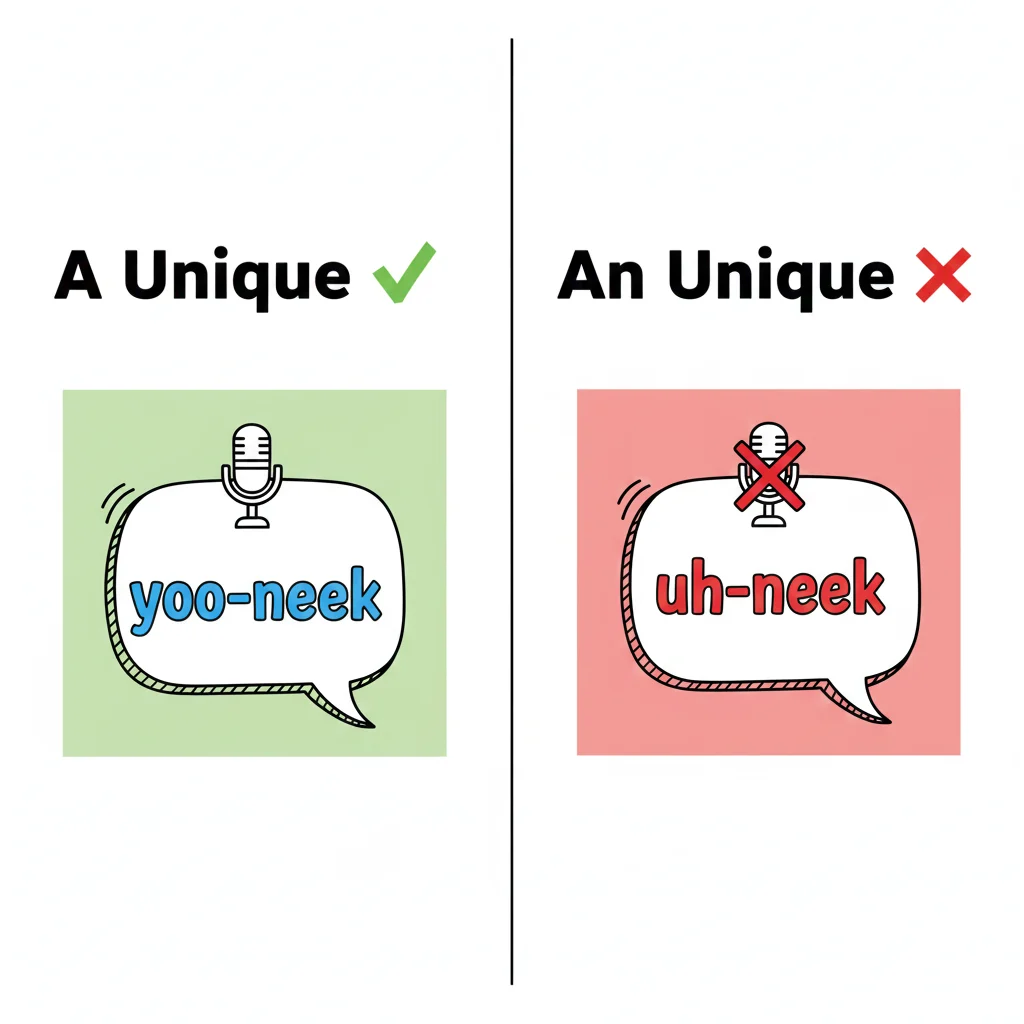
The word “unique” begins with the letter “u,” but here’s the trick — it doesn’t sound like a vowel! 😮
It sounds like “yoo”, as in “you-neek.”
Since “yoo” is a consonant sound, we use “a” — not “an.”
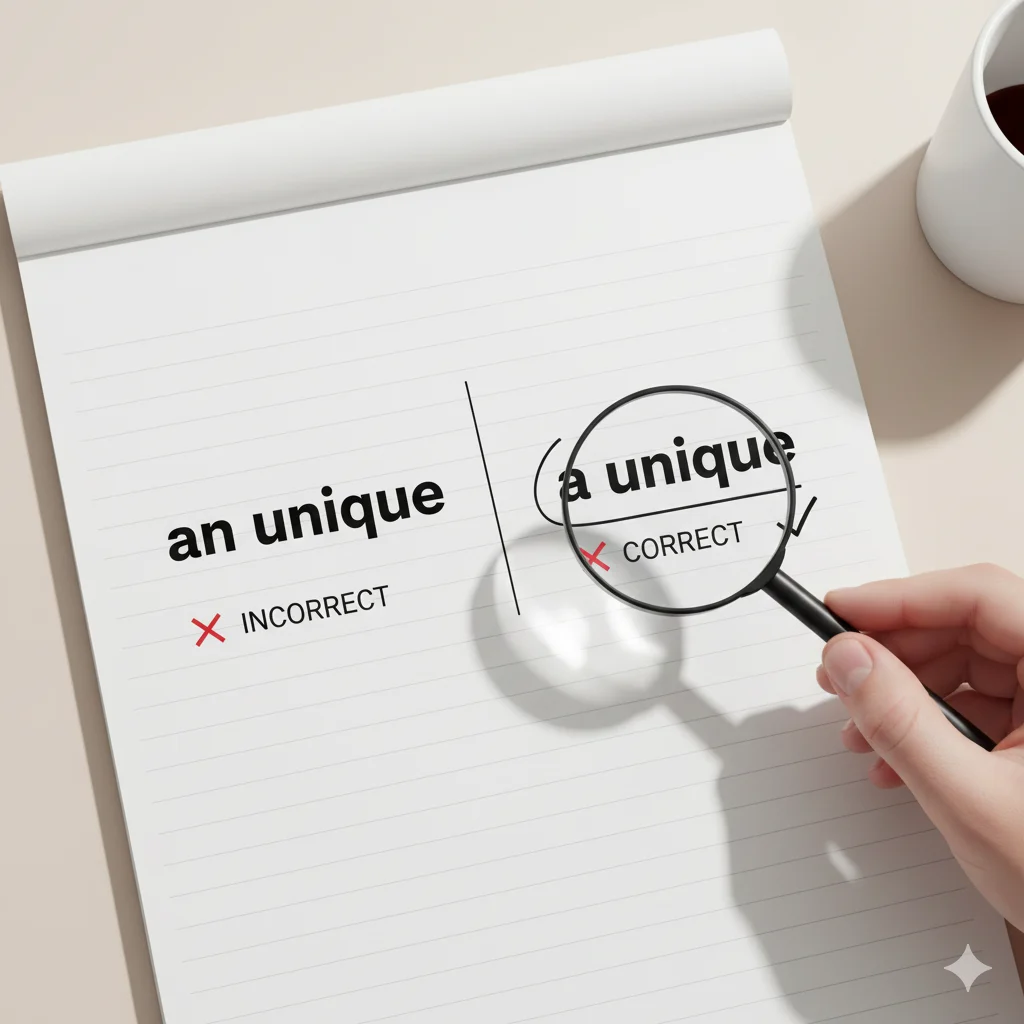
✅ Correct: a unique idea
❌ Incorrect: an unique idea
Jesus’ / Jesus’s: The Tiny Grammar Detail Everyone Gets Wrong 😮
📊 The Key Difference Between “An Unique” and “A Unique”
| Form | Correct or Incorrect? | Why | Example Sentence |
|---|---|---|---|
| ✅ A Unique | ✅ Correct | “Unique” starts with a consonant sound /yoo/ | She had a unique way of solving problems. |
| ❌ An Unique | ❌ Incorrect | “An” is only used before vowel sounds, not the /yoo/ sound | He shared an unique story. (Wrong) |
📘 Quick Tip to Remember:
If the word starts with a vowel letter but sounds like “you”, use a, not an.
Examples: a university, a unicorn, a uniform, a unique gift.
🚫 Common Mistakes and How to Avoid Them
Let’s look at some common mix-ups learners make:
❌ Incorrect: She has an unique dress.
✅ Correct: She has a unique dress.
❌ Incorrect: That is an unicorn.
✅ Correct: That is a unicorn.
Why the mistake happens:
Because “u” is a vowel, many people assume an should come before it. But English depends on sound, not spelling.
How to fix it:
Say the word aloud — if it begins with a “yoo” sound, use a. If it begins with a pure vowel sound like “uh” or “ah,” use an.
🧠 When to Use “A Unique”
You use “a unique” before any noun that starts with the word unique, since it’s the grammatically correct form.
✅ Examples:
- She gave me a unique birthday card. 🎂
- That’s a unique opportunity to learn.
- It was a unique experience I’ll never forget.
- He has a unique voice that stands out.
- They built a unique bridge in the city. 🌉
📝 Memory Hack:
If you hear “yoo,” go with a — “a yoo-neek idea.”
💡 When to Use “An Unique”
The short answer: Never. 🚫
“An unique” is grammatically incorrect in standard English because unique starts with a consonant sound, not a vowel sound.
But there’s an interesting fact for English lovers! 📚
Hundreds of years ago, some older texts used an before words starting with “u” (like an unicorn). Over time, pronunciation changed, and the “yoo” sound became common — that’s why today we say “a unique,” “a unicorn,” and “a university.”
✅ So remember: English spelling may look tricky, but the secret is in the sound! 🎧
🔁 Quick Recap: A Unique vs An Unique
✨ A Unique
- ✅ Correct form
- Used before “unique,” “unicorn,” “university”
- Example: It’s a unique gift for a special person.
⚠️ An Unique
- ❌ Incorrect form
- “An” is only for words starting with vowel sounds
- Example: An apple a day keeps the doctor away. 🍎
📍 Rule Reminder:
Always check the sound, not just the letter.
“A” before consonant sounds.
“An” before vowel sounds.
🧭 Advanced Grammar Tip for Curious Learners
Did you know? The word unique comes from the Latin “unicus”, meaning one of a kind.
That’s why we say something is unique when it’s special or unlike anything else. 💫
In formal writing, such as essays or reports, it’s perfectly correct to say:
“Each student contributed a unique idea to the project.”
Using “an unique” in professional or academic writing would be marked as an error by grammar checkers and teachers alike.
In texting or casual conversation, people may sometimes type an unique by accident — but in correct English grammar, “a unique” is the only acceptable choice.
🎯 Mini Quiz — Test Your Understanding!
Fill in the blanks with “a” or “an.”
- She saw ___ unique butterfly in the garden.
- It was ___ honor to meet the president.
- My brother wants to be ___ astronaut.
- We visited ___ university in London.
- That was ___ unusual question!
✅ Answers:
- a
- an
- an
- a
- an
✨ Conclusion
Now you know the truth behind “an unique” vs “a unique.” 🎉
The correct phrase is always “a unique” because the word unique starts with a consonant sound — “yoo.”
Remember, English isn’t about how a word looks but how it sounds.
Keep practicing, listen to how native speakers use these words, and soon, using a unique correctly will be second nature! 🌻
Keep learning, keep improving — your English journey is truly unique! 💪
❓ FAQs
1. Which is correct — a unique or an unique?
✅ The correct form is “a unique” because “unique” starts with a consonant sound (/yoo/).
2. Why do people say “an unique”?
It’s a common mistake caused by confusion between vowel letters and vowel sounds.
3. Can I ever use “an unique”?
❌ No, never in modern English. It’s grammatically incorrect.
4. What are some similar examples?
“A university,” “a unicorn,” and “a European country” — all use “a” because they start with the “yoo” sound.
5. How can I remember easily?
If it sounds like “you,” use a — “a unique,” “a unicorn,” “a university.”

Isla Merrin is a language and writing expert at Definevs.com, creating simple, engaging guides to help readers master words, grammar, and modern English usage.