Have you ever seen the words “aide” and “aid” and wondered if they mean the same thing? You’re not alone! These two tiny words look and sound almost identical — but they aren’t always interchangeable.
In fact, one refers to a person who helps, and the other usually refers to the help itself. Confused? Don’t worry — by the end of this guide, you’ll understand exactly when to use aide and when to use aid, with plenty of examples and memory tricks.
We’ll cover:
- Meanings of aide and aid
- The difference between them
- How to use each word correctly in sentences
- Common mistakes (and how to fix them)
- A quick recap, mini quiz, and FAQs
🧐 What Does Each Word Mean?
Let’s start simple. Both words are related to help, but their meanings and uses are different.
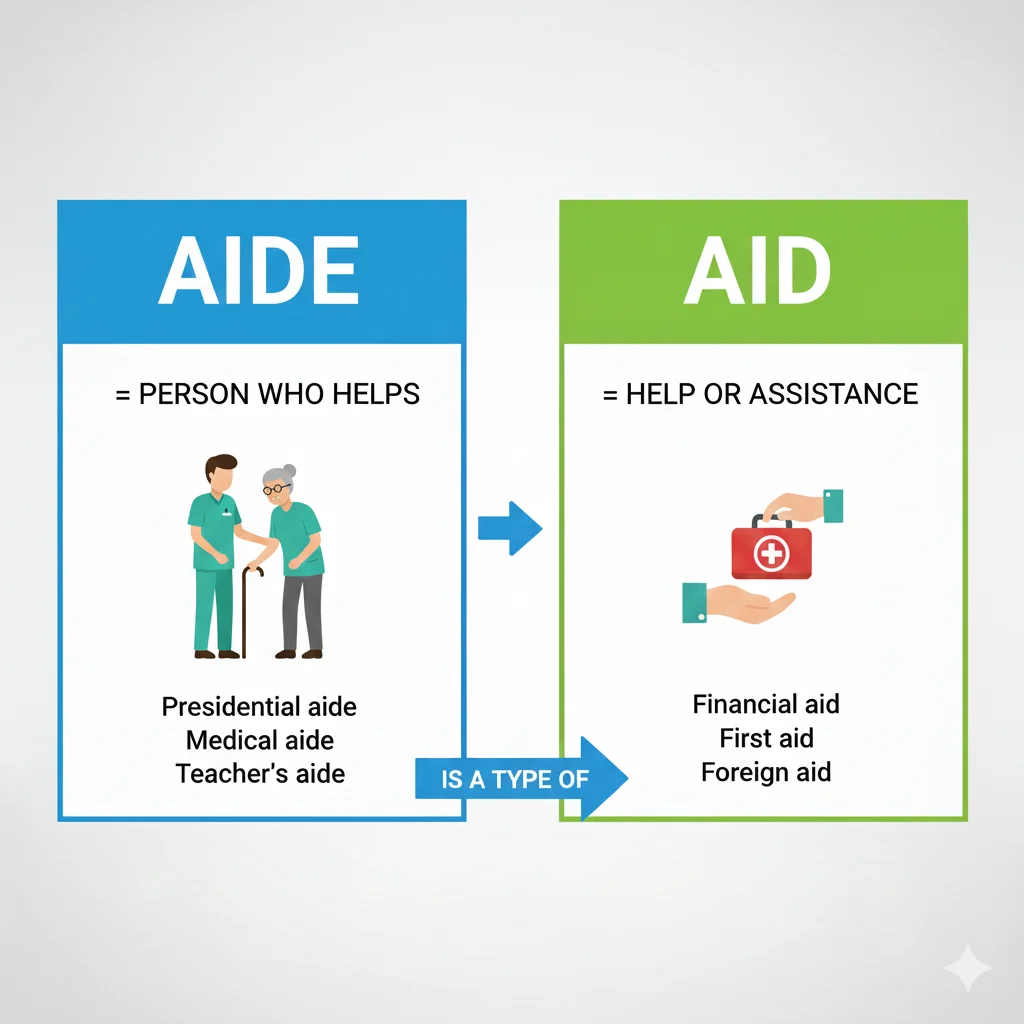
🧍♀️ Aide – a person who helps
- Part of Speech: Noun (a person)
- Meaning: Someone who assists or supports another person, often in a job or official role.
- Think of an aide as a helper.
Examples:
- The teacher’s aide helped students during class.
- The president’s aide arranged the meeting.
- My grandma has a nurse’s aide who helps her at home.
💡 Memory tip: “Aide” has an E at the end — think of it as standing for “Employee” or “Extra helper.”
🤝 Aid – help, assistance, or the act of helping
- Part of Speech: Can be a noun or a verb.
- Meaning:
- As a noun: “Aid” means help or assistance.
- As a verb: “Aid” means to help or to assist.
Examples (noun):
- The country sent medical aid to the disaster area.
- She received aid from her friends after the accident.
- Financial aid helped him pay for college.
Examples (verb):
- The volunteers aided the flood victims.
- Glasses can aid your vision.
- Fresh air aids recovery.
💡 Memory tip: “Aid” without the E means the help itself or the action of helping.
⚖️ The Key Difference Between Aide and Aid
Here’s the simple difference:
| Feature | Aide | Aid |
|---|---|---|
| Part of Speech | Noun (person) | Noun or Verb |
| Meaning | A person who helps | Help itself or the act of helping |
| Example | The doctor’s aide prepared the equipment. | The nurse gave aid to the patient. |
| Tip to Remember | Ends with E → Employee/helper | No E → Effort or assistance |
🧠 Quick Tip:
Use aide when talking about who helps.
Use aid when talking about what or how help is given.
🚫 Common Mistakes and How to Avoid Them
❌ Mistake 1: Using aide instead of aid
Incorrect: The government provided aide to the victims.
✅ Correct: The government provided aid to the victims.
💡 Why? Because we’re talking about help, not a person.
❌ Mistake 2: Using aid instead of aide
Incorrect: The president’s aid spoke to the press.
✅ Correct: The president’s aide spoke to the press.
💡 Why? Because “aide” is a person — the helper.
❌ Mistake 3: Adding “an” before aid
Incorrect: He worked as an aid in the office.
✅ Correct: He worked as an aide in the office.
💡 Why? The article “an” goes with aide (person), not aid (thing/action).
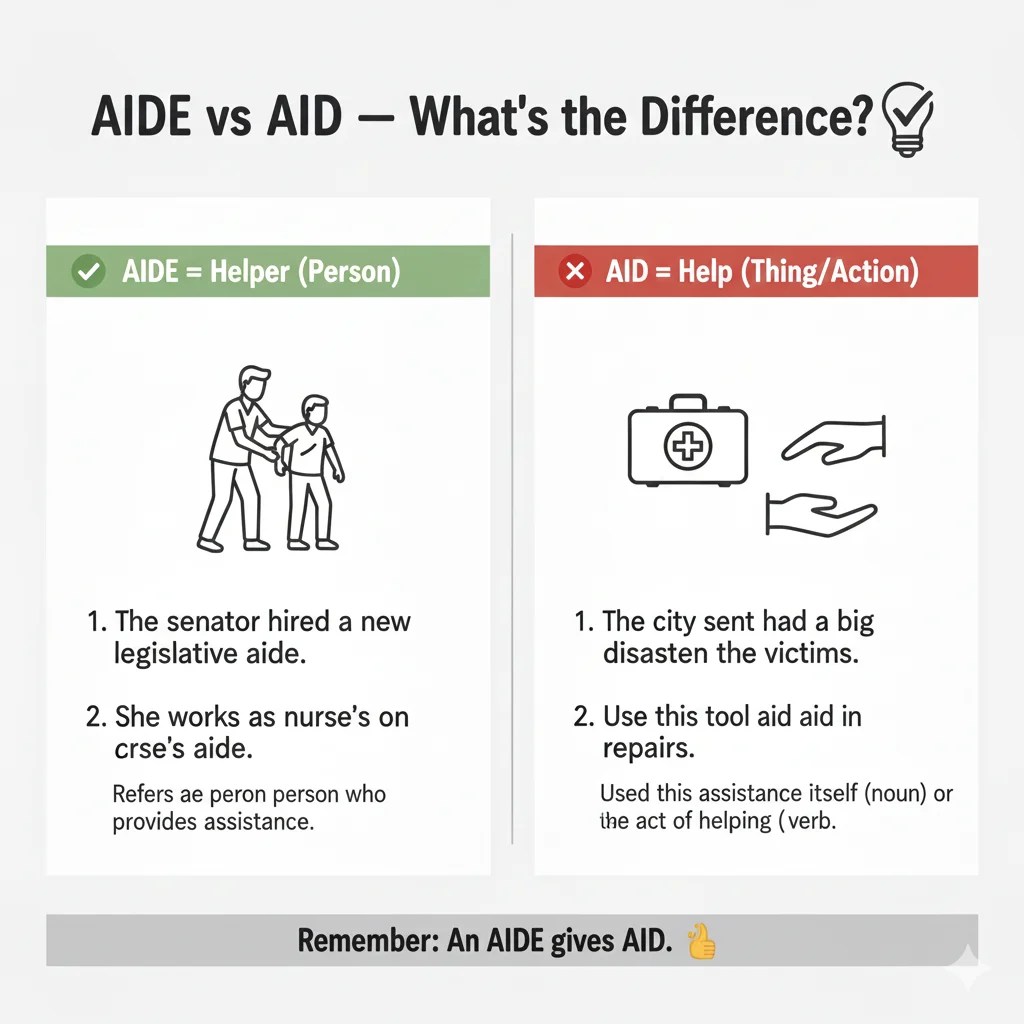
🧍♂️ When to Use “Aide”
Use aide when referring to someone who helps another person.
It’s often used in professional or formal settings.
Examples:
- The senator’s aide organized the event.
- My aunt is a teacher’s aide at a local school.
- A nurse’s aide assists with patient care.
- The manager’s aide scheduled all her meetings.
- His aide reminded him about the conference.
💡 Memory Hack:
If you can replace the word with “assistant,” then use aide.
Example: “Teacher’s aide” = “Teacher’s assistant.” ✅
💬 When to Use “Aid”
Use aid when talking about help, assistance, or the act of helping — not the person.
Examples:
- Volunteers gave aid to earthquake victims.
- The new app will aid students in learning math.
- The first responders aided the injured.
- The company donated aid to charity.
- Water and rest will aid your recovery.
💡 Memory Hack:
“Aid” = the help itself or to help someone.
Try saying “help” in place of “aid.” If it fits, it’s correct!
Example:
✅ “They provided help to the victims.” → Works → use aid.
❌ “The help organized the meeting.” → Doesn’t work → use aide.
🧾 Quick Recap: Aide vs Aid
- Aide = a person who helps.
- Aid = help itself (noun) or to help (verb).
Summary Table
| Use | Aide | Aid |
|---|---|---|
| Type | Noun (person) | Noun or Verb |
| Meaning | Helper / assistant | Help / to help |
| Example | The nurse’s aide was kind. | The nurse gave aid to the injured. |
| Trick | Ends with “E” → Employee/helper | No “E” → Effort/action |
💭 Easy way to remember:
“Aide” has an E for Employee (a person).
“Aid” is just help — no person attached!
🧩 Advanced Tips
- Word Origin:
- Aid comes from the Latin adiutare, meaning to help or support.
- Aide came later from the French word aide, meaning helper or assistant.
- Formal Writing:
- In essays or reports, aid is more common (“foreign aid,” “financial aid”).
- Aide appears in formal job titles (“presidential aide,” “teacher’s aide”).
- Common Phrases:
- Aid: First aid, hearing aid, financial aid, medical aid
- Aide: Nurse’s aide, teacher’s aide, political aide
- Online Writing Tip:
Don’t mix them up! Autocorrect may not catch it, but grammar checkers often do.
Effect / Affect: The Tiny Grammar Secret Everyone Gets Wrong 🤯
🧠 Mini Quiz: Test Your Knowledge!
Fill in the blanks with aide or aid 👇
- The nurse’s _______ helped comfort the patient.
- The charity sent food and medical _______ to the refugees.
- His personal _______ manages his schedule.
- The volunteers _______ the victims after the storm.
- Glasses can _______ you in seeing better.
- The school offers financial _______ for low-income students.
- The senator thanked his _______ for all the hard work.
🟩 Answers: 1. aide, 2. aid, 3. aide, 4. aided, 5. aid, 6. aid, 7. aide
❓ FAQs
1. What’s the main difference between aide and aid?
“Aide” is a person who helps, while “aid” is the help itself or the act of helping.
2. Is “aide” only used for jobs?
Mostly, yes. It’s often used in titles like teacher’s aide or presidential aide.
3. Can “aid” be a verb?
Yes! “Aid” can mean to help. Example: “Doctors aided the wounded.”
4. Why is “aide” spelled with an ‘e’?
It comes from French, where “aide” means “helper.” That final “e” reminds us it’s a person.
5. Which is correct: “medical aide” or “medical aid”?
“Medical aid” (without ‘e’) is correct — it refers to help or treatment, not a person.
🏁 Conclusion
Now you know the clear difference between aide and aid — one is a person, the other is the help itself.
Whenever you’re unsure, just remember:
Aide = Assistant. Aid = Help.
Practice using both in your writing and speech, and you’ll never mix them up again.
Keep learning a little English every day — it really aids your confidence! 🌟

Arwen Blythe is a passionate language and culture enthusiast, crafting clear, engaging guides on words, phrases, and modern English for Definevs.com readers.