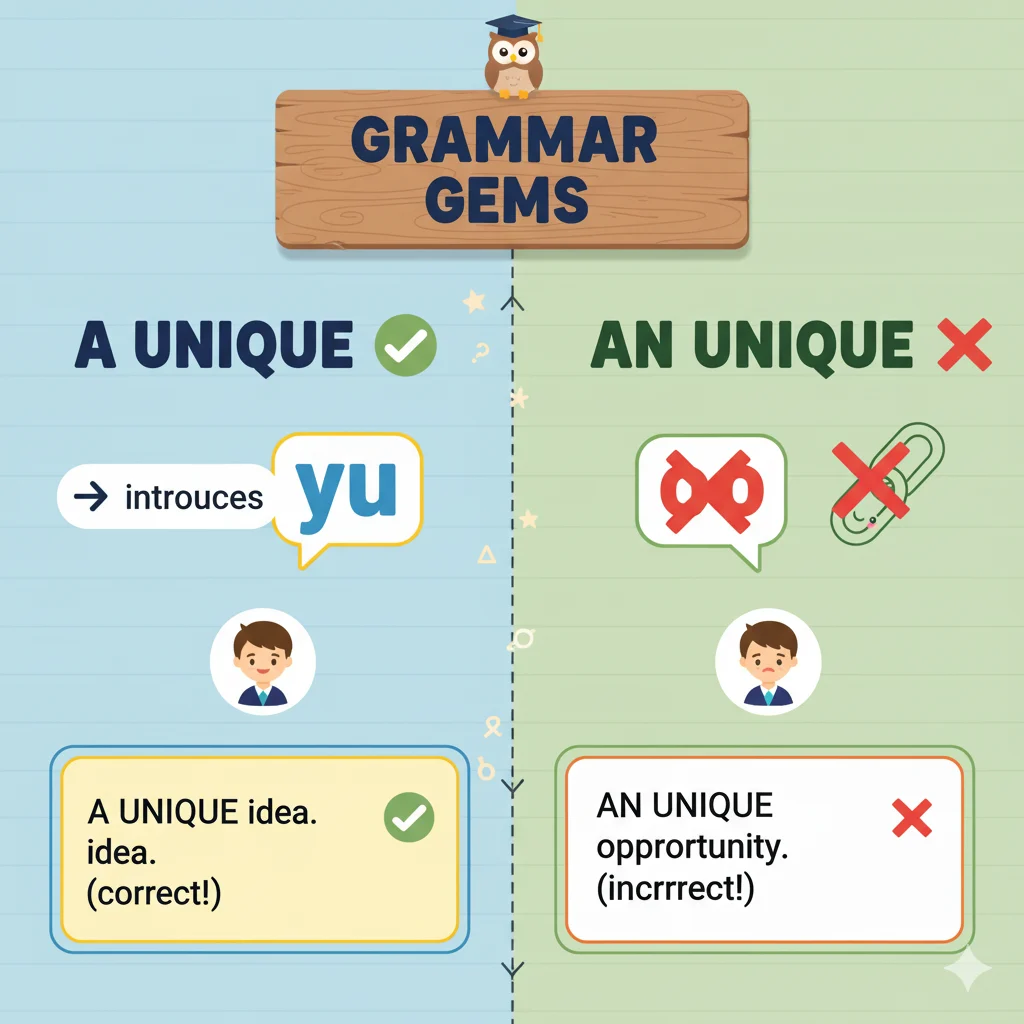
Have you ever stopped mid-sentence wondering whether to say “a unique” or “an unique”? 🤔
Don’t worry — you’re not alone! Many English learners (and even native speakers) get confused about which article to use before the word “unique.”
In this simple grammar guide, you’ll learn:
- What “a” and “an” mean and how to use them
- Why “a unique” is correct while “an unique” is not
- Easy grammar tips, examples, and memory hacks
- Common mistakes and how to avoid them
By the end, you’ll never mix them up again — promise! 🌟
📘 What Does Each Word Mean?
Before we understand why “a unique” is correct, let’s look at the two small but powerful words: “a” and “an.”
1. The Word “A”
- Part of speech: Indefinite article
- Used before: Words that start with a consonant sound
- Examples:
- a cat
- a book
- a dog
✅ Tip: It’s about the sound, not the letter. You say “a university,” not “an university,” because “university” starts with a /yu/ sound — a consonant sound.
2. The Word “An”
- Part of speech: Indefinite article
- Used before: Words that start with a vowel sound (a, e, i, o, u)
- Examples:
- an apple
- an elephant
- an hour (because “hour” starts with a silent h → vowel sound “our”)
✅ Tip: “An” helps make pronunciation smoother before vowel sounds.
🧩 The Key Difference Between “A Unique” and “An Unique”
| Expression | Correct or Not | Why | Example Sentence |
|---|---|---|---|
| A unique | ✅ Correct | “Unique” starts with the /yu/ sound (a consonant sound) | She is a unique student in her class. |
| An unique | ❌ Incorrect | The sound /yu/ is not a vowel sound | ❌ She is an unique student. |
👉 Quick Grammar Tip:
Always listen to the sound, not just look at the first letter.
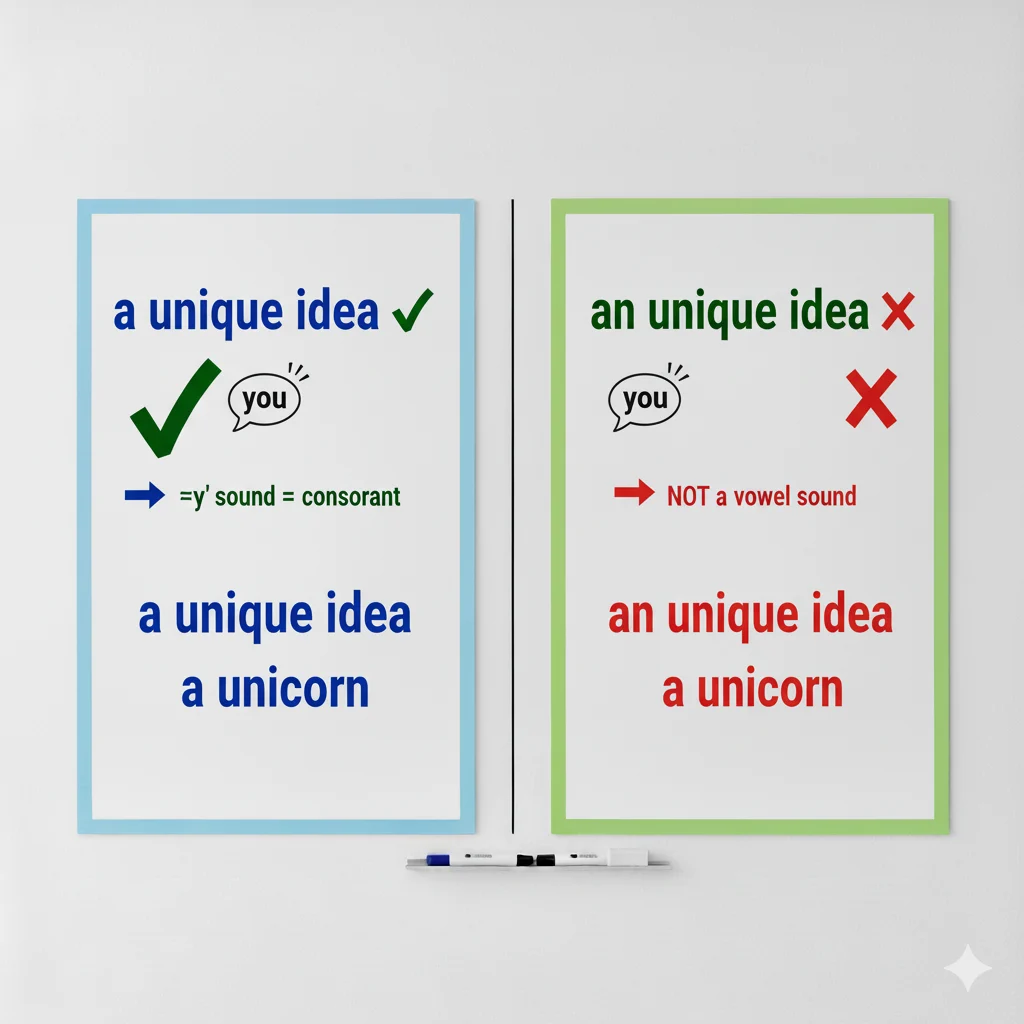
Even though “unique” starts with the letter u, it sounds like “you-neek.” The “y” sound is a consonant sound, so the correct article is “a.”
🚫 Common Mistakes and How to Avoid Them
Here are some typical mix-ups English learners make:
❌ Mistake 1: Saying “an unique idea”
Why it’s wrong: The sound is not a vowel. “Unique” begins with the “yoo” sound (like “you”), not “oo.”
Correction: ✅ Say “a unique idea.”
❌ Mistake 2: Thinking vowel = an
Why it’s wrong: It’s not about letters; it’s about sound.
- “an hour” ✅ (starts with vowel sound “our”)
- “a university” ✅ (starts with consonant sound “yu”)
❌ Mistake 3: Copying speech patterns without listening
Some learners mimic others without noticing pronunciation. Always say it out loud — if it starts with “yu,” use a.
🕒 When to Use “A Unique”
Use “a unique” before any word that starts with the “yu” sound.
It fits perfectly in casual speech, writing, and formal essays.
✅ Examples:
- She gave a unique presentation in class.
- This is a unique opportunity for students.
- My grandmother has a unique recipe for cookies.
- You have a unique way of solving problems.
- It was a unique experience to travel alone.
💡 Memory Hack:
Think of “unique” as starting with “you.”
You’d never say “an you,” right? → So say “a unique.”
📚 When to Use “An Unique”
The truth is — never! ❌
“An unique” is grammatically incorrect in standard English because “unique” starts with a consonant sound.
You might see it online or in old writings, but that’s just a typo or misunderstanding.
If you want to sound fluent and correct, always say “a unique.”
🧠 Quick Recap: A Unique vs An Unique
- “A unique” ✅ → Correct form
- “An unique” ❌ → Incorrect form
- Rule: Choose “a” or “an” based on sound, not just the first letter.
- “Unique” = /yuˈniːk/ → consonant sound = use a
- Think: A university, A unicorn, A unique idea
Easy Trick:
If you can say “you,” then it’s “a,” not “an.”
💬 Advanced Tips: Origin, Formal Usage & Exam Advice
- The word “unique” comes from Latin unicus, meaning one of a kind.
- Because “unique” already means one and only, it shouldn’t be modified by words like very or more.
- ❌ “Very unique”
- ✅ “Truly unique” or “completely unique”
In formal writing (like essays):
Use “a unique” confidently. Examiners often look for correct article usage and clean grammar.
In texting or casual writing:
Even though some people skip articles online (“That’s unique!”), it’s good to know the proper form when needed.
🧩 Mini Quiz: Test Yourself!
Fill in the blanks with “a” or “an.”
- She had ___ unique idea for the project.
- That was ___ hour I’ll never forget.
- He is ___ honest boy.
- We saw ___ university near the park.
- It was ___ unusual story.
- She met ___ unicorn in her dream.
✅ Answers:
- a 2. an 3. an 4. a 5. an 6. a
🧾 5 FAQs About “A Unique” vs “An Unique”
1. Which is correct — a unique or an unique?
✅ A unique is correct because “unique” starts with the consonant sound “yu.”
2. Why do people say an unique sometimes?
They confuse the rule and think “an” always goes before vowels. But pronunciation matters more than spelling.
3. What part of speech is “unique”?
It’s an adjective, describing something one-of-a-kind. Example: a unique design.
4. Can I say “very unique”?
Grammatically, it’s better to say “truly unique” or “completely unique” since “unique” already means “one of a kind.”
5. How can I remember the rule?
If the next word sounds like it starts with “you,” use a, not an. (a unique, a university, a unicorn).
🏁 Conclusion
Now you know the difference between “a unique” and “an unique.”
Remember: it’s not about the letter — it’s about the sound. Since “unique” begins with “yu,” the correct phrase is “a unique.”
So next time you speak or write in English, you’ll sound clear, confident, and correct — for real! Keep practicing, and you’ll keep improving every day. 🌟

Mira Loxley is a passionate language and writing expert at Definevs.com, turning tricky words and grammar into clear, engaging guides for every reader.