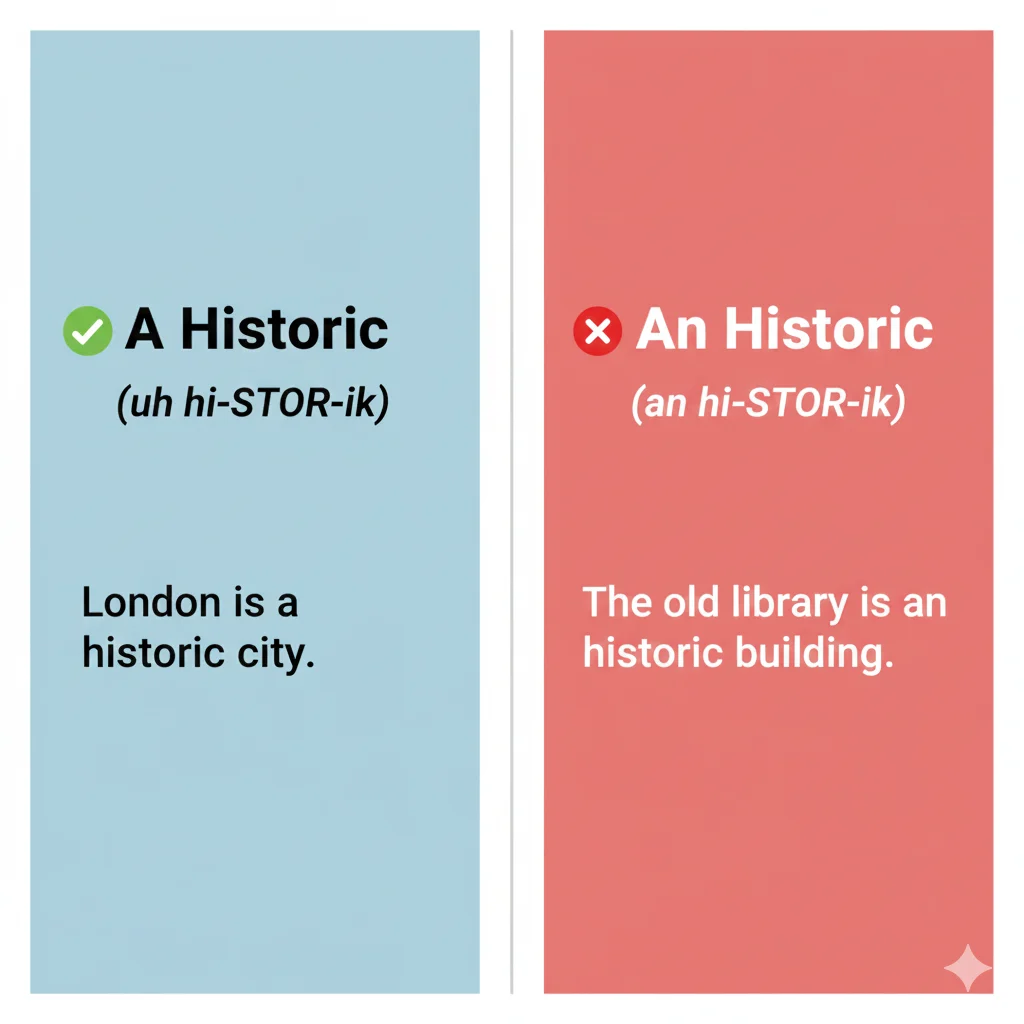
Use “a historic” in modern English.
Use “an historic” only if you speak in a traditional British style where the h is softly pronounced.
For everyday writing, school, essays, and online content:
👉 “a historic moment” is correct and preferred.
Choosing between “a historic” and “an historic” confuses millions of English learners because both forms appear in books, newspapers, and speeches. Some writers use “a historic event,” while others say “an historic event.” Which one is actually correct? And why does this tiny letter—a or an—cause so much confusion?
In this easy, friendly guide, you’ll learn the meaning, difference, grammar rules, and correct usage of both phrases. You’ll also see real-life examples, simple tricks to remember the rule, a comparison table, and a small quiz to test yourself.
By the end, even a 4th-grade learner will feel confident using these phrases correctly.
What Does Each Phrase Mean?

To understand the difference between “a historic” and “an historic,” you first need to understand how the words a and an work in English.
1. “A historic”
- “A” is used before words that begin with a strong consonant sound.
- “Historic” begins with a hard “h” sound”: hiss-TOR-ik.
So in everyday English, we say:
✔ a historic moment
✔ a historic day
✔ a historic decision
Examples:
- It was a historic day for our school.
- The team made a historic comeback.
- She gave a historic speech last night.
2. “An historic”
Long ago, in older British English, many speakers did not pronounce the h in “historic.”
It sounded like: iss-TOR-ik.
Since the word started with a vowel sound (i), they used an instead of a.
✔ an historic moment (old/traditional British style)
✔ an historic event (formal/historical writing)
Today, most people do pronounce the h, so “an historic” is considered old-fashioned.
Examples:
- The king announced an historic victory.
- It was an historic agreement between two nations.
- They celebrated an historic milestone.
The Key Difference Between “A Historic” and “An Historic”
Below is the clearest way to tell the two apart:
| Phrase | Pronunciation Rule | Modern Use | Sounds Like | Example Sentence |
|---|---|---|---|---|
| A historic | Used when h is pronounced | ✔ Modern English ✔ Schools ✔ Essays | hiss-TOR-ik | It was a historic match. |
| An historic | Used when h is not pronounced (old style) | ✔ Traditional British ✔ Formal speeches | iss-TOR-ik | The treaty was an historic win. |
QUICK TIP TO REMEMBER
👉 If you say the H strongly, use “a.” If the H feels silent, use “an.”
But in today’s English, the H is pronounced, so:
⭐ “A historic” is the correct and preferred form.

Common Mistakes and How to Avoid Them
Mistake 1: Thinking “an historic” is more correct
❌ Incorrect: It was an historic moment.
✔ Correct: It was a historic moment.
Why this mistake happens:
Older books and speeches used “an historic,” so people think it looks more formal or fancy.
How to fix it:
Say the word out loud.
If you can hear the H, choose a.
Mistake 2: Thinking the rule is based on spelling
Some learners think the rule is based on the first letter.
It is actually based on the first sound.
❌ Incorrect: We reached an house.
✔ Correct: We reached a house.
The H in “house” is strong, just like in “historic.”
Mistake 3: Mixing usage within the same text
❌ Incorrect: This was a historic step and later became an historic event.
✔ Correct: This was a historic step and later became a historic event.
Be consistent throughout your writing.
When to Use “A Historic”
Use “a historic” in almost all modern situations because people pronounce the H clearly.
Use it when writing:
- School essays
- Exams
- Letters
- Blogs
- News articles
- Social media posts
- Everyday conversation
Examples:
- Winning the trophy was a historic achievement.
- Our city hosted a historic festival last night.
- The scientist made a historic discovery.
- The team created a historic plan for the future.
- That was a historic moment for our country.
This is the form teachers expect, examiners prefer, and modern dictionaries support.
When to Use “An Historic”
Use “an historic” only if:
- You speak in a very traditional British accent
- The H is barely or not pronounced
- You are quoting older texts
- You are writing in a very formal, old-style tone
Examples (traditional style):
- It became an historic peace agreement.
- Leaders gathered for an historic announcement.
- That battle marked an historic turning point.
- They stood together on an historic night.
- It was an historic moment of unity.
Memory Hack
Think of “an historic” as old-fashioned English—like something from a history book.
If you are not trying to sound old-fashioned, choose “a historic.”
Quick Recap: A Historic vs An Historic
- A historic = modern, correct, widely used
- An historic = old-style British, rarely used today
- The rule depends on sound, not the first letter
- If the H is pronounced → use “a”
- For all school and modern writing → “a historic” is preferred
Advanced Tips (For Curious Learners)
1. Why Did “An Historic” Exist?
In old British English, the H in many words was not pronounced.
People said:
- otel instead of hotel
- ero instead of hero
- istoric instead of historic
Since these sounded like vowel beginnings, “an” was used.
2. What Do Modern Grammarians Say?
Most style guides—including:
- Associated Press (AP)
- Chicago Manual of Style
- Oxford English Dictionary (modern entries)
—all prefer “a historic.”
3. Is “An Historic” Wrong?
Not exactly.
It’s old but not incorrect if the H is silent in your dialect.
However, it is not recommended for students, exams, or modern writing.
4. Texting & Online Writing
Online English focuses on clarity and speed.
Because of this:
👉 “A historic” is the clear and safe choice.
Mini Quiz: Test Yourself!
Fill in the blanks with a historic or an historic.
- It was ___ day for the entire world.
- Scientists made ___ discovery that changed everything.
- The king signed ___ agreement.
- Our school celebrated ___ achievement.
- They watched ___ event live on TV.
- The speech became ___ turning point in history.
- The museum opened ___ new gallery.
Quiz Answers
- a historic
- a historic
- an historic (traditional style; but “a historic” is modern)
- a historic
- a historic
- an historic (traditional) or a historic (modern)
- a historic
FAQs About “A Historic” or “An Historic”
1. Which is correct: a historic or an historic?
“A historic” is correct in modern English. “An historic” is old-fashioned.
2. Why do some people use “an historic”?
Because older British pronunciation dropped the H, making the word sound like it began with a vowel.
3. Is “an historic” wrong for school essays?
Yes. Teachers expect “a historic.”
4. Does the rule depend on spelling or sound?
It depends on sound. If you hear the H, you use “a.”
5. Should I use “an historic” in professional writing?
Only if you are quoting older texts or intentionally using a traditional style.
Conclusion
Choosing between “a historic” and “an historic” becomes easy once you understand the sound rule. In today’s English, we pronounce the H strongly, so “a historic” is the correct and recommended form for school, writing, social media, news, and professional communication.
Use “an historic” only if you’re following an older British style or quoting historical texts.
The more you practice, the easier English grammar becomes. Keep learning, keep practicing, and keep improving your confidence—one small rule at a time.

Arwen Blythe is a passionate language and culture enthusiast, crafting clear, engaging guides on words, phrases, and modern English for Definevs.com readers.